Jaguar Uranium moved forward with its debut in the U.S. market as part of a strategy aimed at financing the exploratory development of its uranium assets in South America, with special focus on projects located in Mendoza. The company structured an initial public offering on NYSE American under the symbol JAGU, with the objective of raising capital intended to accelerate geological work, technical evaluation and planning of future campaigns in districts with nuclear history in Argentina.
By Panorama Minero
The initial public offering contemplated the issuance of approximately 6,250,000 Class A common shares, set within an indicative range of between US$4 and US$6 per share, with an over-allotment option close to 15% intended to cover potential additional market demand.
Prior to the listing, Jaguar Uranium had just over 12.3 million common shares outstanding, in addition to warrants and options that raised the fully diluted total to more than 16 million shares, which implies potential dilution close to 30% for initial investors if these financial instruments are exercised. The structure also included the conversion of debt instruments into shares and agreements linked to previously acquired assets, configuring an implied valuation close to US$12 million for its Argentine projects within the overall corporate structure.
The stock market operation was presented as a key step within the typical junior company model, which seeks to generate value from the expansion of geological information and the revaluation of historical assets. With an initial price close to US$4 per share and a placement aimed at raising around US$25 million, Jaguar aims to finance exploratory activities on its Argentine properties and advance technical studies linked to resource development.
Historical assets as the basis of the exploration program
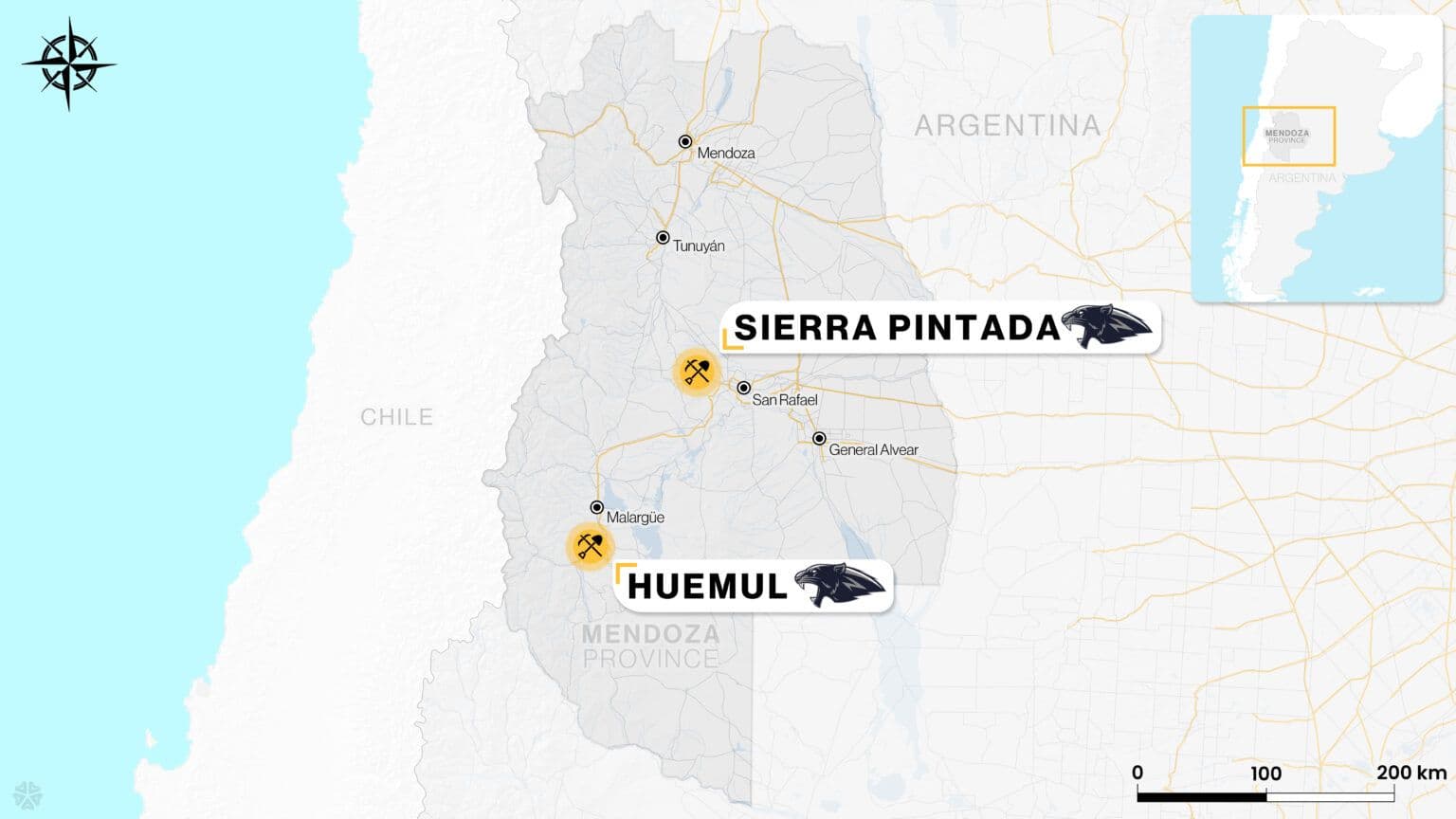
Within its portfolio, the company highlights the Huemul project, in southern Mendoza, considered the country’s first uranium mine and operational between 1955 and 1975. The area covers thousands of hectares around the historic Huemul-Agua Botada district, where uranium grades associated with copper and vanadium were recorded, reinforcing the polymetallic potential of the system. Added to this is the Sierra Pintada district, the last uranium-producing enclave in Argentina, whose mineralization remains open beyond the exploited areas and constitutes one of the main targets for new exploration campaigns.
According to the company, the interest in Mendoza responds to the combination of productive background, existing regional infrastructure and the historical presence of the Argentine nuclear industry, factors that reduce initial risks compared to completely greenfield projects.
Exploration financing in a context of growing nuclear demand
The corporate plan is based on the expectation of a global uranium deficit driven by the expansion of nuclear energy, the development of small modular reactors and the need for stable energy sources for electricity-intensive industries. In this scenario, the company considers that historical districts in South America could once again gain prominence within the global nuclear fuel map.
Although the stock market debut showed high initial volatility, the main objective of the operation is not aimed at immediate productive results, but at consolidating a financial platform that allows progress with exploration programs and technical studies in Mendoza and other regions.
Jaguar Uranium’s strategy reflects the growing role of international markets as a tool to finance early stages of nuclear mining. With capital oriented toward exploration and generation of geological information, the company seeks to reposition historical Mendoza assets within a global context in which uranium is once again gaining strategic weight, although its future valuation will depend both on technical progress and on the local regulatory framework.