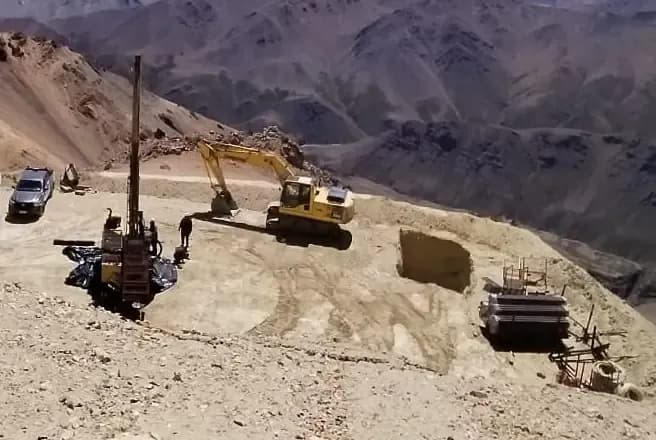
With an estimated investment of US$5 million and international private financing, the Canadian company is starting the first drill holes in the district on a copper–gold–molybdenum porphyry target in Malargüe.
By Panorama Minero
The start of the diamond drilling campaign at the El Perdido project marks a turning point for Mendoza’s mining sector and for the development of Malargüe Distrito Minero Occidental (MDMO). For the first time since the creation of this territorial and regulatory framework, MDMO is recording advanced exploration drill holes, making El Perdido the first project in the district to validate its mineral potential through drilling and the first test case of the new mining cycle promoted by the province.
The milestone is twofold. From a technical standpoint, these are the first drill holes carried out in MDMO, on a copper porphyry system that until now had been evaluated exclusively through surface work. From a financial standpoint, the campaign represents the first investment of foreign private capital specifically oriented toward mining drilling in Mendoza within this new development framework. The project is operated by Kobrea Exploration Corp., a junior exploration company based in Vancouver, Canada, which managed to structure international private financing to move forward with diamond drilling in Malargüe.
Up to this point, drilling carried out in the province had been mostly associated with local or provincial capital and outside this district. In this context, El Perdido positions itself as the first Mendoza project to attract private funds from abroad aimed directly at advanced exploration, a relevant fact in a global scenario where financing for junior companies is increasingly competitive and selective.
From a geological standpoint, El Perdido corresponds to a copper porphyry system with gold and molybdenum association (Cu–Au–Mo), emplaced in the southern sector of the Andean Neogene porphyry belt. The project is developed over an approximate area of 6,800 to 6,900 hectares and is part of Kobrea’s portfolio within MDMO, a group of properties totaling more than 73,000 hectares under Kobrea’s control in southern Mendoza. It is a system with no historical drilling, so the drill holes currently underway constitute the first direct access to the mineralized subsurface.
Surface exploration work allowed the delineation of a district-scale target, with a continuous hydrothermal alteration footprint of 2 to 3 kilometers. Detailed geological mapping identified the development of potassic alteration, porphyritic intrusives—mainly quartz diorites—and a stockwork of quartz veinlets, features considered diagnostic of potentially fertile porphyry systems. Added to these elements are consistent surface geochemical anomalies of copper, gold, and molybdenum, which supported the prioritization of the target.
Geophysical information was decisive in advancing to the drilling stage. Magnetometric surveys—including historical data and reinterpretations integrated by Kobrea—outlined large-scale magnetic anomalies coincident with the zones of alteration and surface geochemistry. The integration of these datasets made it possible to build a preliminary geological model of the system, define the architecture of the porphyry, and select the priority drilling targets on which the first drill holes are focused.
Timeline
The start of the campaign is the result of a sequence of technical and regulatory milestones developed throughout 2025. In July, Kobrea obtained provincial approvals for drilling and access road construction, formally enabling the project’s transition to advanced exploration in MDMO. In August, the company reported a significant expansion of the porphyry target after integrating new geophysical and remote sensing data. In November, access works and site logistical preparation began an indispensable condition for the mobilization of equipment and personnel.
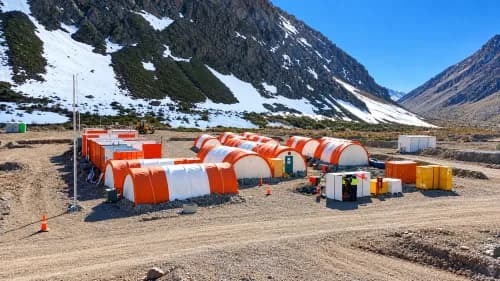
Between late 2025 and early 2026, the company completed the mobilization of diamond drilling equipment (operated by Conosur Drilling), technical staff, and specialized contractors, initiating a campaign that represents the largest disbursement of foreign private exploratory capital recorded to date in MDMO. According to what was reported by the company in its corporate releases, around US$5 million were specifically allocated to El Perdido for this first phase, including access works, field logistics, and the initial drilling campaign. The financing comes from private placements carried out by Kobrea in capital markets, with a clearly exploratory purpose.
Properties under Analysis
Kobrea structured its entry into the district through a strategic agreement with the local firm Agaucu, which grants it rights over seven projects in MDMO: Sofi, El Perdido, Mantos de Cobre, Cuprum, Elena, Verónica, and El Destino. Within the framework of this agreement, the company can advance exploration of these assets with the option to consolidate interests, articulating an integrated district-scale exploration approach. El Perdido was defined as the priority project, concentrating most of the capital and technical efforts at this stage.
The framework also allows optimization of the use of raised funds, applying geological and geophysical studies transversely across several projects in the portfolio—such as airborne magnetometry and remote sensing analysis—while focusing drilling on the most advanced target in the district. Other projects, such as El Destino, are part of the medium-term strategy and have differentiated budgets and schedules.
Beyond the geological results yielded by the drill holes, the start of drilling at El Perdido has strategic value in itself. The project is consolidated as the test case of MDMO, both from a technical and financial standpoint. The arrival of a Canadian junior with international private capital, a focus on copper, and a risk-based exploration strategy introduces a concrete signal to the market: Mendoza is once again positioning itself on the radar of global exploration capital, in a context where copper is consolidating as a critical mineral for the energy transition.
Within this framework, El Perdido not only opens a new stage for its own development, but also puts to the test the institutional, environmental, and technical framework designed by the province to enable advanced exploration. The drill holes that are now beginning represent, in that sense, the first real examination of MDMO as a platform for long-term mining development in Mendoza.