Drilling, surveying, technical English, and digital tools were key topics addressed in this training, which aimed at labor market insertion in the mining sector.
By Panorama Minero
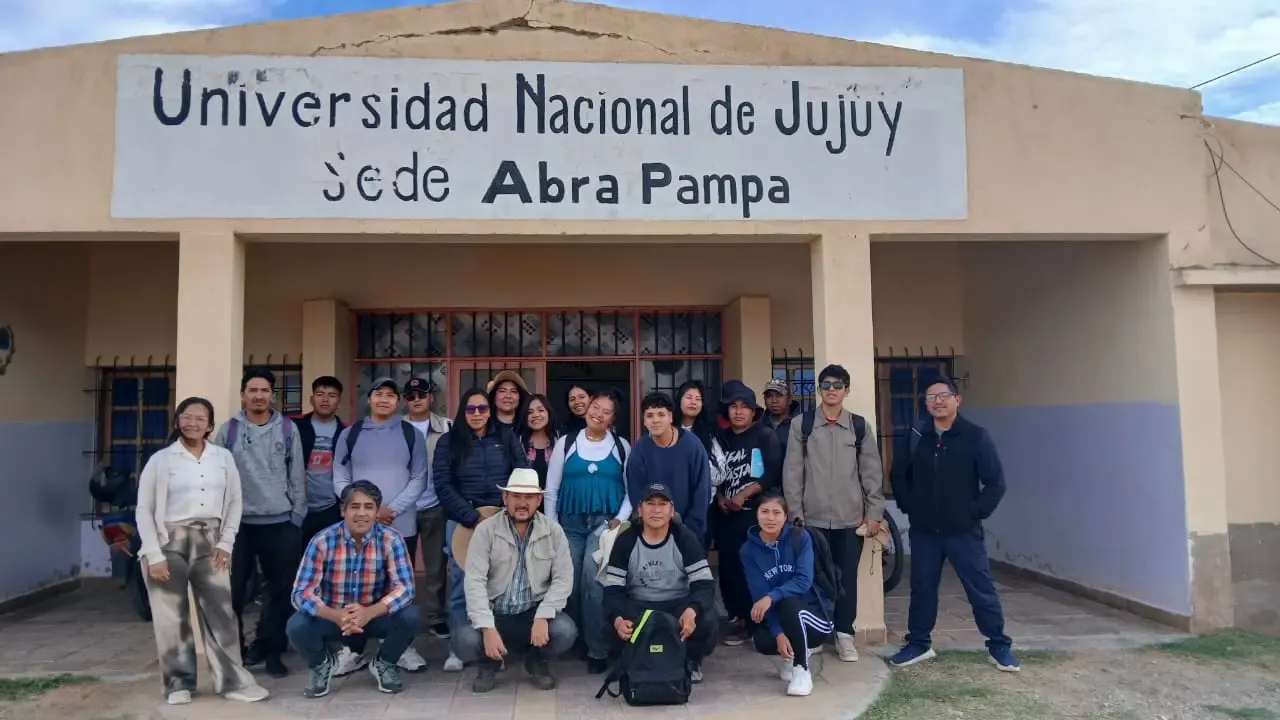
Specialists from various areas provided key knowledge and practical training as an introduction to some of the demands of the mining field, culminating in five days of training with strong attendance in Abra Pampa and Tilcara. This was the 1st Comprehensive Mining Training Cycle – Quebrada and Puna, which achieved broad participation due to its content.
It was an intensive training proposal carried out between January 12 and 16, 2026, at two locations of the National University of Jujuy: Tilcara (January 12 and 13) and Abra Pampa (January 14, 15, and 16). This training was aimed at providing concrete tools and basic but strategic knowledge to people interested in training and entering the mining labor market, with a strong practical and territorial focus.
The cycle brought together instructors and professionals with academic and work experience in mining, geosciences, surveying, and technical communication, and was structured into five courses addressing different key dimensions of the activity. One of the central components was the course “Mining and Drilling,” taught by María Emilia de los Ángeles Maraz, a university drilling technician trained at the National University of Salta with experience in lithium projects in the Puna region of Jujuy.
During her presentation, Maraz explained that the objective was to provide a general and understandable view of drilling work. “We addressed which types of activities require drilling and which do not, and we worked especially with the equipment most commonly used in the field, such as diamond drilling, rotary, and top drive,” she said, detailing that the focus was placed on the specific tasks carried out on the equipment. “Above all, we looked at what kind of work a drilling assistant does, a geology assistant, what maneuvers are performed, and what day-to-day work in those areas is like,” she added.
The instructor clarified that this was a basic course, conceived as a first approach. “The idea is for participants to leave with a complete notion of the labor field. And if they later want to go deeper, they should know that the Drilling Technician program exists and is taught in San Salvador de Jujuy, as a real possibility for training and work,” she explained.
Another highlighted space was the course “Effective communication in the mining field – basic notions of English,” led by Elena Sarmiento Velazco, an advanced student of Chemical Engineering and of the Mineral Processing Technician program at UNJu, with a First Certificate awarded by the University of Cambridge. The training was oriented toward the practical use of the language in work contexts.
“We covered basic notions so that people who are in mining or want to be in mining can learn technical vocabulary, be able to interact with a foreign supervisor, or understand a manual in English,” explained Sarmiento Velazco. “The idea is not only mining, but that they can communicate in any environment. Nowadays, not only mining companies— all companies are asking for English, and it is a tool that allows them to aspire to another position or role,” she specified. She explained that during the sessions, attendees’ interest was especially focused on so-called “mining vocabulary,” key for daily work and field safety.
In the area of surveying and new technologies, surveyor engineer Carlos Gabriel Toledo Herrera taught theoretical–practical courses on GNSS RTK equipment, photogrammetry, and the use of drones in mining environments, delivered with a methodology centered on practice. “These are GNSS RTK receiver units, which are generally known as GPS, although GPS is only one of the constellations used by these systems,” he explained.
For his part, Toledo Herrera highlighted the importance of applied work in real practice. “Theory is very necessary, but in mining what matters most is to know how to operate the equipment. That is why we teach how to carry out real surveys, point collection, and staking out, using the latest available technology,” he said. He explained that in Tilcara an urban survey was carried out, and in Abra Pampa work was done on the grounds of the university campus, where participants generated contour lines and simulated a construction project, combining traditional methods with modern instrumentation.
The cycle was completed with a practical workshop on Excel applied to geosciences, coordinated by Verónica Peñalva, who explained that work was carried out using real cases from the Puna. “We worked on a real case involving a basin in the Puna and, based on that, we interpreted data and also analyzed the statistical component,” she noted. She also highlighted participation levels: “The groups were full, with classrooms at capacity. It caught my attention that participants were aware that these tools are necessary when accessing certain positions.”
Peñalva also highlighted the joint work that made it possible to carry out the proposal, thanking the support of the university campuses, instructors, and local organizations, and valued the interest generated in different localities of the Quebrada and the Puna. The success of the first cycle, reflected in high attendance and in inquiries received from other regions such as La Quiaca, Susques, and Mina Aguilar, opens the expectation of a second edition and of replicating the experience, strengthening local technical training and job opportunities linked to mining activity.