Three years after the change of control, the operation is advancing with a US$665 million project approved under the RIGI and a plan to expand exploration across the district.
By Panorama Minero
Three years after AISA Group acquired Minas Argentinas, Gualcamayo is entering a new stage of development. The San Juan mine continues to produce gold and silver from previously mined ore, while Deep Carbonates (DCP) advances as an underground project involving an investment of US$665 million and approved for inclusion in the Large Investment Incentive Regime (RIGI).
The current scenario contrasts with that of September 2023. When AISA acquired Minas Argentinas, Gualcamayo had accumulated 15 years of commercial production and more than 3 million ounces produced, while it was moving toward closure and had already submitted the corresponding plan to the Province of San Juan. At that time, known resources amounted to 1.4 million ounces.
“Where others saw the end of a cycle, we saw installed infrastructure, permits and licenses. We saw roads, power, a camp, equipment, mining expertise, production and a district that had not yet been fully understood in terms of its scale,” explains Juan José Retamero, founder of AISA Group.
An Operation That Changed Its Production Model
One of the main changes took place in April 2024, when Minas Argentinas stopped mining and crushing new ore. The operation then shifted its focus to recovering gold contained in material that had already been mined and placed on the leach pad.
The company rebuilt the heap, redesigned the irrigation system, increased its flow capacity and introduced metallurgical adjustments aimed at improving recovery levels.
The results began to become evident during 2025. Without adding new ore, Gualcamayo produced 43,700 gold equivalent ounces, while the cost per ounce sold fell from approximately US$2,400 in 2023 to US$1,150, a reduction of nearly 52%. According to information filed with the National Securities Commission, financial results moved from negative figures in 2023 to US$116 million before taxes in 2025. Annual investment, meanwhile, increased tenfold and currently stands at around US$60 million.
“The gold price helps put the value into perspective, but it does not create a mine. Argentina’s macroeconomic environment improves the context, but it does not certify resources, organize an operation, sustain employment or solve technical challenges,” Retamero says.
Deep Carbonates, the Next Development
The main focus of the new stage is Deep Carbonates (DCP), located beneath Gualcamayo’s former production areas.
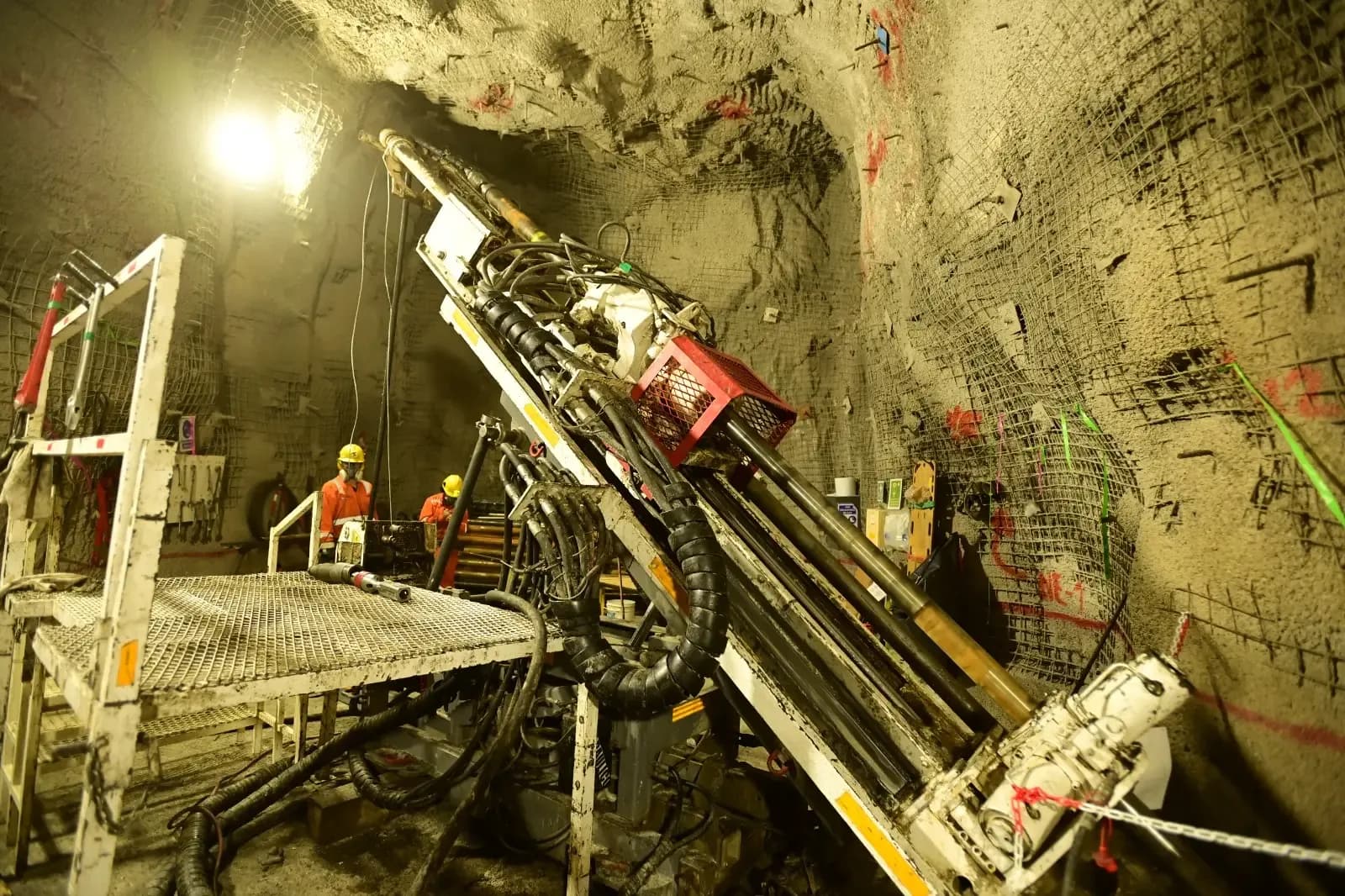
Following more than 80,000 metres of diamond drilling, its resources were reclassified under NI 43-101 and JORC standards. According to the statistical appendix provided by the company, DCP contains more than 4.8 million ounces in resources, of which 2.4 million ounces correspond to reserves.
The project was approved in early 2026 for inclusion in the RIGI, with a planned investment of US$665 million. The company’s projections contemplate US$26.5 billion in exports between 2030 and 2055.
Pre-feasibility studies are currently underway. The design contemplates an underground mine and a pressure oxidation (POX) plant. If implemented under the terms currently being evaluated, the company states that this technology would have no precedent in South America.
Based on the resources identified to date, Minas Argentinas projects production of approximately 166,000 ounces per year for at least 17 years, excluding any potential additions resulting from future exploration campaigns. The construction stage would require between 1,000 and 1,500 workers.
“We are going for a new Gualcamayo. This is not simply about extending the life of the operation we know, but about building a new mine, with a different scale, new technology and a long-term horizon,” says Gabriel Corvo, CEO of Minas Argentinas.
Initial Works of More Than US$15 Million
Part of this process began to materialize during 2026. In August, preliminary works totaling more than US$15 million began, including expansions of the existing plant, reagent storage facilities and camps.
The main civil works were awarded to a San Juan-based company, which hired 230 workers. With these hires, approximately 1,000 people became linked to Gualcamayo’s activities, according to information provided by the company.
Regarding the composition of its workforce and suppliers, Minas Argentinas reports that 96% of Gualcamayo’s workers are from San Juan and that more than 69% of the goods and services contracted are sourced within the province.
From a Mine to a District of Nearly 40,000 Hectares
AISA’s strategy is not limited to Deep Carbonates. The company seeks to expand exploration into other areas of a property covering nearly 40,000 hectares.
According to statistical information provided by the company, Gualcamayo currently has 7.1 million ounces in resources and 4.9 million ounces in certified reserves. The in-depth studies supporting these figures cover approximately 4% of the property, while the geological team has identified areas considered to have greater potential across an area exceeding 15 square kilometres.
“We are thinking of Gualcamayo as a district, not simply as a mine. Everything we know today comes from having explored in depth only a very small portion of the property,” explains Nicolás Bareta, Head of Mining at AISA Group.
Within this framework is the so-called G50 Program, an initiative involving planned investments of US$1.5 billion that AISA is considering submitting as a second project under the RIGI. Its first stage contemplates a period of between 24 and 36 months to evaluate remaining resources, in parallel with exploration of other areas with gold and industrial metals potential.
“The geological team has already identified areas of maximum potential covering more than 15 square kilometres, where major geophysical anomalies coincide with extraordinary surface values,” Retamero says.
Infrastructure and Local Engagement
Gualcamayo’s continued operation has also maintained various initiatives in Jáchal. During 2025, the Trust Fund associated with the operation participated in projects such as the San Roque drinking water network, waterproofing of the Canal del Norte, reconstruction of six water bridges and a reinforcement well for the Villa Mercedes drinking water treatment plant.
Minas Argentinas also organized business matchmaking sessions between contractors and San Juan suppliers, as well as engagement activities with students and teachers from universities and technical schools.
In environmental and social matters, the company reports that it operates under ISO 14001, ISO 45001 and ISO 26000 standards, while also maintaining surface and groundwater monitoring programs and community participation mechanisms.
Three years after the change of control, Gualcamayo’s current scenario therefore combines the continuity of existing production, the initial works associated with its next stage, the technical development of Deep Carbonates, and an exploration strategy aimed at evaluating areas that have not yet been studied in depth.
“Three years ago, we bought a mine that had already submitted its closure plan. We did not come to manage that closure: we came because we were convinced that Gualcamayo had much more to offer. Today, we have decided to build a new mine, explore a district of nearly 40,000 hectares and invest with the coming decades in mind. There is still a great deal to be done, but three years later Gualcamayo is no longer discussing when it will end. It is discussing how far it can grow,” Juan José Retamero concludes.