From former Casposo workers to suppliers for mining exploration: the La Esperanza de Calingasta Work Cooperative was born in the labor crisis and today generates genuine employment with local production of core sample boxes, betting on cooperative work and the development of the department.
By Panorama Minero
What began with meetings of unemployed people in Calingasta, after the Casposo mine was placed under care and maintenance, is today a consolidated cooperative that supplies inputs for mining exploration in San Juan and other provinces. The La Esperanza de Calingasta Work Cooperative is the result of the resilience of a group of workers who knew how to reinvent themselves in the face of difficulties.
The story goes back to the years before 2019, when the Casposo mine began reducing its activity until ceasing operations. In that critical context, the former Casposo employees organized into a group that, over time, became a space for meeting, debate, and, unknowingly, the genesis of a productive project that today provides work for 14 families.
The Birth of an Idea in the Midst of Crisis
Fabio Ibaceta, one of the project’s promoters and current President of the Cooperative, recalls that the idea began to take shape between 2016 and 2018. The current president of the cooperative recalls that at that time, most of those working at the gold mine faced a lack of options offered by the Calingasta department.
At that moment, Ibaceta began generating income by selling cleaning supplies, but a casual finding changed the course. During a trip to the north of the country, he found a broken core sample box. These boxes are used to store the samples coming from drillings carried out in different projects. This was what sparked the search for a new beginning.
After meeting with some of his friends, who were in the former Casposo employees group, he moved forward and invested some funds to manufacture the boxes for drilling cores. With the help of another colleague who had access to a model in better condition, they began working alongside Mario Sosa, Víctor Jofré, and Mariano Astudillo. It was not easy: they made three prototypes until achieving one that met the standards required by mining activity.
The turning point came when they took the third box to a drilling company operating in Villanueva. The response from the exploration company was positive, and in addition to the boxes, they began to receive other jobs related to mining operations: trips to the City of San Juan to collect spare parts, laundry for the crews, and auxiliary tasks.
The Process of Continuing to Advance to Strengthen the Enterprise
Growth brought new challenges, among which was being able to respond as entrepreneurs to all the requirements formulated by clients. However, with ingenuity and a lot of creativity, they managed to overcome the obstacles they encountered along the way.
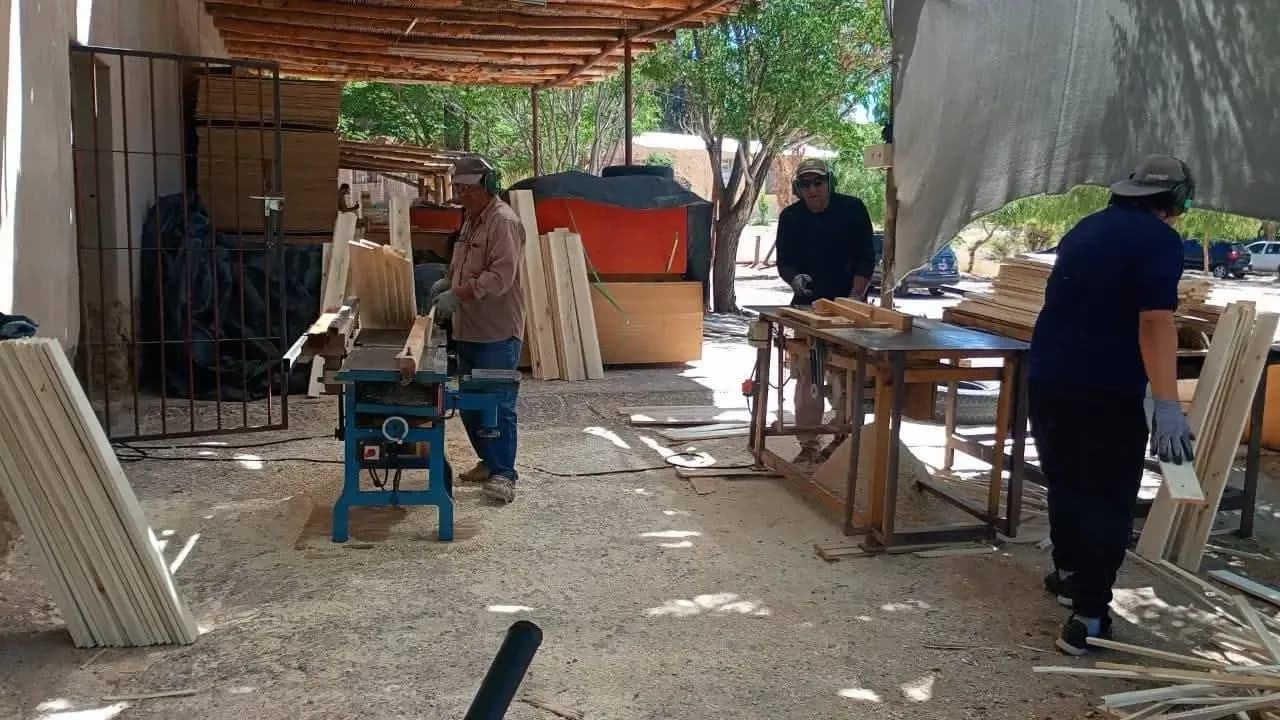
Then came the pandemic, along with new difficulties: the lack of machinery forced an almost extreme artisanal effort, planning the wood with grinder discs and then sanding it manually.
But the group never gave up, and in this way, after some efforts, they obtained a five-function combined machine, which was essential for professionalizing their production. In this way, they left behind their artisanal work, where the utility knife and the manual saw were the main tools.
Local Wood, Quality, and Expansion
In the early days, the wood was purchased in the city of San Juan and later from a sawmill in Villanueva. Competing was not easy because potential clients considered them expensive, but they countered this argument with quality products and by showing that buying locally strengthened the economy of Calingasta.
The sale of their quality products ended up opening doors, while also strengthening Calingasta’s economy. One of the suppliers took them to the provinces of Salta and Catamarca, where the hardness of San Juan poplar was well appreciated. From there, companies Energold and Conosur began buying from them. Commercial links were also established with projects such as Altar and Los Azules.
The Cooperative, an Essential Step
Formalization came between 2018 and 2019, in the midst of the pandemic. Through the media, they learned about the possibility of forming a cooperative. After researching online, they moved forward with this goal, which they achieved some time later.
Creating a cooperative required the participation of at least 10 people, one of the most difficult obstacles they finally overcame. The cooperative’s registration was delivered at an event in Difunta Correa, a moment they remember as symbolic and foundational.
Today, the La Esperanza de Calingasta Work Cooperative consists of 14 people, with daily work led by Víctor Jofré, Mariano Astudillo, and Óscar Palacio. In the last season, they signed agreements with the operating companies of the La Coipita and Altar projects, which purchased 4,500 core sample boxes from them, consolidating their role as suppliers to the exploration sector.
Local Work, Identity, and the Future
Beyond the numbers, the message that runs through the experience is clear: do not stay still. The President of La Esperanza Cooperative maintains that from the beginning he tried to motivate young people not to remain idle and to seek alternatives, to continue growing with this initiative that is unique in Calingasta.
The cooperative leader emphasizes the importance of local buying in the departments within the projects’ area of influence. With that vision, they affirm that betting on Calingasta is providing work.
When the demand for boxes decreases, the cooperative diversifies its activity: they carry out repairs of doors, windows, beds, and countertops for low-income families. They are also registered at the provincial and national level as a construction cooperative, authorized to bid for works such as sidewalks or school repairs, although so far they have not been called.
The expectation is clear: to generate more work. La Esperanza de Calingasta is a concrete example of how mining knowledge, collective organization, and territorial roots can be transformed into a sustainable productive alternative, born from the bottom up and designed so that work stays at home.