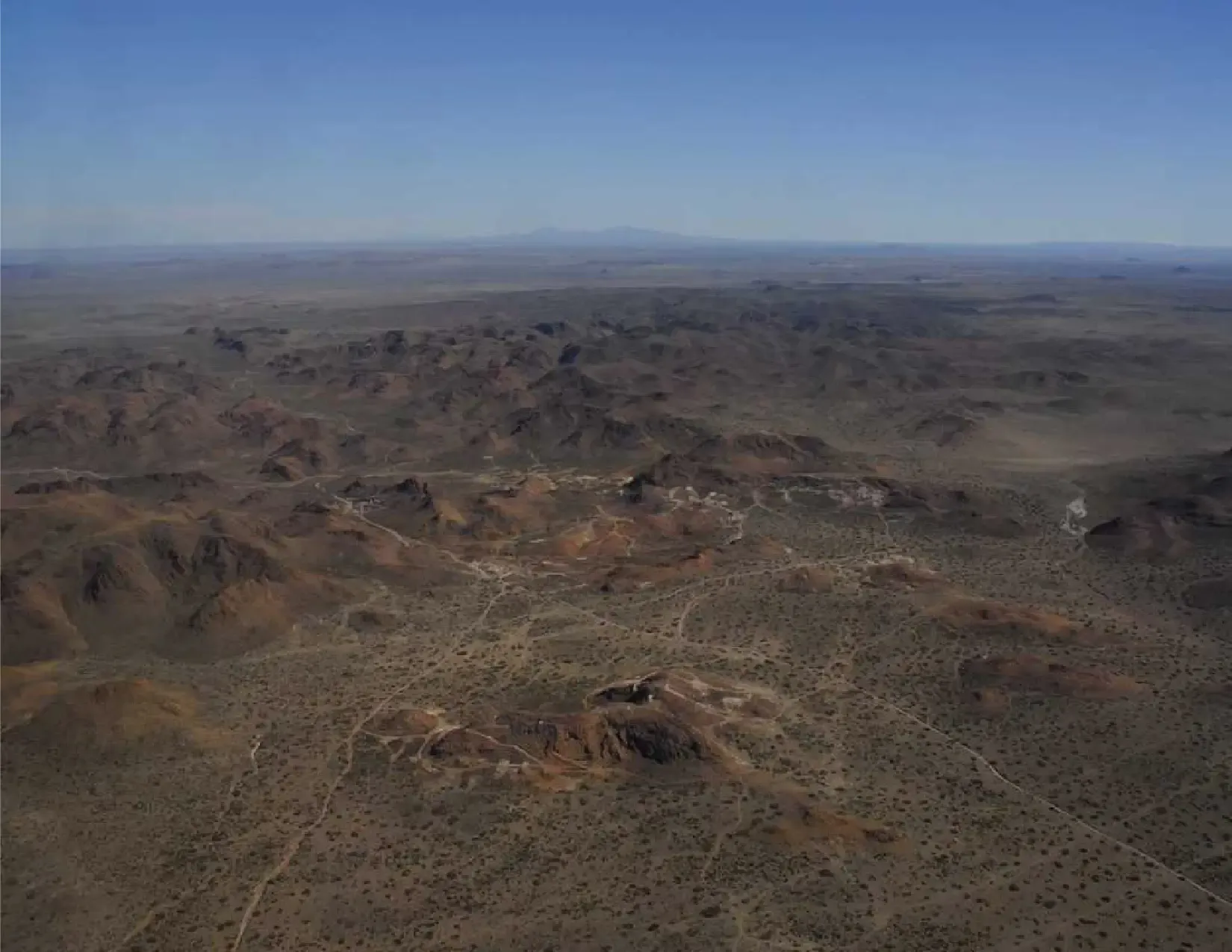
The project had a single window of opportunity in 2019 and remains technically viable today, but is normatively blocked by Law 7,722.
By Panorama Minero
For just over a week in December 2019, the Don Sixto project returned to Mendoza’s mining radar. The approval of Law 9,209 —which enabled metal mining— opened a window that lasted only days: the law was repealed and the scenario returned to square one. For Don Sixto, it was the only concrete sign of possibility in more than two decades.
That episode summarizes the project’s recent history: a deposit with advanced exploration, robust geological information, and proven mineralization that has never managed to move into a development stage due to the prevailing regulatory framework. Today, under Law 7,722, Don Sixto remains technically viable but regulatory blocked.
Don Sixto —historically also known as La Cabeza— is a gold–silver project located in southern Mendoza, in the Malargüe Department, within the San Rafael Block. It is not a project close to production or an initiative currently undergoing environmental evaluation. Its relevance lies elsewhere.
Don Sixto demonstrates that Mendoza does indeed host real gold mineralization, with well-developed hydrothermal systems and depth continuity. At the same time, it clearly exposes the gap between geological potential and the possibility of effective development, serving as a case study in the provincial mining debate.
Location and geological context
Unlike the large copper porphyries of the Andes, Don Sixto is set in an extra-Andean environment within the San Rafael Block. It corresponds to a Permian–Triassic volcanic–structural context.
From a geological standpoint, the project is a low-sulfidation (LS) epithermal deposit, with gold as the primary metal and associated silver. Mineralization occurs in quartz veins, stockworks, and siliceous breccias, with silica–sericite and adularia–illite alteration. Sulfide content is low, generally below 2%, a typical characteristic of this type of system.
In simple terms: it is not an isolated surface showing, but a complete, coherent, and well-characterized hydrothermal system.
Advanced exploration
One of Don Sixto’s strongest aspects is its exploration history. The project was discovered in 1996 by Argentina Mineral Development (AMD), based on remote sensing, geochemical surveys, and structural mapping. Intensive exploration campaigns were carried out in the late 1990s and early 2000s.
According to historical technical information generated during those campaigns and later validated during project transfers, Don Sixto accumulated several thousand meters of drilling, distributed across more than a hundred diamond and reverse-circulation drill holes.
By Mendoza standards, Don Sixto underwent genuinely advanced exploration, well beyond simple prospecting. It did not reach prefeasibility stages, but it did achieve a level of geological understanding that is uncommon in the province.
Resources: what can be said
Available resource data are historical. An estimate prepared by AMD in 1999 reported an inferred resource of approximately 720,000 ounces of gold, contained in roughly 12 million tonnes at grades close to 1.8 g/t Au.
However, this must be clearly stated: no subsequent work by other operators was carried out to update the previously reported resource figures.
From a technical perspective, Don Sixto is a project with demonstrated potential, but with a historical resource that would require updating.
Processing and the regulatory bottleneck
Like most low-sulfidation epithermal deposits, the natural processing route for Don Sixto would involve cyanide leaching. This is the main obstacle to its development in Mendoza.
Law 7,722 prohibits the use of substances such as cyanide in metal mining, rendering the project technically viable but legally unviable. This restriction explains why Don Sixto never advanced beyond exploration, even during periods of high gold prices.
In that context, an episode occurred a few years ago that now seems anecdotal but revealing. A group of Australian entrepreneurs claimed to have a technology capable of producing gold without cyanide and expressed interest in Don Sixto as a potential testing ground. To that end, they requested samples from the deposit.
The samples were never delivered, the agreement was never formalized, and the group disappeared from the radar. There were no tests, no announcements, and no follow-up.
Ownership and current status
At different times, Don Sixto was part of the portfolios of Exeter Resource and later Yamana Gold. Following Yamana’s acquisition, the project came under the control of Pan American Silver. There are currently no public announcements regarding reactivation, investment, or new exploration programs. The project remains on hold, with no operational or environmental activity, awaiting a change in conditions that does not appear imminent.
Don Sixto was never a mine. But it remains concrete evidence that Mendoza has gold, that it was explored seriously, and that it became trapped within a regulatory framework that prevented any scale-up. Its history encapsulates many of the contradictions of provincial mining development: proven potential, sufficient technical information, and a blockage that was not geological or economic, but regulatory.