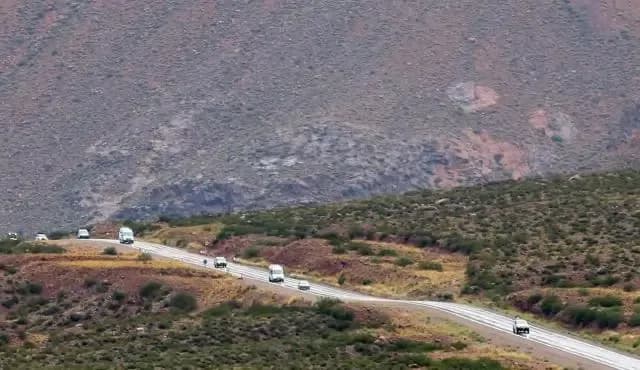
The new extractive cycle exposes historical gaps in connectivity, energy, and logistics, in a context where Chile already functions as the natural outlet for Argentine minerals.
By Panorama Minero
The debate on mining development in Mendoza is gradually shifting from a strictly regulatory discussion to a more structural one: infrastructure. As projects advance in exploration and begin to show more defined timelines, the physical and logistical limitations that condition the real viability of the activity become increasingly clear. In this context, the province faces a challenge that goes beyond any single project and can be summarized by one key question: is Mendoza capable of handling mining at scale?
For now, concrete progress is limited. Notable achievements include the implementation of so-called productive roads in the Malargüe Western Mining District, a necessary intervention to allow access to exploration areas, and the announcement by PSJ Cobre Mendocino to initiate studies for a new transformer station and a high-voltage line in the high mountains. Beyond that, there are no significant announcements regarding railways or major logistics corridor plans.
In this scenario, the Cristo Redentor Integrated System emerges as the most critical—and at the same time, most underutilized—piece of regional infrastructure. It is a corridor that has experienced years of operational deterioration, with recurring management issues, prolonged closures, and a lack of planning that keeps it far from its potential as a strategic logistics route. Nevertheless, it is also the system that already serves a concrete mining role: it transports lime from San Juan to supply Chilean mining, demonstrating that the corridor functions, albeit in a limited way, as a productive vector.
Projects and Current Status
This role gains relevance in the emerging scenario for Argentine mining. Two of the three most advanced metallic projects in the country are located in the Andean region and look, directly or indirectly, toward the Pacific Ocean. In PSJ’s case, its relative proximity to the system makes it a key factor, and its prefeasibility study considers sending trucks with concentrate through this pass to the Pacific Ocean.
This scheme is neither hypothetical nor a future projection: Argentine lithium is already following this logistical logic. Part of the northern production currently exits through northern Chile, via Angamos Port, establishing a concrete precedent of binational integration in mining and logistics. This flow demonstrates that when infrastructure and management allow it, the Andes cease to be a barrier and function as a shared productive corridor.
The mining role of the Cristo Redentor Integrated System is neither theoretical nor potential: it already fulfills a key logistical function for regional mining. Lime produced in San Juan regularly passes through this corridor to Chilean mining, confirming that the infrastructure exists and is used by the extractive industry, even with its current operational limitations. This movement of mining cargo, ongoing for years, clearly shows that the system can operate as a productive route and that the problem is not the lack of activity, but the absence of comprehensive planning to scale, organize, and provide predictability for this mining use. This is not a new debate. In recent years, there have even been requests for certain flows, such as lime transport to Chile, to be channeled through mining corridors that bypass urban areas of Mendoza.
However, the underlying discussion remains the same: without a substantial improvement of the Cristo Redentor Integrated System, large-scale mining in the region faces cost overruns, delays, and a loss of competitiveness that is difficult to reverse.
Milei-Kast Alignment
Adding to this structural scenario is a political factor that could open a rare window in the region. Starting next year, an unprecedented political alignment could occur between Argentina and Chile, reflecting the ideological and discursive affinity expressed by Javier Milei and José Antonio Kast. In practical terms, this could translate into a greater willingness to address long-postponed bilateral agendas, including the modernization and enhancement of the Cristo Redentor Integrated System as a strategic productive corridor.
If this convergence materializes in policy, it could be key to resolving discussions historically trapped by bureaucracy, political shifts, and the lack of a long-term shared vision. The integrated system requires coordinated decisions regarding investments, customs operations, phytosanitary control, winter management, and logistical planning—all aspects beyond a single jurisdiction and only resolvable with political will on both sides of the Andes.
In this sense, the timing is particularly sensitive. Argentine copper mining projects are beginning to present concrete schedules, while Chile maintains a mature logistics structure oriented toward the Pacific Ocean. Real improvements in infrastructure and corridor management would capitalize on this complementarity, reduce logistics costs, and provide predictability to projects currently evaluating exit options cautiously.
This is not about presenting an ideal scenario or anticipating agreements that do not yet exist, but about noting that, for the first time in years, the political context could cease being an obstacle and become an opportunity. Seizing it will depend on Mendoza, the national government, and binational agencies recognizing that the bottleneck is not in the Andes, but in the lack of decisions to leverage what has already been built.
Report with Critical Points
Simultaneously, the national infrastructure requirements report for mining development reinforces this diagnosis and highlights, specifically for Mendoza, three pending areas: strengthening strategic provincial roads, comprehensive improvement of the Cristo Redentor Integrated System, and advancement of the Las Leñas Pass as a long-term alternative.
The latter is repeatedly mentioned in the document as a structural project, but its development remains a historical debt. The last concrete step was the feasibility studies on the Chilean side, while the Argentine process remains incomplete. Only in recent months, alongside the relaunch of the mining agenda in Mendoza, did the provincial government request that the national government resume the Binational Committee, a necessary but still incipient step to reactivate a project of this magnitude.
The report also mentions the Pehuenche Pass within the Andean connectivity framework. However, its use as a major mining logistics corridor has evident limitations. The pass has restricted hours, more limited operations, and a significantly higher rate of winter closures compared to Cristo Redentor itself, making it unreliable for operations that require continuity, predictability, and scale.
In this context, while Pehuenche may play a complementary role for specific flows, it currently does not offer the conditions to become a structural outlet for Mendoza’s mining, particularly in large-volume metallic projects. The report’s diagnosis is clear: beyond alternatives, the heart of Andean infrastructure for Mendoza remains Cristo Redentor, with strengthened provincial roads and modernized binational management.
The challenge, therefore, is significant. Mendoza is entering a phase in which mining projects are no longer discussed solely in terms of permits or environmental impact, but based on their real operational capacity. In this scenario, infrastructure—roads, energy, and international corridors—ceases to be a complement and becomes the factor that defines timelines, costs, and, ultimately, the very possibility of mining consolidating as a productive activity in the province.