The international market is showing strong appetite for a metal essential to the energy transition: copper. Traditional producers such as Chile and Peru are well positioned to benefit from the upward trend in copper prices, while Brazil and Argentina aim to position themselves as major suppliers of the resource.
By Panorama Minero
The global copper boom opens countless opportunities for Latin American nations with mineral reserves, but it also brings multiple operational, economic, environmental, and social challenges, among others.
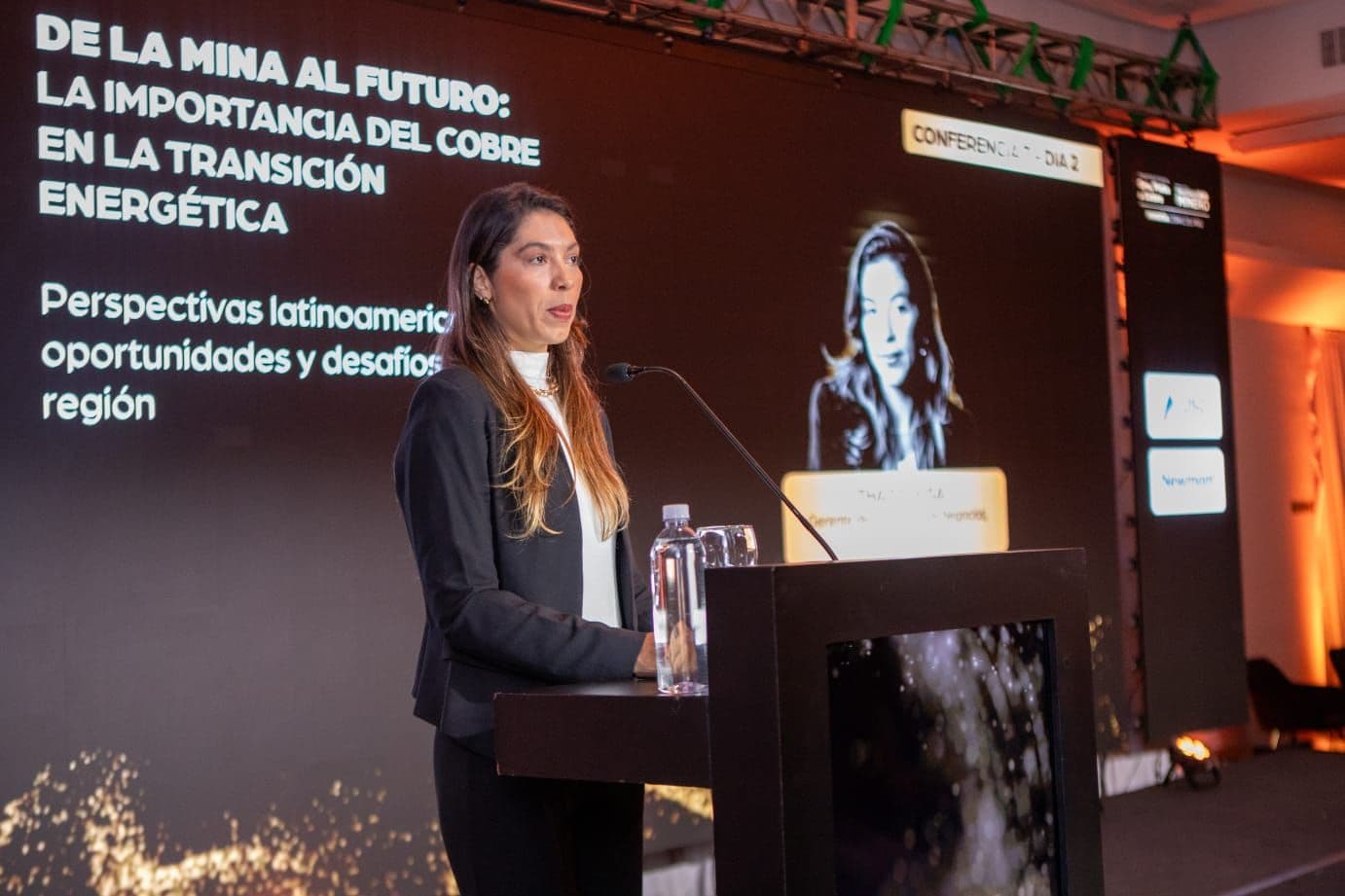
This dynamic regional outlook was analyzed by Thaís Sousa, Business Development Manager at Argus Media, during her participation in the 19th edition of Argentina Gold, Silver and Copper 2025. “Critical metals are driving the development of clean and sustainable technologies. A resource like copper is fundamental for the manufacturing of solar panels, wind turbines, and electrical grids,” said the specialist, who spoke on the panel ‘From the Mine to the Future: The Importance of Copper in the Energy Transition’.
Markets such as the United States and the European Union, she noted, are actively promoting a greater use of renewable energy, an expansion of electric vehicle fleets, and diversification of industrial supply chains. “China, meanwhile, is ready to lead the installation of gigafactories for battery production,” she added.
All these trends, she summarized, point toward an exponential increase in global copper demand by 2050. “In 2024 and 2025, the market showed a surplus. But the tariff war could change the outlook,” she warned.
Today, according to her analysis, there is a clear upward trend in international copper prices within a context of volatility. “Beyond the disruptive policies in the United States, inventories of copper around the world are rising. The U.S. is sending a message to the global market by substantially increasing its stockpiles,” she explained.
In this context, she stated, Latin America can position itself as an epicenter for new deposits. “There is also significant room for major discoveries in Central Asia and Africa,” she added.
High potential
For now, Latin America accounts for 45% of global copper production. Leadership, Sousa specified, lies with Chile and Peru, with Brazil rounding out the top three. “Hopefully Argentina will join that list soon,” she noted.
Everything suggests, she argued, that investments in copper development will expand throughout the region. “An estimated US$246 billion is expected to flow into the sector by 2050,” she quantified.
With such capital, she projected, Latin America will be in a stronger position to reduce its dependence on refining capacity in Asia. “Additionally, genuine job creation will increase, and responsible and sustainable mining practices will be strengthened,” she pointed out.
“Latin America has significant potential to attract investment and develop infrastructure linked to copper, considered a strategic resource for the energy transition. In this regard, new projects with an ESG focus are emerging—projects that from the outset meet the requirements of the carbon market. Ensuring sustainability is essential, minimizing negative environmental and social impacts,” she concluded.