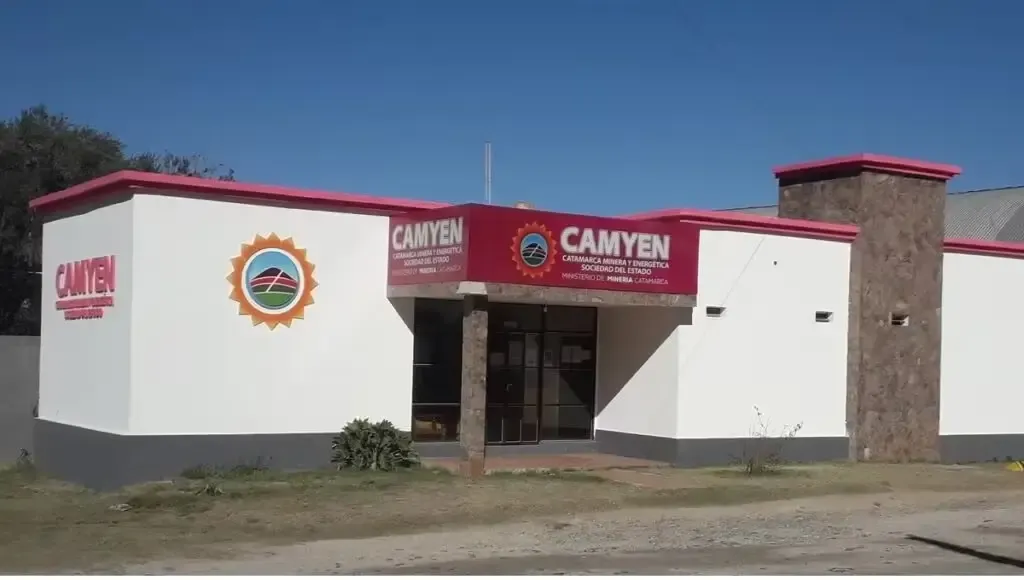
State-owned Catamarca Minera y Energética (CAMYEN) will cease to operate as a State-Owned Company (SE) and will become a Single-Shareholder Corporation (SAU). The change, which has already received preliminary approval from the Senate and is moving toward approval in the Chamber of Deputies, will grant the company a key authority: the ability to sell, assign or encumber the mining claims it holds. According to the provincial government, the reform seeks to “modernize its structure and strengthen the strategic management of mining projects” and bring CAMYEN in line with other state-owned mining companies in Argentina that already operate under this structure.
By Panorama Minero
The Government of Catamarca is moving forward with a reform of CAMYEN centered on adapting the company to national legislation—following the repeal of the State-Owned Companies Law—and defining its corporate assets and the disposal of those assets. The bill establishes that the new CAMYEN SAU “will hold title to the mining properties and rights granted to it by the Province or acquired through any lawful means” and may “transfer, assign, encumber or otherwise dispose of them whenever the transaction is deemed beneficial.” The bill, introduced by the Executive Branch, has already received preliminary approval from the Senate and has the necessary support in the Chamber of Deputies to become law.
Although this authority was already contemplated in the legislation that created CAMYEN (Law No. 5354), the Government acknowledges that it “has been subject to differing interpretations.” According to the Executive Branch, this lack of regulatory clarity placed the company “at a disadvantage compared with similar companies, making it less competitive,” because it could not freely dispose of its properties while private companies were able to do so. The inability to sell mining areas, the Government emphasized, “constitutes a limitation on attracting investment and effectively unlocking the value of the properties within the company’s portfolio.”
Catamarca’s reform follows a path already taken by other provinces with established mining industries. The Government specifically cited Impulsa Mendoza Sostenible S.A., which is authorized to “acquire and dispose of mines and any mining rights, within and outside the country,” as well as Jujuy-based JEMSE, which, because there are no restrictions on the transferability of its mining properties, has completed transactions involving the transfer of rights to strategic foreign partners in recent years. This mechanism has been identified as one of the main factors in attracting foreign direct investment to the lithium sector.
The Government also referenced La Rioja, where Energía y Minerales Sociedad del Estado (EMSE) may transfer or otherwise dispose of its awarded rights through any contractual mechanism, and Salta, where Recursos Energéticos y Mineros Salta S.A. (REMSA) operates under a framework that allows it to hold mining rights and transfer them or partner with third parties for their development. Under the new law, CAMYEN will seek to join this regional framework and expand its “negotiating tools” to support the development of new projects.
A Mining Cadastre of More Than 450 Properties
The significance of the discussion over the sale of mining claims becomes clearer when considering the size of CAMYEN’s portfolio. The company currently holds more than 450 mining properties distributed throughout the province, associated with strategic minerals such as copper, gold, lithium and other resources of economic and geological interest. Of this total, more than 300 properties have already received concession resolutions, including both exploration permits and mining concessions, while the remainder are at advanced stages of the application process.
According to the Government, the size of this portfolio is a direct result of the latest reform of the Mining Procedures Code, which gives CAMYEN preferential rights to acquire title when a mining claim is declared vacant. The accumulation of more than a decade of operational experience and the sustained growth of this portfolio were, in fact, among the main arguments supporting the need to “restructure the company.”
Adapting to the National Regulatory Framework and Strengthening Transparency
The corporate transformation also responds to changes in the regulatory framework at the national level. Decree of Necessity and Urgency (DNU) 70/2023 repealed National Law No. 20,705 governing State-Owned Companies and established that companies with state ownership, regardless of their corporate structure, must be converted into corporations governed by General Companies Law No. 19,550, operating under the same conditions as companies without state ownership. Since the Province is CAMYEN’s sole shareholder, the Government determined that the Single-Shareholder Corporation (SAU) structure is the most appropriate for its operations, as it entails a lower administrative burden than other corporate structures.
The new regulations also introduce an “active transparency” portal. CAMYEN will be required to publish and maintain on its institutional website or the Province’s open-data portal an inventory of the mining properties it holds, a registry of current assignment, transfer and partnership agreements, and financial statements approved by the shareholders’ meeting.