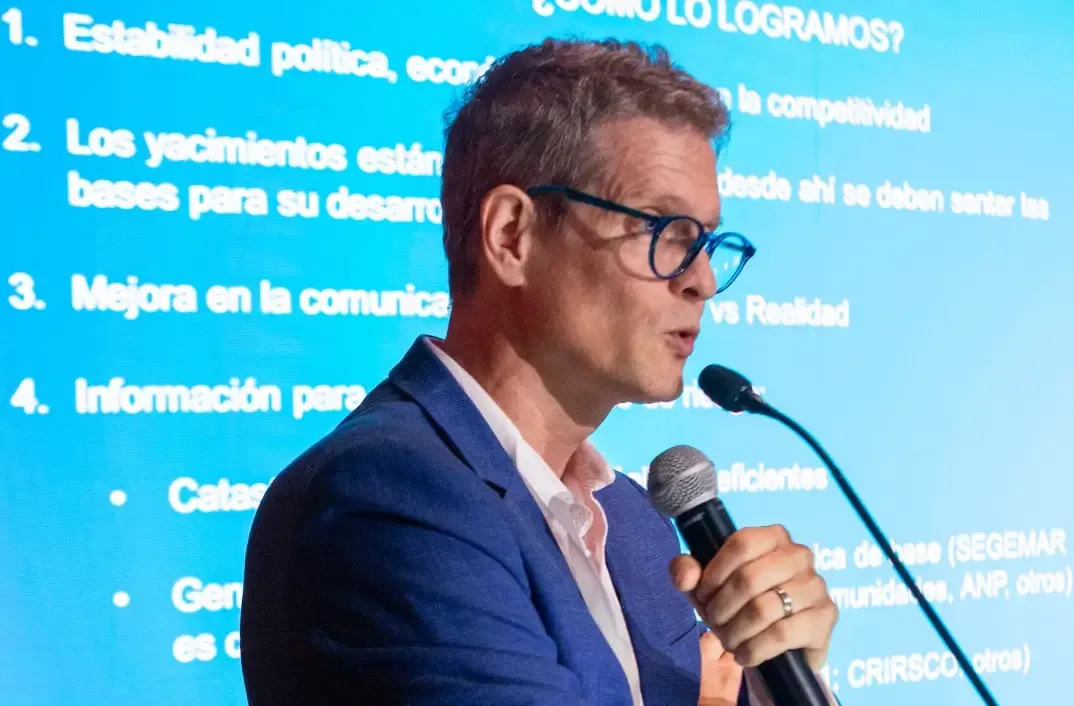
Mining has gained prominence on Argentina’s public agenda, while expectations surrounding new projects have risen accordingly. For Miguel Soler, this creates an opportunity but also a challenge: improving the quality of the discussion and communicating more clearly what mining can deliver, over what timeframe and with what geographic reach.
By Panorama Minero
A geologist by training, Soler previously served as Secretary of Mining of Jujuy and chaired Argentina’s Federal Mining Council (COFEMIN), a body that brings together the country’s provincial mining authorities. He currently works as a World Bank consultant on mining policy and regulation.
In an interview with Panorama Minero, Soler discusses the current outlook for Argentina’s mining sector, relations with local communities and the challenge of managing expectations generated by lithium development and large-scale copper projects. He also addresses the need to expand the supplier base, develop skilled workers and create competitive conditions for investment at a time when Argentina is competing with other mining jurisdictions for capital.
How do you see the current state of Argentina’s mining sector, at a time when the industry has gained greater prominence on the public agenda?
The current situation is positive because mining has become part of the public conversation. The fact that the industry is being discussed is already an important step forward.
However, we still need to improve the quality of that conversation. There are claims being made that are not accurate, perceptions that do not necessarily reflect reality and expectations that probably will not be met. But having mining on the agenda allows us to address those issues and begin developing concrete actions, because society is now more receptive to discussing the industry.
One of the issues receiving the most attention is the level of expectations surrounding mining. How should those expectations be managed?
The only way to manage expectations is to show tangible results progressively and clearly explain how the industry works. We also need to communicate where the national and provincial governments expect development to take place and what its actual impact can be.
An exploration project in the Andes primarily creates opportunities for nearby communities. When a mine enters production, that impact increases, and so does its relationship with surrounding communities and population centers.
As a project grows, it requires more supplies, services and goods, and eventually local, or even provincial, capacity may not be sufficient to meet all of that demand. That is where one of the major challenges emerges.
Mining is increasingly being discussed as a new source of wealth capable of contributing to the development of Argentina’s provinces and the country as a whole. The real challenge is ensuring that communities in mining regions can see tangible economic growth. That does not mean everyone needs to work directly at a mine. The impact should also extend to other productive activities, infrastructure, education and healthcare. That is a long-term objective.
How can that potential be communicated without creating the expectation that mining will have the same impact across the entire population?
We need to communicate better because there are already examples that demonstrate tangible results. One is the Susques department in Jujuy, where two lithium mines are currently operating.
Fifteen years ago, some schools were losing students and communities were seeing their populations decline. Today, we are seeing a different dynamic: schools have students, towns have grown, and members of local communities have built homes, purchased vehicles or become suppliers.
At the same time, we need to explain the actual scale of employment. A lithium project in the Puna, the high-altitude plateau region of northwestern Argentina, cannot directly employ people from across the entire country. Even a large lithium operation may employ around 700 people during its operating phase, while a copper mine could employ roughly 2,000, excluding the construction stage.
The combination of operating copper and lithium mines, other minerals and additional productive activities can generate development, but the effects will not reach everyone in the same way. That is also an important part of the conversation.
What role does engagement with local communities play in that process?
It is a central issue. In the Susques department, for example, the latest census recorded a population of around 4,500. The area has two operating lithium mines and more than ten projects at different stages of development, as well as hundreds of workers connected to the industry.
The economic impact also extends to their families and other activities, although naturally it does not reach everyone in the same way. That is why there will always be concerns and objections, including those related to environmental issues or water use.
What matters is identifying the different stakeholders, understanding where they are located and what their relationship is with the territory, and working from that reality. Communities directly connected to projects have a central role in that process. Critical views may also come from other groups, and those positions need to be heard and considered in the context of their relationship with each project.
Have you seen changes in recent years in the way companies engage with communities?
Yes, the change is noticeable, although it is a long-term process. It also requires an active government that can act as a facilitator and become directly involved when necessary.
It is a gradual learning process. Companies mature, communities mature, and so do provincial governments and municipalities. All stakeholders gain experience as the industry develops.
From your academic experience, what role can universities and other educational institutions play as mining expands?
Universities, secondary schools and educational institutions more broadly have a fundamental role to play. We need to develop the workforce and technical capabilities required to turn projects into operating mines.
Mining requires a very diverse range of skills. There are mechanical and industrial engineers who may never have imagined working at a mine, but the industry also needs accountants, technicians, mechanics, welders and a large number of people working in services, catering, logistics and other support activities.
We need to strengthen technical and production-oriented education, including mechanical engineering and other disciplines that will be required if these projects move forward. Universities are a key part of that process because they provide the knowledge and professionals needed to execute these investments.
How can young people be encouraged to pursue those opportunities when mining projects have such long development timelines?
That is another challenge related to managing expectations. It is difficult to tell someone to choose a degree based on a project that could begin four years from now when there is no certainty about when it will actually move into development.
That is why projects need increasingly clear timelines, including information on when they could begin and what professional and technical profiles they will require. That would make workforce planning much more effective.
Suppliers face a similar issue. We recently discussed this at a meeting of Argentina’s Lithium Roundtable in Buenos Aires. A supplier considering an investment in new equipment needs some visibility on future demand. If the company makes that investment and then cannot deploy the equipment to provide services, the viability of the business itself can be put at risk.
Against this backdrop, are you optimistic about Argentina’s next cycle of mining development?
I am optimistic that at least some projects will move forward, but I am also cautious. Everyone wants investment to happen, but for capital to actually come to Argentina, we need to create a competitive environment that makes those investments viable.
Argentina also needs to understand that it is not the only mining investment destination in the world. Nor are we the only country with copper porphyry deposits or lithium resources. We have those resources, but we need to create the conditions for them to be developed. If investors do not find those conditions here, capital can move to other countries and opportunities will be lost.
We also need more exploration to build a pipeline of projects capable of eventually replacing gold and silver operations that are already well advanced in their mine lives. Added to that are Argentina’s infrastructure needs and the possibility of bringing experienced mining workers back into the industry.
There are many ways in which mining can contribute to economic development and employment. For that to happen, projects need to move forward and investment needs to materialize.