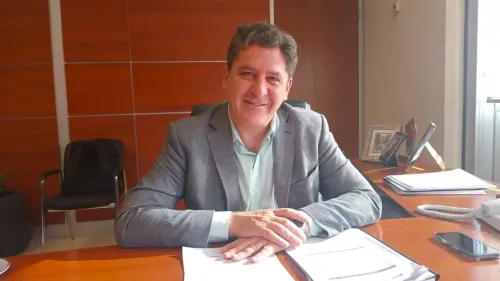
Abás Tanús Mafud, president of the Catamarca Mining Chamber, discusses the capabilities the province will need to develop as its mining industry expands. He estimates that Catamarca currently faces a 30% to 40% shortage of engineers and argues that, before setting local procurement targets, the province needs a clear assessment of what its existing business and supplier base can actually provide.
By Panorama Minero
Mining is entering a new phase in Catamarca. The province already has an established lithium industry, with operating mines and additional projects approaching production, while large-scale metals projects are returning to the agenda, led by copper. This shift in scale is raising an increasingly important question: whether Catamarca has the suppliers, skilled professionals and industrial capabilities needed to meet the expected demand.
For Abás Tanús Mafud, president of the Catamarca Mining Chamber, answering that question requires first assessing the capabilities that already exist within the province and identifying the gaps that still need to be addressed. Workforce availability is one of them: according to Mafud, Catamarca currently faces a shortage of engineers of between 30% and 40%, a gap that could become more pronounced as new projects advance.
The changing landscape is also fueling a broader debate over local procurement. Mafud argues that the discussion should not begin with mandatory percentages for local contracting, but rather with an assessment of existing supplier capacity, the areas that need further development and the conditions companies need to compete effectively.
Catamarca already has lithium projects in production and others approaching operations, while metals projects are returning to the province’s mining agenda. What changes when these two trends begin to advance at the same time?
Expectations around the industry have grown in recent years, particularly around lithium, which is already a reality. We now have several projects operating. In Catamarca, we have Fénix and Tres Quebradas; Sal de Vida, one of Rio Tinto’s expansion projects, is preparing to begin operations. POSCO’s Sal de Oro is also approaching operations, while Galan has already started work.
This is already happening, but it is also creating expectations because there is significant potential for further growth and for contributing to the global energy transition. Naturally, that growth is generating a great deal of interest and many questions about how to participate in it, particularly among suppliers, and about how the sector can continue contributing to a growing mining-based economy in northern Argentina.
That growth is creating expectations among suppliers, workers and local communities, but mining companies have specific needs and a finite capacity to meet them. How can the industry prevent expectations around new investment from exceeding the opportunities it can realistically create?
The most important thing is to have an open and realistic conversation about what each party can actually do. A mining operation or company needs to be able to explain how far it can go, how it can get there and what it needs. A supplier needs to be able to say: I can provide this, I need additional training in this area, or I need to find partners for this.
Communities also need to consider how they can participate in and support this growth. All three parties, together with government, need to keep talking in order to create better conditions, but those discussions need to be based on concrete realities so that we do not create false or excessive expectations that ultimately work against us.
Lithium, like mining more broadly, is a long-term industry. We need to work together through this period of growth, just as we will need to do during other stages of the cycle. That dialogue has to be built over time.
Mining has gained economic importance at a time when other sectors are facing difficulties. Is that shifting employment and economic expectations toward mining that the industry itself may not be able to absorb?
Mining has gained prominence in recent years. For the first time, it became part of a presidential debate, and today everyone is willing to talk about mining. That is positive, but it also creates expectations, and those expectations need to be managed.
It is true that when other sectors decline, people often look to mining for a solution. Mining can contribute, but it cannot do everything on its own. We need to be clear about what the industry can and cannot do, so that people understand our activity and we also understand what communities expect from it.
Today, some people may prefer to become suppliers rather than employees, and perhaps the answer is not more suppliers, but better suppliers. We do not know yet. Everyone is thinking about how to provide services to mining companies, how to enter the industry or how to build a business around mining. We need greater clarity around that equation so that it produces good outcomes rather than expectations we ultimately cannot meet.
The simultaneous growth of lithium and metals mining requires more than capital: it also demands technicians, skilled trades and specialized professionals. Where are Catamarca’s most significant workforce gaps today?
We need all stakeholders at the same table to determine the best way forward, because development needs to be sustainable, socially responsible and competitive.
Today, we need to train more people across the entire skills spectrum, from construction trades to engineers. One of my biggest challenges as president of the Chamber is finding a way to address Catamarca’s shortage of engineers, which we estimate at between 30% and 40% overall, particularly with major copper projects now on the horizon.
There are many issues that will be very difficult to solve unless we work on them together. We cannot think only about tomorrow; we also need to plan for the medium and long term. We need stability, legal certainty, predictability and planning. Those are the areas where dialogue needs to be strengthened.
A shortage of skilled professionals cannot be addressed as quickly as a mining project can advance. How are you working with the education system to anticipate demand that could materialize over the next several years?
As a Chamber, we have visited a number of schools to speak with students. It is important to work with secondary schools and technical and vocational institutions, strengthen the education and training system, and use available resources as efficiently as possible.
We also need to think about qualifications that are useful not only to mining but across different industries. We developed a map of the professions and skills the mining industry will require, while also asking what capabilities will remain in the province over the longer term. Will we have better-trained industrial engineers, technicians and skilled tradespeople?
We need to provide Catamarca’s education and training system with the resources required so that young people can build careers both in mining and in other industries.
Have universities and public institutions been able to respond to the workforce needs you have identified and begin adapting education and training programs accordingly?
We are working with all the relevant institutions. The provincial ministries responsible for education and labor have provided significant support, and several of the reports and initiatives we have developed were prepared jointly with government officials.
We have also begun working with the university, particularly its Faculty of Applied Sciences and Technologies, on the possibility of developing an industrial engineering program. The response has been very positive because there is broad agreement on the need to train people for future demand.
This may not solve our short-term needs, but it can establish the foundations for Catamarca to develop the workforce we know the province is capable of producing over the longer term. We need to provide the tools to make that happen.
Copper projects require a very different scale of workforce, services and supplier capacity than lithium operations. With projects such as MARA on the horizon and metals mining returning to the agenda, is Catamarca’s supplier ecosystem prepared for that step change?
Metals mining is returning to Catamarca’s agenda, with Alumbrera and Diablillos as MARA prepares to advance. For us, it is very positive to be able to support our member companies through this process.
The biggest challenge now is how to strengthen the entire supplier and services ecosystem so that it can support both lithium and copper. The scale of workforce and supplier requirements for copper or gold projects is very different from what lithium operations require.
We believe there will be shortages of qualified suppliers in certain areas, as well as workforce shortages. We have two options: we can focus on what we are going to lack, or we can work together to find the best solutions.
That is why we signed an agreement with the local suppliers chamber to prepare an assessment of the capabilities that already exist in Catamarca and those that are still missing. We are laying the groundwork for the future, but this is not a distant challenge: we need to develop these capabilities in the very short term. The return of metals mining to Catamarca is perhaps one of the most important developments for the province this year.
Local supplier participation is often measured through procurement targets, and Argentina’s mining provinces have taken different approaches. Does it make sense to establish local-content targets before determining which goods and services the province can supply competitively?
I do not think the central question is the percentage. The real question is the capacity that already exists. We first need to focus on that capacity and determine how we can strengthen it. Once we have that baseline, we will be in a better position to decide whether setting a percentage makes sense.
We have worked on proposals that respond to the public’s interest in participating in the mining industry through the provision of services, while at the same time finding an approach that is consistent with the needs of mining companies.
The key is understanding where we stand, what capabilities we already have and what we are going to need. Once we have that information, it will be much easier to discuss what public policies or industry guidelines should be adopted and whether a specific percentage is actually necessary.
With Catamarca’s mining industry potentially expanding considerably over the coming years, what should be the priority to ensure that this growth translates into lasting capabilities within the province?
It is very important to have all stakeholders at the same table. Without mining there are no mining suppliers, and we would not be having this discussion.
It is also important for people to understand the mining industry better. We should not expect mining to solve every problem, but it can provide opportunities and capabilities that contribute to the development of this part of Argentina.
Supporting that process requires understanding the industry, and that understanding has to be built locally and regionally, with all stakeholders working together to take the next step.