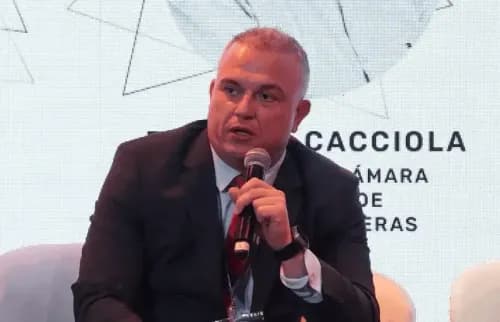
San Juan’s Production Minister, Gustavo Fernández, explained that the provincial strategy seeks to leverage mining as a driver for diversifying and internationalising the economy. The approach includes shared infrastructure and the development of SMEs capable of becoming global suppliers.
Fernández highlighted horizontal value addition, business partnerships and training as tools enabling local companies to offer goods, services and technology in international mining markets.
By Panorama Minero
As part of the strategic discussions surrounding San Juan’s economic development, Production Minister Gustavo Fernández outlined the operational and policy approaches through which the provincial administration addresses the role of large-scale mining. According to the official’s statements, mining activity should not be viewed in isolation, but rather as a driver of investment attraction and a “key” capable of opening up opportunities for growth and internationalisation across all the province’s productive sectors.
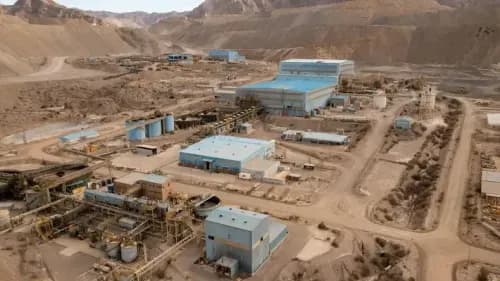
According to Fernández, the directive issued by Governor Marcelo Orrego to the Ministry of Production and the Ministry of Mining is to coordinate their efforts to reposition San Juan as the ideal destination for mining investment in Latin America, while simultaneously strengthening local production in other areas. Under this approach, mining acts as a catalyst that provides the province with two central assets: large-scale infrastructure and international visibility.
Regarding infrastructure, Fernández emphasised the concept of “shared infrastructure”. Investments associated with large-scale mining — particularly those linked to copper projects, with San Juan accounting for 80% of Argentina’s potential — have the economic scale required to promote road corridors, the restoration of railway transport, the expansion of electricity transmission network capacity and improvements in air connectivity. The government’s position is that these road and energy infrastructure projects should not serve mining deposits exclusively, but should also be available to other productive activities in the province, such as agribusiness (wine production, olive growing and table grape production), tourism, the knowledge economy and renewable energy.
Internationalisation and the “Global Showcase”
The head of the Production Ministry also noted that the global scale of mining places San Juan in a “global showcase”, or a position of high international visibility that other activities would not be able to access independently. In this regard, Fernández explained that international initiatives and engagements focused on mining open up marketing channels and opportunities for other products from San Juan to enter international markets.
As an example, he cited how mining promotion missions in international settings, such as Canada, opened up direct opportunities for exports from local agribusiness and facilitated access to genetic varieties developed to restore export-scale table grape production, through a workshop in Chile.
The Paradigm Shift: From Local Suppliers to Global Suppliers
One of the central pillars outlined by Fernández is the redefinition of the concept of supplier development. The provincial strategy seeks to move beyond the traditional notion of a “local supplier” — one whose purpose is solely to supply mining projects located within San Juan — towards the development of “global suppliers”.
According to the minister’s statements, San Juan companies providing goods, services and technology that develop their capabilities by meeting the demanding standards of large-scale mining become equipped to export their offerings to other mining markets around the world, such as Chile, Peru, Canada and Australia. In this way, supplying the mining industry becomes an export industry in its own right, encompassing knowledge, technology and services, regardless of the geographical location of the mining deposit.
The Proposal for “Horizontal Value Addition”
This policy of supplier internationalisation forms the basis of what the provincial government calls “horizontal value addition”. Fernández contrasted this perspective with the conventional concept of vertical value addition, which focuses on processing exclusively within the same extractive value chain (moving, for example, from rock extraction to copper concentrate, then to cathodes and finally to wire).
By contrast, the horizontal value addition proposal argues that the real potential for capturing value lies in using mining as a lever to diversify the province’s economic structure. This involves developing cross-sector capabilities among local companies so that they can export knowledge, technical services, technology and goods both to the international mining industry and to other productive sectors.
Competitiveness and Rejection of Provincial Protectionism
To achieve the status of global suppliers, the minister argued that local companies must operate in an openly competitive environment. In his statements, Fernández rejected positions advocating the “shielding” of provincial borders through mandatory protection schemes or restrictions on the entry of external companies.
The official argued that protectionism generates isolation and reduces the competitiveness of local industry, preventing it from developing the standards required to compete abroad. Based on the principle that the province should not impose barriers if it expects its companies to sell outside San Juan, the provincial administration promotes exposure to domestic competition as essential preparation for entering international markets.
Business Partnerships as a Strategic Tool
Faced with the challenge of competition, the provincial government’s proposal identifies business partnerships as the essential instrument for strengthening San Juan companies. Rather than isolation or the imposition of quotas, the creation of strategic alliances is encouraged, including Temporary Business Associations (Uniones Transitorias de Empresas, UTEs).
Through these partnerships, San Juan companies contribute their knowledge of the terrain, experience accumulated in the region and human resources, while complementing these strengths with the technical, operational or financial capabilities of national or international companies. Fernández illustrated the effectiveness of this approach by referring to recent tenders in the transport sector for mining projects such as Vicuña, and for the construction of sections of road infrastructure, where all participating San Juan companies chose to submit bids in partnership with national firms to strengthen their proposals.
Information Transparency and the Local Development Law
In line with the principle of not imposing rigid quotas or closed borders, Fernández explained the mechanisms of the Local Development Law. The main focus of this legislation is to make market information transparent through the Employment and Supplier Development Plans that mining companies are required to submit.
Through this instrument, mining companies communicate their future demand for goods, services and workforce profiles. This demand is compared with the available local supply, recorded in the Mining Suppliers Register (REPROMIN). The gap identified between mining companies’ demand and the available supply forms the basis for development programmes implemented progressively over time, with measurable targets established year by year.
Human Resource Development and Training Programmes
Finally, regarding human capital, Fernández highlighted that the province’s mining tradition — with historical roots dating back to the establishment of the first School of Mines by Domingo Faustino Sarmiento and 25 years of experience in gold mining — provides an established starting point.
Nevertheless, in anticipation of the increased demand for labour that new projects will generate, the Ministry of Production is implementing the “Aprender, Trabajar y Producir” (“Learn, Work and Produce”) programme across the province’s 19 departments. This programme includes both specific technical training and the preparation of people to fill positions that become vacant in workshops, shops and agribusinesses when trained workers move into the mining industry.
The province is also promoting entrepreneurship through initiatives such as “San Juan Emprende”, with the aim of establishing new companies capable of taking advantage of emerging business opportunities.