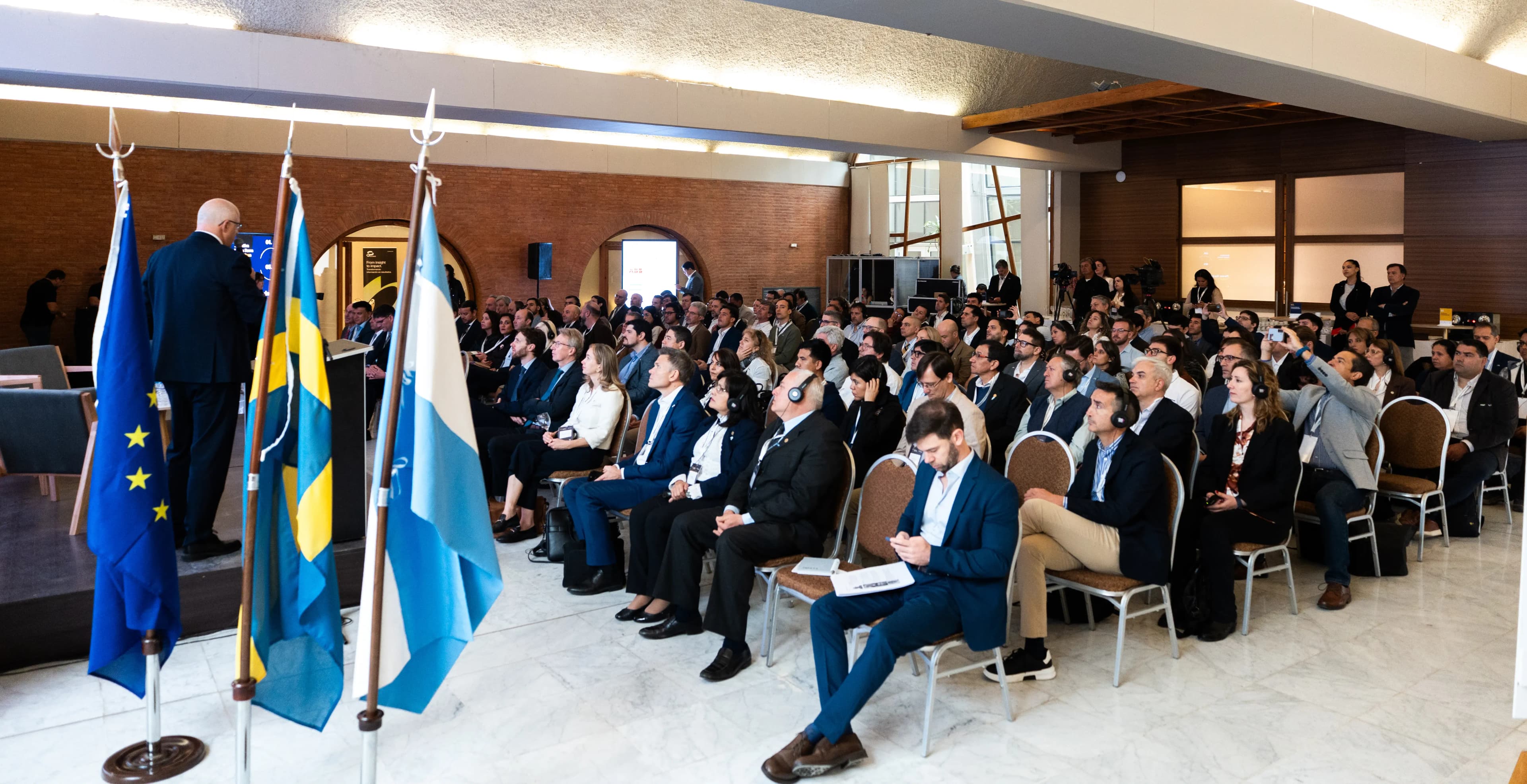
The province of San Juan hosted the fourth edition of the Swedish Mining Initiative, the first to be held outside Buenos Aires. The event included presentations on the range of solutions developed by the Scandinavian country for the mining sector, with potential applications in Argentina.
By Panorama Minero
The Swedish Ambassador to Argentina, Mr. Torsten Ericsson, delivered the welcoming remarks and highlighted the roadmap established by his country with the goal of making its mining industry free from fossil fuel consumption by 2035. “It is not a declaration of intent; it is a roadmap,” he stated.
“Trust is built through presence, over time, and through joint work among different sectors of society. We believe this collaboration is necessary because the development of mining requires contributions from a large part of society and affects society as a whole. The invitation I extend to you today is simple: let this seminar not be an end point, but a starting point,” Ericsson concluded.
Following the Swedish diplomat’s welcoming remarks, Mikael Johansson, Director of Business Sweden’s Global Mining and Metals Program, presented the Swedish Ecosystem and Innovation. Johansson discussed his country’s role as a leading nation at the forefront of innovative and sustainable technologies.
In this regard, Johansson emphasized how the accelerated adoption of technology has resulted in increased productivity at Swedish mines. He also referred to comprehensive from-pit-to-port solutions, as well as the trend toward the electrification of trucks at mining operations in Sweden.
This broad range of solutions includes major industrial players — ABB, Sandvik, SKF, Ericsson and Epiroc — together with research and development institutes, small and medium-sized enterprises and public organizations.
The panel entitled “Water Management in Mining”, comprising David Purkey, Senior Research Fellow at SEI (Stockholm Environment Institute); Oscar Dölling, Professor and water resources specialist at UNSJ; Joel Juri, Superintendent of Water Resources at Vicuña; and David Devia, Secretary of Water Resources and Renewable Energy of the Government of San Juan, addressed a critical and decisive issue: the efficient use of water resources. The panel also analyzed how Sweden’s experience could be applied in the province of San Juan.
Subsequently, representatives from the UNSJ Faculty of Engineering — Andrea Díaz, Dean; Volvo Trucks & Buses Argentina — Damián Vilella, Commercial Director; UNDP Argentina — Matías Moffet, Environment Area Coordinator; and Sandvik — Luis de Luca, Commercial Manager analyzed capacity building for the mining sector, with an emphasis on the profiles required by the industry, key trends and the challenges arising from the future demands of San Juan’s mining sector.
Finally, five thematic roundtables were held — Digitalization; People and Sustainability; Environment and Sustainability; Mining Projects (Pre-Operation); and Mine Operations — where participants discussed the needs, challenges and outlook for the mining industry.