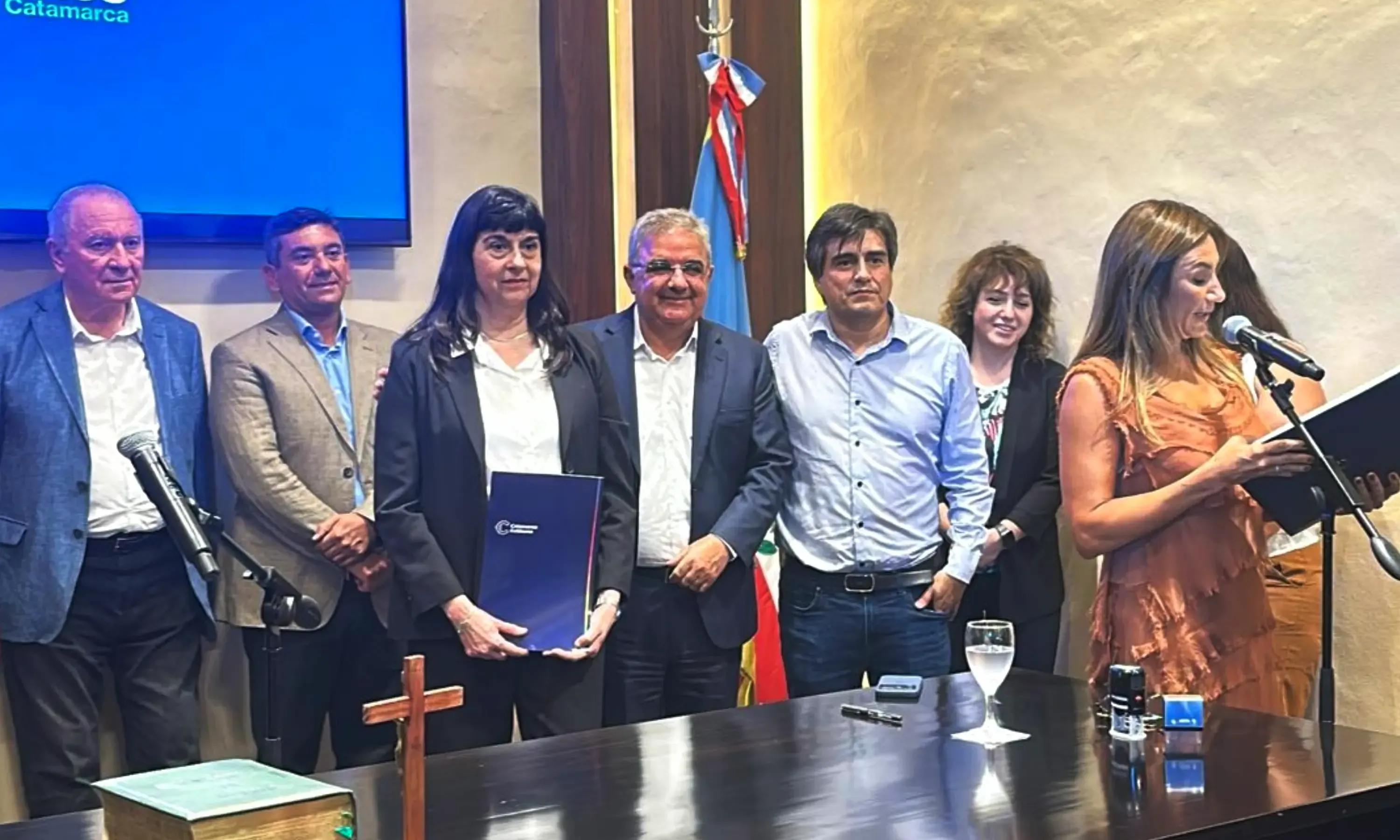
The governor of Catamarca presented an assessment of the sector during the swearing-in ceremony of the new Minister of Mining, Teresita Regalado, and detailed key infrastructure projects for the province.
By Panorama Minero
The governor of Catamarca, Raúl Jalil, highlighted the growth of mining investments in the province and announced a series of measures to strengthen the sector, with special emphasis on small and medium-scale mining. The statements were made during the swearing-in ceremony of Teresita Regalado as the new Minister of Mining, at Government House.
During his address, Jalil underscored the strategic importance of the mining sector for Catamarca by stating that “80% of our land is mountainous” and celebrated that the province has managed to attract investments from more than 15 countries. “We have secured investments thanks to very important work, from Europe, Switzerland, the U.S., India, China; companies such as Glencore and Albemarle are with us; practically there are already more than 15 countries that are investing,” detailed the provincial governor.
The governor highlighted that among the investors there are also “local businesspeople” and emphasized the recovery of YMAD (Yacimientos Mineros de Agua de Dionisio) for the province. “Restoring YMAD to Catamarca has been very important in terms of having public policies together with CAMYEN (Catamarca Minera y Energética), which was also something defined by former governor Lucía Corpacci,” Jalil stated.
However, the governor placed special emphasis on the development of small and medium-scale mining as “the great challenge” of his administration. To illustrate the sector’s potential, Jalil made a comparison with Chile: “Chile exports almost US$6 billion in small and medium-scale mining, which is practically what we export. Chile exports a total of about US$60 billion,” he noted.
In that regard, the governor announced concrete measures to support the sector. “We are going to support small and medium-scale mining with loans and also invite Catamarca and Argentine businesspeople; we are already visiting some small projects that at this time, with mineral prices, can move forward,” he stated.
Jalil also announced that starting next week, “consultation rounds on the works” to be carried out with funds from the Mining Trust will begin. In this regard, he highlighted that these works will be defined by residents of the area of influence of the mining projects. Jalil emphasized these consultation rounds as the mechanism “the most transparent that has been achieved” for the use of mining royalties. As he explained, the system has “a manager” and “Banco Nación is involved,” and it operates through public hearings.
In terms of infrastructure, the governor detailed several projects underway. “We have already put out to tender the energy project up to Laguna Blanca, so we estimate that in one year we will have energy in that place,” and then added that “it is also in the tendering process from Laguna Blanca to Antofagasta.”
Among the priority road works, Jalil mentioned “the paved routes to Antofagasta, as well as the opening of the routes from Fiambalá toward Antofagasta.” In addition, he highlighted two projects that will be completed during his administration: “La Cuesta de Zapata, connecting Belén with Tinogasta, and the opening of the Chuquisaca–Fiambalá route to Antofagasta de la Sierra, which will facilitate exports through the San Francisco pass.”
One of the most notable announcements was related to the Bajo La Alumbrera project. “The announcement by Glencore to begin working on what was Bajo La Alumbrera has been very important,” Jalil stated, and he predicted: “I believe it will be the first project to export copper from Argentina after many years.”
In his address, Jalil also referred to the Tres Quebradas lithium project operated by the company Zijin-Liex, which “is already exporting” and which, according to him, is expected to “double the amount of production” thanks to the recovery of the lithium price.
In the final part, the governor highlighted other aspects of mining development. “Work with suppliers is very important, as well as training and the workforce,” he stated, acknowledging the work that has been carried out in these areas.
Jalil not only shared his views on mining, but also on other productive sectors, such as tourism and manufacturing. “We have many challenges,” he concluded in his address before officials, deputies, and mayors at Government House.