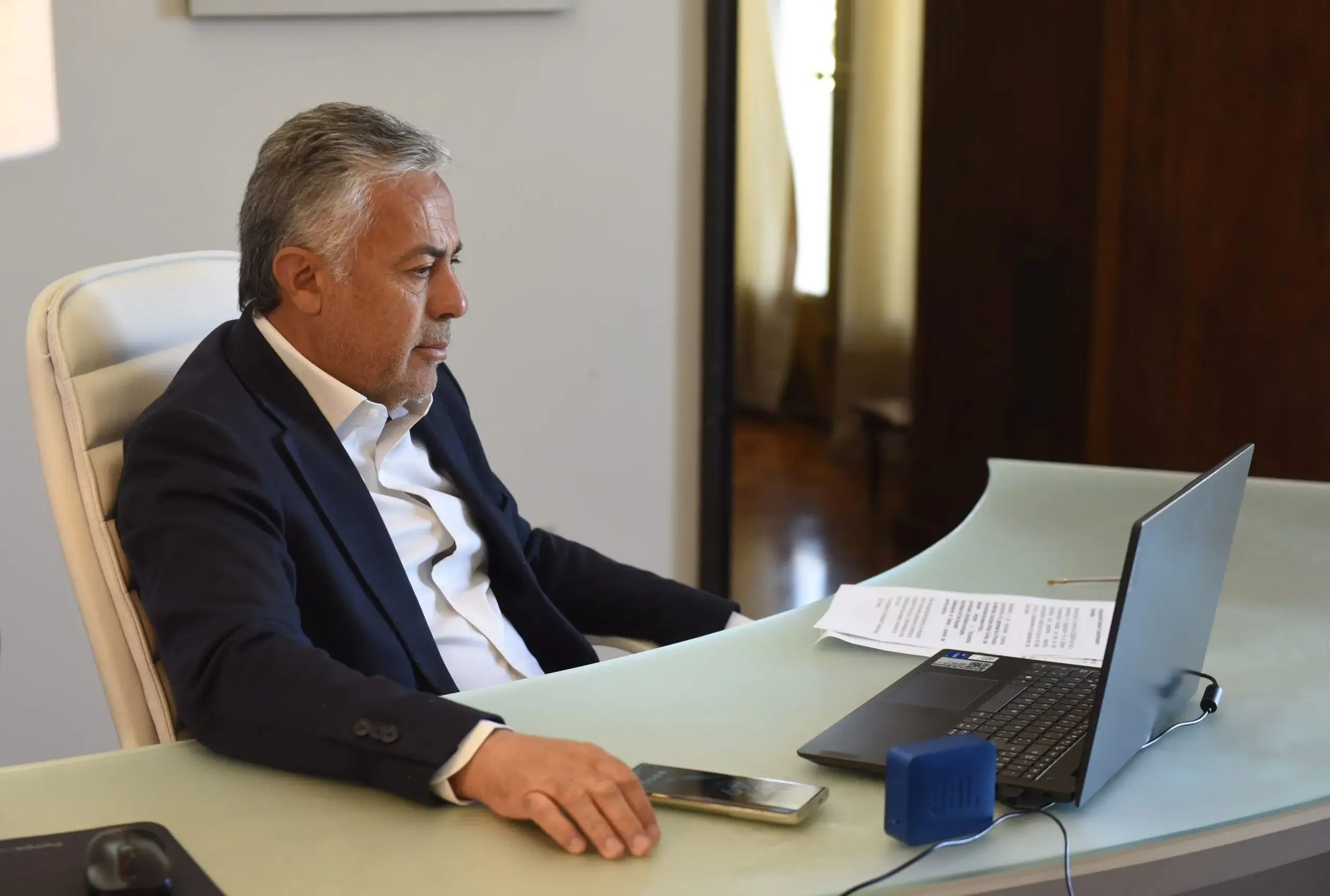
The governor stated that Mendoza province of has entered a process it had previously been unable to navigate, with environmental assessments, controls, and decision-making mechanisms now enabling progress.
By Panorama Minero
Mendoza Governor Alfredo Cornejo offered an assessment of the province’s current mining landscape and the process that has unfolded over recent months, describing it as markedly different from previous years. The governor emphasized the shift Mendoza is experiencing, the social debate surrounding mining activity, and the conditions that, in his view, make it possible to envision mining development in the short to medium term.
Cornejo argued that mining in Mendoza is no longer a purely theoretical discussion. According to him, the province has moved from a scenario of paralysis to one in which concrete projects are under evaluation and progressing at different stages. In this context, he stated that mining development should no longer be viewed on a timeline of decades. “It will not be in 20 or 30 years—it will be in the immediate future,” he said, pointing to conditions that are fundamentally different from those of the past.
A Process Mendoza Had Not Previously Undertaken
The governor noted that for many years Mendoza was unable to advance mining projects due to the existing legal framework, particularly Law 7,722. He pointed out that the law “has been in force for 15 years” and that during that period “not a single project was developed,” which he attributed to how certain environmental and procedural aspects were interpreted.
In that sense, Cornejo explained that the province is now going through a process it had not experienced before: comprehensive environmental assessments, detailed technical analysis, and decisions that move beyond the purely exploratory stage. According to the governor, this trajectory explains why Mendoza can now discuss mining from a different standpoint, with concrete project files and active procedures.
The Role of Oversight and the Social Debate
One of the central points of the governor’s assessment relates to public perception of mining. Cornejo acknowledged that a segment of society rejects the activity on principle, but distinguished this from those who express concerns due to fears about insufficient oversight. In that context, he stated that “the effort must be to prove that oversight can work.”
He stressed that the debate cannot remain limited to broad slogans and must instead be grounded in concrete information. In this regard, he argued that Mendoza now has stronger tools than in the past to exercise environmental oversight, both technically and operationally. He also highlighted that current processes involve specialized agencies and project-specific evaluations.
Environmental Assessments and Procedures
Cornejo explained that the mining projects currently under review in Mendoza involve consultations with technical agencies that carry out detailed analyses of the areas proposed for development. In particular, he referred to the review and field assessment work conducted in exploration areas as part of existing environmental procedures.
According to the governor, these mechanisms are already being applied and form part of the Environmental Impact Assessments currently under consideration. From his perspective, this demonstrates that Mendoza is not operating outside national technical standards, but has already incorporated them into its administrative processes.
However, Cornejo criticized the requirement under Law 7,722 that certain projects must be reviewed by the provincial Legislature. He argued that this mechanism introduces a political dimension into decisions that, in his view, should be resolved on technical grounds. “It is unreasonable to explain that a multi-billion-dollar investment depends on a legislative vote,” he said.
He clarified that this position does not imply reducing oversight, but rather strengthening it through competent technical bodies. In this sense, he argued that environmental control must be rigorous, ongoing, and technically based, without transferring final decision-making to the political arena.
The Current Legal Framework and Scenario
With respect to the regulatory framework, the governor stated that Law 7,722—which imposes restrictions on mining activity in Mendoza—remains in force and that its amendment is not under discussion in the short term. However, he maintained that the law can function effectively if applied with clear criteria and appropriate procedures.
From his perspective, the historical problem was not the existence of the law itself, but how it was interpreted and implemented. He reiterated that the province is now undergoing a different process, with greater procedural clarity and decisions that allow projects to move forward.
An Open-Ended Assessment
Cornejo presented his assessment of 2025 not as a definitive conclusion, but as a transitional phase. He acknowledged that mining continues to generate tension and divergent views in Mendoza, but emphasized that the province has entered a process it had been unable to undertake for many years.
Looking ahead, he stated that the key challenge is to sustain this trajectory, demonstrate that oversight mechanisms are effective, and show that the state is capable of managing a complex industry. In this context, he argued that the debate should focus on how projects are developed, rather than reverting to abstract discussions that, for years, prevented progress.