Control of raw materials, transport traceability, and the new regulatory framework for industrial plants redefine the functioning of the sector.
By Panorama Minero
Construction activity in Mendoza is undergoing a silent but profound reconfiguration. With the full implementation of the new Mining Procedure Code and the technical definitions adopted by the provincial mining authority, the raw materials supplying the sector have been fully incorporated into a formal mining control system, changing the logic with which the supply chain historically operated.
Aggregates, limestones, gypsum, and other third-category minerals, fundamental for public and private works, are now subject to a system that requires traceability from origin to final destination, including mandatory controls over transport, documentation, and legality of mining rights. Each load moving through the province must now have documentary support, regardless of whether its destination is a construction site, a building materials yard, a concrete mixer, or an industrial plant.
This change means that mineral transport has ceased to be a marginal operational link and has become a critical point in the system. The Mineral Transit Guide now functions as a central instrument: it certifies origin, volume, type of mineral, and destination, and authorizes the authorities to inspect at any stage of transport. In practical terms, without traceability there is no circulation, and without circulation there is no supply of inputs for construction.
The Construction Industry integrated into the Mining Regime
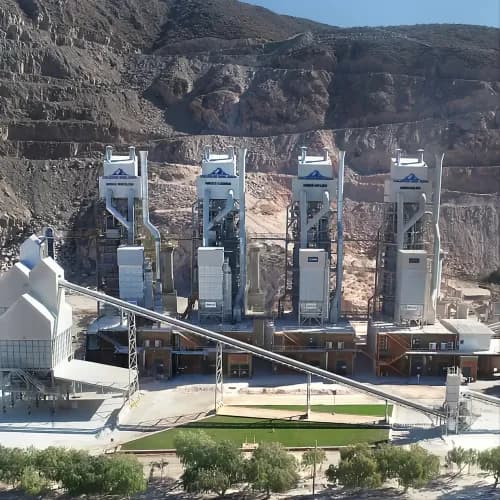
The new framework is not limited to the extraction stage. During 2025, the province advanced in a technical definition that fully integrated the construction industry into the mining regime. Through Resolution No. 450, the Mining Directorate classified cement plants, concrete mixers, and brick factories as mineral processing plants, requiring them to comply with the same environmental requirements as the rest of the mining activity, including the submission of Environmental Impact Reports.
Even if the final product is industrial—cement, concrete, or bricks—the prior process involves the direct transformation of mineral-origin inputs. The mixing of aggregates, crushing, grinding, or calcination of limestone and clay fall within the unit processes defined by mining legislation, which incorporates these activities into the system of control, oversight, and traceability.
The magnitude of the change is reflected in the figures. Mendoza has more than 500 third-category mines, which historically supplied the provincial construction demand. In the adaptation process initiated in 2024 and consolidated this year, 178 operations had to regularize their environmental status to continue operating, in a context where informality had been a structural constant in the sector.
Impact on costs, prices, and market dynamics
The incorporation of the entire supply chain into the formal mining regime began to impact costs. The regularization of freight, load control, mandatory documentation, and compliance with environmental requirements introduced adjustments in the pricing structure of aggregates, a basic construction input. The effect does not respond to a new tax or a deliberate restriction of supply, but to the internalization of costs that had not been fully reflected for years.
In the first weeks of full implementation of the framework, different sector actors began to notice variations in prices of essential materials such as sand, gravel, and crushed stone, inputs that have a direct impact on the final cost per cubic meter of concrete. In many cases, the adjustments were related to the need to reorganize logistics, adapt loads to permitted limits, and absorb costs associated with the regularization of transport documentation.
The impact also began to be felt in building materials yards and suppliers, where supply became more selective and delivery times started to adjust to a more controlled supply chain. The exit or readjustment of operators who could not comply with the new requirements in a timely manner temporarily reduced the availability of certain inputs, generating localized market tensions.
From a structural perspective, construction ceases to operate as a system disconnected from mining and becomes integrated as an extension of the mining chain, with shared responsibilities regarding legality, traceability, and environmental control. Industrial plants, transporters, and material suppliers become active participants in the control system, required to verify the origin and documentation of each input they use.
This process begins to be reflected in construction costs, both in the private segment and in public works, where budgets must account for a pricing structure that reflects real production conditions and regulatory compliance. The reorganization of the construction material base thus introduces a new scenario for the sector, in which predictability and transparency occupy a central role.
The new framework redefines the functioning of the sector. In the short term, it introduces tensions in prices and logistics. In the medium and long term, it lays the foundations for a more orderly, predictable, and transparent activity, where construction production and supply rely on a formal system that reduces gray areas and aligns the entire chain under common rules.