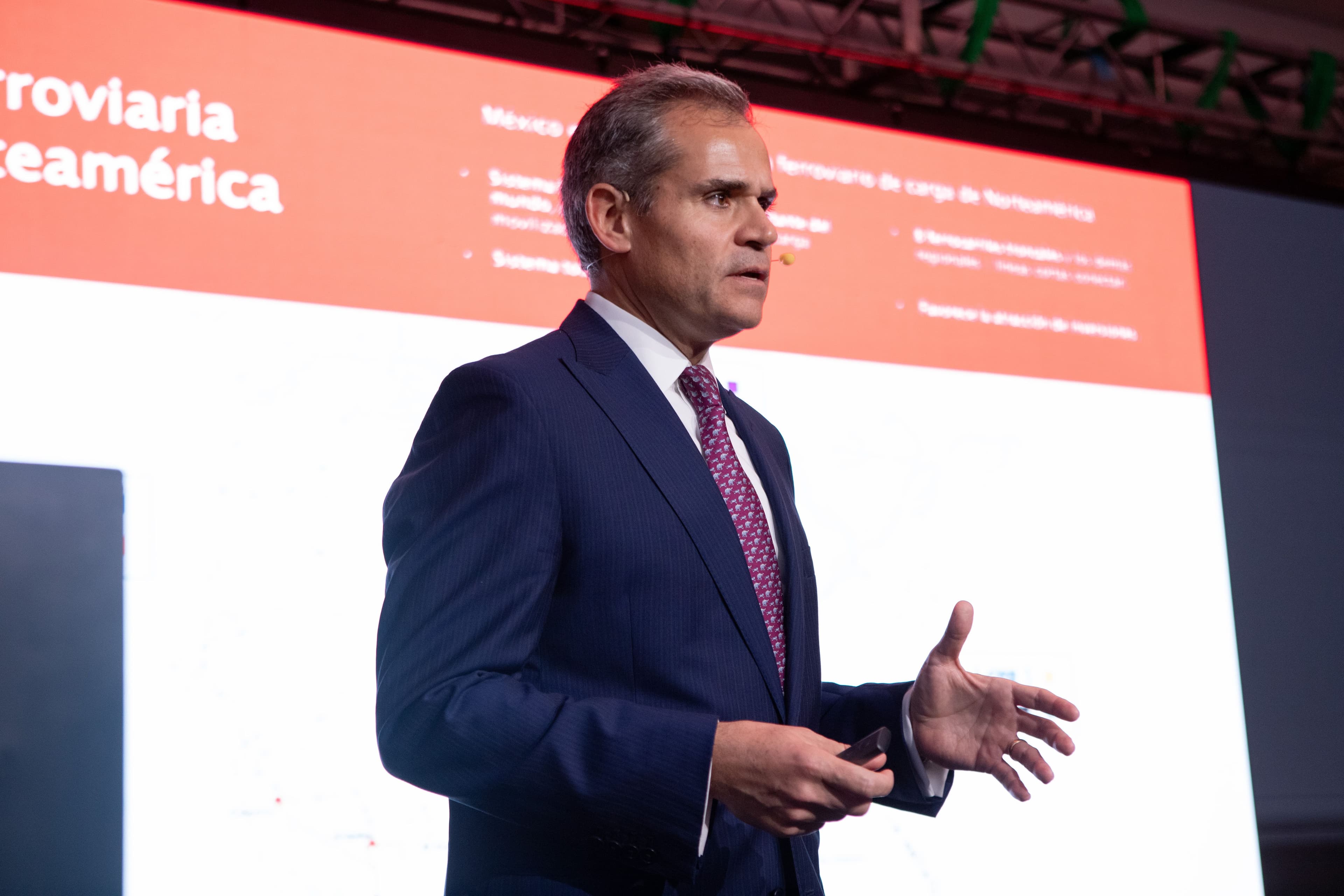
Bernardo Ayala, CEO of Grupo México Transportes USA, introduces the freight leader. The company specializes in industrial products, with a strong focus on the movement of minerals and related products.
By Panorama Minero
What motivates you to be present in Argentina?
First, the historic moment Argentina is experiencing, from the perspective of the changes that are being implemented and have already been implemented. This opens a unique window for us—an opportunity to participate. We already went through a very similar process in Mexico in 1998.
It's a process in which we have been operating, growing, and improving the network for almost 30 years now. These are unique windows that appear only very sporadically, and we see here a major opportunity—not only from the legal standpoint related to the sector, but also due to the growth taking place in the mining sector, the agricultural sector, and others that may emerge.
Grupo México has a strong presence in both the U.S. and Mexico. What can you tell us about that?
In Mexico, we operate the country’s largest network, approximately 10,000 kilometers. In the U.S., we have three railroads: one is a line that runs from the Mexican border to Texas, specifically to the city of Dallas. Then we have an operation where we run a “train ferry,” as we call it, that loads railcars and transports them from Mexico to the U.S.
Each vessel carries 150 freight cars—a full train. We operate two such vessels, and then we have an operation in Florida that runs from Jacksonville to Miami, which is a very fast network. We operate all types of trains—consumer goods trains—and we transport products for UPS, Amazon, and others. The trip takes about eight hours and we unload immediately upon arrival.
What products do you transport?
In the minerals sector, we transport copper concentrate, as well as cathodes and anodes. Therefore, we take copper concentrate to the smelter, and from the smelter we return with the cathodes and anodes that are either exported or used for domestic consumption.
In the case of iron ore, we move ore slurry to a plant where it is refined into pellets, which we then transport to another plant for smelting. The finished product—wire rod, rebar, ingots, steel bars, etc.—is produced there. From that point, these are transported to other markets. So, it is a network in which we transport both the raw material and the finished product, or a secondary product that still needs to go through another manufacturing process.
And in fact, when it comes to manufacturing processes, we also transport the final product, such as blenders, washing machines, etc.
How much has rail technology evolved?
Tremendously—starting with something very basic, like locomotives. Those that used to have 2,500 to 3,000 horsepower are now locomotives with 4,400 horsepower, using alternating current.
We use what are called remote locomotives—that is, locomotives at the front of the train, and then additional locomotives placed within the train or at the end, providing extra power along the route. These locomotives follow the instructions of the lead units. The same applies to railcars, which can now handle greater tonnage.
On top of that, there is the track itself—the gauge and quality of the rail—to support heavier loads. We’ve gone from railway sleepers to reinforced concrete. It’s a process of continuous improvement. There are also dispatch systems, safety systems, communication with locomotives, video surveillance, drone use for certain inspections, and more.
How much has artificial intelligence or train autonomy evolved?
We are incorporating a new artificial intelligence system; in fact, the project is called La Maquinista. It is a program where AI helps us identify the most efficient movements for assembling trains in order to manage operations dynamically and continuously—without having to manually plan which types of cars will be used, with what load, and on which route. It is a tool that tells us which is the most efficient train to dispatch on a given route at a given time.
Does the company have any community outreach projects, such as a hospital train?
We operate a train called Doctor Vagón. We started about 6–7 years ago, and Doctor Vagón is a full hospital—it includes an X-ray room, surgery room, dental clinic, and even a movie theater where films are shown at the end of the day so people can come out and watch. Popcorn is provided.
We engage with the community so they can receive medical care, and we travel to the most remote communities that have limited access to medical services. And we don’t visit them just once—we design a program to return to each community so that people can have follow-up appointments with the doctors traveling on the train.