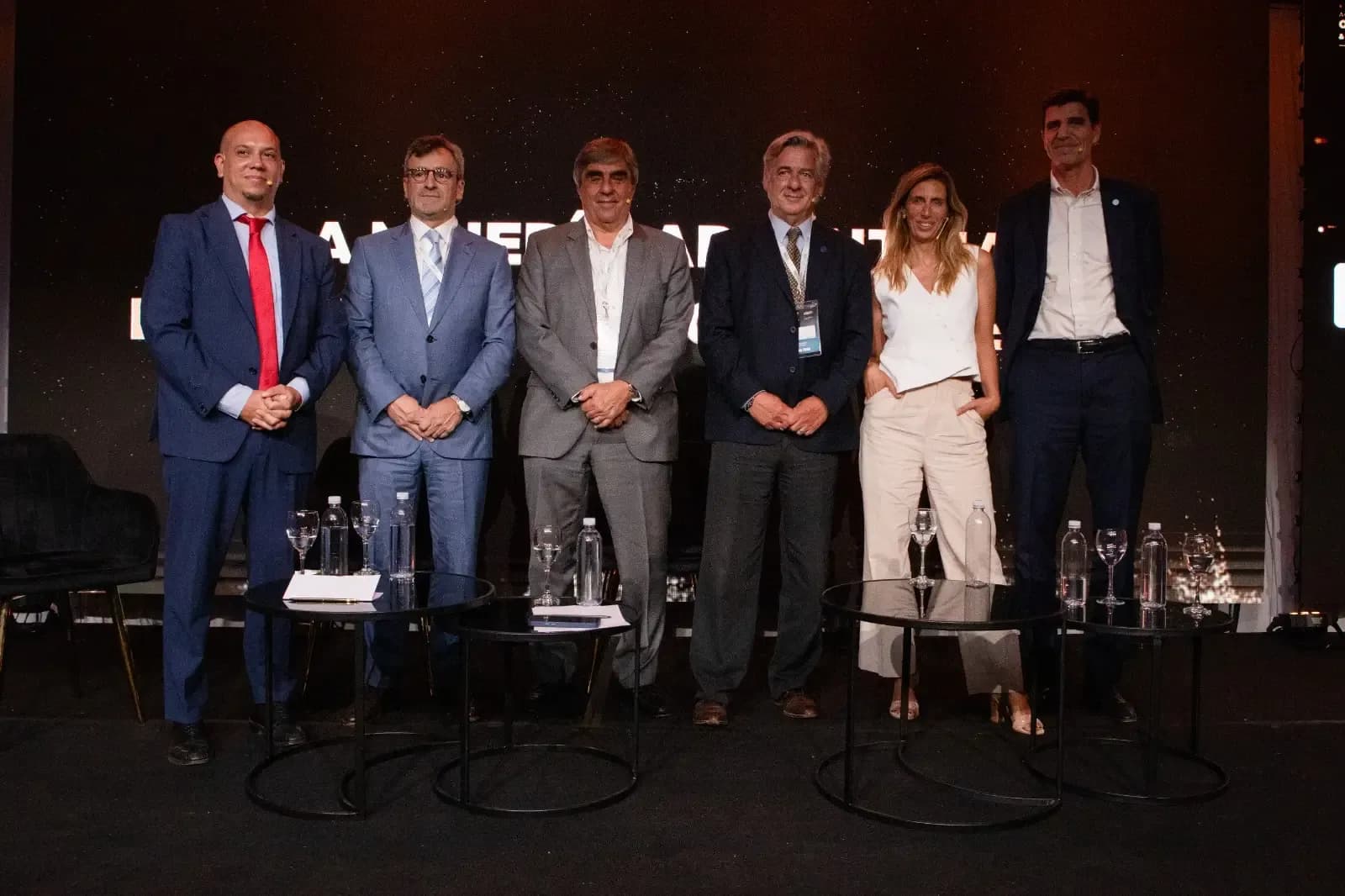
Instead of being viewed as isolated compartments or competing sectors, mining, energy, agriculture, and industry should coordinate efforts and promote joint development. This was the overarching conclusion of the discussion panel that brought together representatives from CAEM, UIA, SRA, and the company Oldelval.
Invited by PANORAMA MINERO at the 19th edition of Argentina Gold, Silver and Copper 2025, leaders from mining, energy, agriculture, and the broader industrial sector shared their main interests and the challenges they have in common, highlighting the possibility of complementing one another within a long-term agenda focused on competitiveness and productivity.
During the panel “Production: The State of Argentina’s Productive Apparatus at a Turning Point for Major Industries,” Roberto Cacciola, President of the Argentine Chamber of Mining Companies (CAEM), described 2025 as “a good year for mining.” According to Cacciola, small and medium-sized enterprises (SMEs) in the sector benefited from the elimination of export duties, three major lithium projects entered the production pipeline, and a fourth is in the process of joining. “To this we must add that three initiatives have already been approved under the Large Investment Incentive Regime (RIGI), not to mention Glencore’s announcement of the reopening of Minera Alumbrera in Catamarca,” he highlighted.
The perspective of Martín Rappallini, President of the Argentine Industrial Union (UIA), was somewhat less optimistic. He described 2026 as “a complex and transitional year,” marked by a significant disparity in performance across different sectors. “Along with the automotive segment, mining is one of the areas experiencing the most growth. We expect overall industrial activity to recover in 2026. We trust in the reforms that are underway. The industrial sector wants to be part of this new Argentina and this process of macroeconomic restructuring,” he affirmed.
From his viewpoint, industry can and must function as an integrating platform. “The more sectors develop, the more competitive the country becomes. We need a capital market that works to finance growth. Having a stable currency and legal certainty are fundamental pillars,” he noted.
Promising Figures
Nicolás Pino, President of the Argentine Rural Society (SRA), expressed his gratitude for being invited to a panel capable of bringing together such diverse sectors. “I welcome the fact that we are moving away from negative preconceptions about how our productive activities coexist. We are proving that coexistence is possible. We’ve moved from a destructive Argentina to a more constructive one. There is great expectation about the direction we are heading,” he said.
According to his estimates, the agricultural sector will close the season with a consolidated production of 140 million tons. “We contribute between US$6 and US$7 out of every US$10 that enter the country. We want to continue supporting the growth of our economy, even though we come from many years of underinvestment,” he stated.
For Ricardo Hösel, CEO of Oldelval, the year can definitively be described as “historic” for the Oil & Gas industry. “We have just broken the oil production record. In 2022 the energy balance showed a US$5 billion deficit. This year we expect to close with a surplus of between US$6 and US$7 billion,” he compared.
This shift, he explained, is almost entirely attributable to Vaca Muerta. “The development of the formation is not the result of rising international oil prices, but of investment efforts and lessons learned. The rock has enormous potential; what is needed to unlock it is more international financing at reasonable rates to execute new infrastructure works,” he argued.
A Promising Outlook
Beyond taxation, Cacciola stated that Argentina’s main competitiveness challenge lies in poor infrastructure. “The works that are needed must be built simultaneously with the mining projects that have been announced,” he warned.
Regarding the relevance of the RIGI, he said that “the main beneficiaries are the Argentine people.” “It is an instrument that was not created for investors but for citizens. It is true that mining currently enjoys 60% social approval, but if we want to maintain that support, we must work hard to create jobs. The reform of the Glacier Law, which is already under discussion, and transparency in supplier development are other sensitive points,” he stressed.
According to Rappallini, Argentine society today is demanding access to products of international quality at international prices. “That is our great challenge as industrialists. We have very strong and experienced entrepreneurs, although we are still competing with a backpack full of stones. All distortions—from union conflicts to inflationary pressures—undermine our country. Nevertheless, together we will build a strong productive ecosystem,” he emphasized.
Pino suggested highlighting the contribution of certain sectors to Argentina’s demographic redistribution. “Wherever our activities take root, population grows,” he noted.
For industries such as mining, energy, and agriculture to continue expanding, he stressed the importance of tax and labor reforms. “We need predictability and trust because everything we do is long-term,” he stated.
Hösel added that all sectors should have incentives to expand. “Everything should be RIGI. It is the only way to invest in the long term,” he concluded.
From his perspective, oil has represented a second opportunity for Vaca Muerta. “We are leveraging the know-how and talent that have been developed to support this expansion. I am very optimistic about the sector’s future. We aspire to become another agricultural sector in terms of foreign currency generation,” he projected.