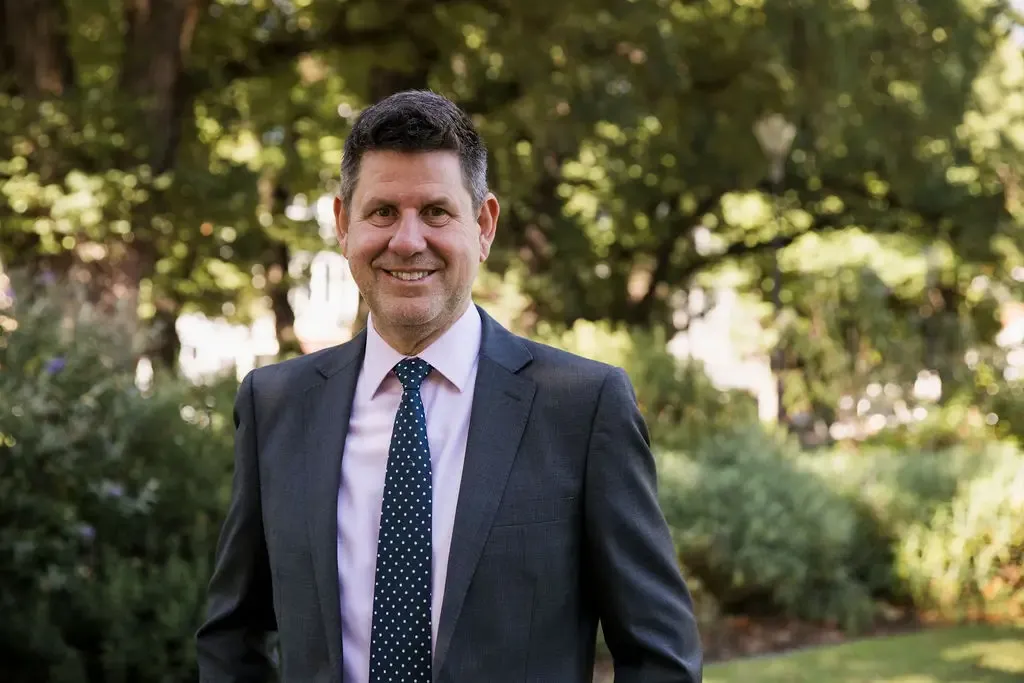
In a context characterized by the growing global demand for critical minerals, technological transformation, and the need for new professional profiles, Stephen Durkin shares his perspective on the challenges facing Australia’s mining industry, the role of world-class training, and the importance of attracting diverse and specialized talent to maintain the sector’s competitiveness.
By Panorama Minero
What are the most relevant challenges for the mining industry and professionals in Australia?
I believe the major challenge for the mining industry is the transition from a long history associated with minerals such as iron ore and coal toward a global shift to critical minerals.
Australia has an abundance of critical minerals, but the industry is undergoing a transition to access these resources that the world is seeking. And in this context, the narrative around critical minerals has recently shifted—from supporting the energy transition to also addressing the needs of global defense and security. This is playing out in a fascinating way across the entire geopolitical landscape surrounding the industry.
Professionals will need to move across different disciplines and develop new skills, ranging from artificial intelligence and ESG competencies to emotional intelligence. It will not only require technical specialists, but also experts who can help secure Australia’s position on the global stage when it comes to supplying these critical minerals.
In response to some of these changes we are observing in the industry and the different skills professionals need, AusIMM is placing greater focus on maintaining standards, providing world-class professional development, and accrediting these professionals.
For example in 2026 we will offer 20 certified online courses across 36 intakes as well as six international conferences covering different topics such as critical minerals, health and safety, mine planning, among others. We are also seeing a significant rise in participation in our online courses from the Latin American region which we view as a very interesting and growing market in terms of its support for the mining industry. This demonstrates Australia's mining, processing, and environmental, social and governance (ESG) expertise is in demand and AusIMM is taking a leading role to extend and promote this capability globally.
Are we facing a shortage of professionals considering the growing demand for minerals and metals?
Given the enormous increase in demand for minerals and metals, the answer is yes.
Australia’s mining industry and METS sector already employs 450,000 people, with an additional 800,000 indirect jobs supported by the sector. But the Australian mining sector is facing a significant labour shortage, second only to the construction sector.
There is undoubtedly a noticeable decline in young people enrolling in traditional mining programs. And the challenge is that, for the sector to continue making a decisive contribution on the global stage, we need more professionals in Australia. We must find new and creative ways to attract this talent to the industry, whether from other sectors or from overseas, including from Latin America.
There are professionals from Argentina, Brazil, Peru and Chile currently working in Australia. And this is one of the reasons why our online courses have been so popular: many people from these countries want to study in our programs so that, when they come to Australia, they are already familiar with the practices used here—engineers, geologists, researchers, geotechnical professionals, environmental scientists and metallurgy specialists.
One of our responses has been to work together with the Minerals Council of Australia, BHP, Rio Tinto and other major companies on the Minerals Industry Experience Program (MiEX), which earlier this year offered paid internships to 100 first-year STEM (*) university students – an initiative we are looking to expand in 2026.
We are also investigating the policy settings to identify how we can expand pathways into the sector, especially the most technically specialised professions. This work focuses on connecting industry, government and higher education to identify capability requirements now and into the future, and chart a pathway forward to maintain our sector’s global position.
How is AusIMM adapting to new trends such as AI?
When we speak specifically about artificial intelligence, there is no doubt that it will have an impact on our industry unlike anything we have seen before. My personal view is that the industry understands and appreciates that artificial intelligence will have an impact, but there is still a lot of work to be done to fully understand how this will unfold and how it will change the way we do things.
And it will transform the way we operate, not only from an efficiency and productivity standpoint, but also from a safety perspective, making the work we do safer.
Can you speak a bit about AusIMM’s successful International Women’s Day Event Series and its significance?
In Australia, only 22% of the workforce is represented by women. As an industry we need to embrace diversity and inclusion in all its forms to ensure that we are more representative of the communities in which we operate, but also to make sure we can attract that talent to our industry.
Our organisation has developed a series of events associated with International Women’s Day, which not only celebrate women in mining but explore the leadership and cultural settings needed to drive positive change in diversity, equity and inclusion. Earlier this year we brought together 3,500 attendees across seven gatherings in seven locations, with the goal of expanding our impact even further in 2026.
How does AusIMM work with the public, private and academic sectors to attract more professionals to the industry?
At AusIMM we carry out a wide range of activities to support the next generation of professionals. Through our AusIMM Student Chapters we work with universities and campuses to support students who are studying mining-related courses, or who are interested in coming to work in the industry.
In addition, we have established a New Professionals Network. This network is made up of people who until recently were students and are now working in the sector, so they can share their stories with students and provide career guidance and advice as they make their early decisions.
On top of that, and as I mentioned earlier, we have the new MiEX program to educate early-year students studying science, technology, engineering and mathematics about what a career in the industry looks like.
Are young people from cities such as Sydney or Melbourne showing interest in participating in mining?
One of the challenges we face in Australia is that most university students are from Sydney and Melbourne, where the country’s biggest universities are located.
Unfortunately, many of these young people do not have friends or family working in the industry. In states such as Western Australia or Queensland, many young people do have friends and family in mining—people who genuinely enjoy their work and are well paid.
Most people working in mining in Melbourne—where this interview is taking place—are involved in finance, consulting, or human resources, but not directly in the mining operations of Western Australia, where people work directly for major mining companies or global suppliers.
We need to invest time and additional effort in informing and educating young people from large cities and work to change their perceptions of the resources sector. Many young people think the industry is just about rocks and trucks, but in reality it is a highly sophisticated industry where technology, innovation and intelligence will have a massive impact going forward.
(*) Editor’s Note: STEM (Science, Technology, Engineering, Mathematics)