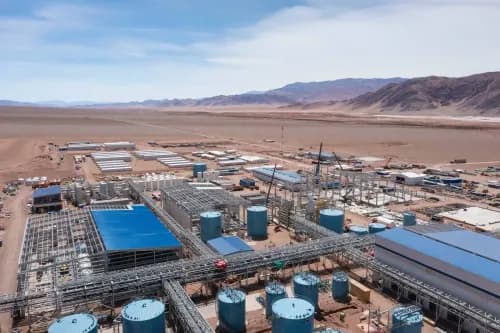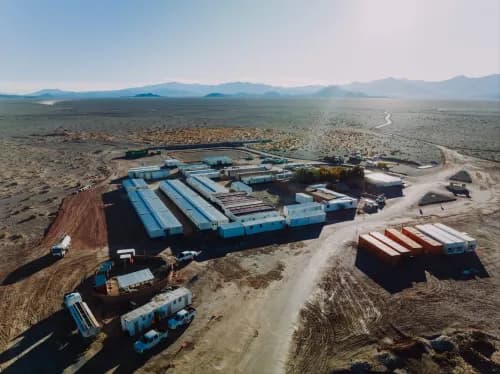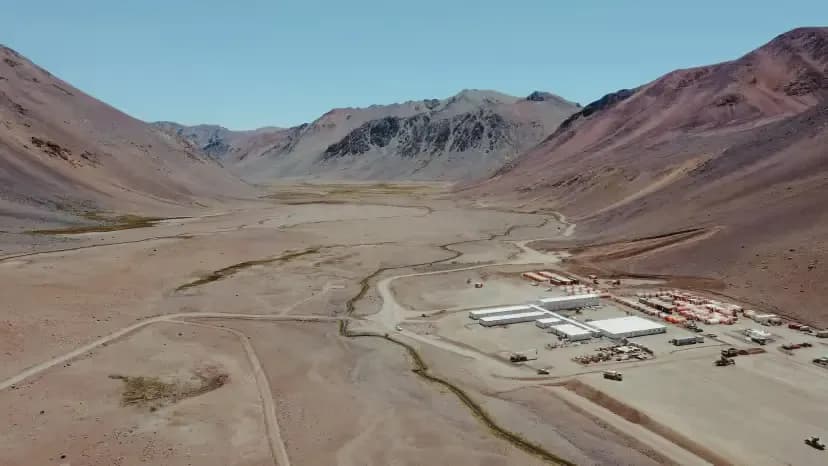
Michael Meding, General Manager of Los Azules, shared the key takeaways from 2025 and outlined the plans for 2026 for the copper project located in the Calingasta Department, San Juan Province.
By Panorama Minero
What conclusions can be drawn from Los Azules as 2025 comes to a close, and what are the outlooks for 2026?
Los Azules concludes another year with significant progress across regulatory, technical, and strategic milestones. It is worth recalling that the project closed 2024 with the Environmental Impact Assessment (EIA) approved for construction and operations, which represented a critical inflection point.
Building on this foundation, throughout 2025 the project team worked intensively on engineering activities with the objective of reaching the feasibility stage. In parallel, in February, Los Azules was submitted as one of the first projects under Argentina’s Large Investment Incentive Regime (RIGI). Following a reformulation in July, the project received approval on September 26, representing a structural milestone, as RIGI approval materially alters the project’s risk profile and overall competitiveness.
Another key focus during the year was the strengthening of international strategic partnerships. In this context, an agreement was announced with the World Bank, through the International Finance Corporation (IFC), to work in alignment with ESG standards. The objective is to position the IFC as a potential future financing anchor, both on the equity side and through project finance debt structures.
At the same time, early works related to engineering and infrastructure have commenced. The objective is to reach an engineering level that enables a formal construction decision by the end of 2026. In parallel, early-stage works are planned, including the final access road capable of transporting large and heavy equipment by late 2026 and early 2027, as well as power transmission infrastructure and the final construction camp within the same timeframe.
This schedule is naturally contingent upon securing the project’s financing structure. The global and regional context is favorable: long-term structural copper demand, Argentina’s geopolitical positioning, and, in particular, the profile of San Juan province support a positive outlook. At this stage, the challenge is not the lack of financing alternatives, but rather optimizing the selection of funding sources, aligning the interests of shareholders and local stakeholders.
How can a project like Los Azules attract capital in a highly competitive global environment?
It is important to note that, at the international level, the share of capital allocated to mining relative to total global equity market investment is at historical lows over the past 50 years. This is partly driven by a growing preference for sectors such as technology, which are perceived as more attractive by the market.
However, there is a structural contradiction: there is no technological or digital transition without minerals. The mining sector must continue to strengthen its positioning and clearly communicate its critical role relative to technology-driven industries, represented by companies such as Microsoft, Apple, and Nvidia.
In parallel, it is essential to continue consolidating the perception of Argentina as an investable country. In recent years, meaningful progress has been made, including successful bond issuances, announced investments, and projects now moving into execution. This is complemented by San Juan’s long-standing positioning as a competitive mining jurisdiction at the Latin American level, supported by a favorable institutional and social framework.
The challenge lies in effectively communicating these advantages and demonstrating that both the province and the country can compete for global capital against traditional mining destinations such as Chile, Canada, and Australia, which also offer strong mining investment incentive programs.
Is there an opportunity for small local investors, without direct ties to the industry, to invest in mining?
This is a highly relevant question. We are currently evaluating the listing of the McEwen Copper group, which includes the Los Azules project, on the Toronto Stock Exchange, while at the same time holding discussions with the Buenos Aires Stock Exchange regarding a potential dual listing. The objective is to enable participation by Argentine investors interested in the mining sector.
Today, it is already possible to invest in mining companies through the local capital markets. However, it is important to recognize that Argentina’s capital market operates at a much smaller scale compared to markets such as New York, Toronto, or Australia. Mining projects are capital-intensive by nature and therefore require international financing.
Looking ahead, it would be desirable for Argentina’s capital markets to continue evolving toward greater depth, capable of supporting large-scale projects, as has occurred in other sectors, such as technology, where companies have successfully raised both domestic and international capital, including cases like Mercado Libre.
Do the previously announced construction and production timelines remain in place?
The objective remains to initiate large-scale construction activities during 2027. It is important to clarify that, from an operational standpoint, the year has two clearly differentiated periods: the beginning and the end of the year allow for more intensive work, particularly in mountainous regions, where weather seasonality is a determining factor.
In this context, 2027 would mark the effective start of large-scale works, beyond early-stage activities. Infrastructure development alone will require the mobilization of more than 500 workers, underscoring the operational scale of the project at that stage.