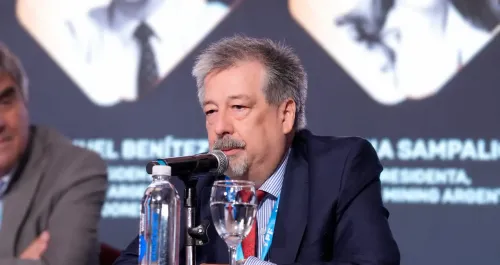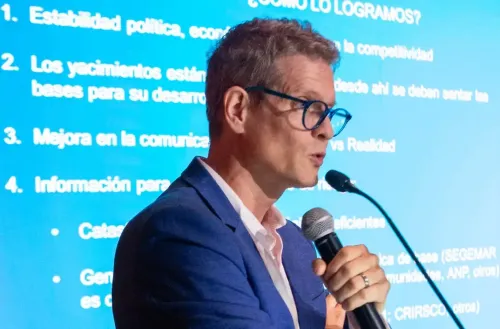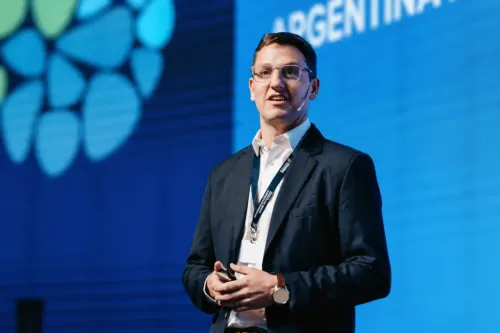
The announcement of the reactivation of Bajo la Alumbrera, the Catamarca deposit responsible for positioning Argentina on the global copper map, marked the beginning of the exchange of ideas in the panel “From the First Cycle to the Next Decade: Decisions for a Step-Change,” continuing the first day of the 19th edition of Argentina Gold, Silver and Copper 2025.
Asked about the news, geologist Patricio Jones, a long-standing reference in the sector’s development in Argentina and current director of Pistos Tierras Raras (Brazil), recalled that the country’s first virtuous mining cycle began in 1993 with an act of legal certainty: the enactment of the Mining Investment Law, which guarantees 30 years of fiscal stability. “Curiously, that cycle ended with an act of legal uncertainty, which was the implementation of export duties in 2007,” he stated.
In his view, current times are encouraging, especially due to growing acceptance among the population. “However, social license is not eternal: it must be maintained through daily work,” he warned.
According to him, exploration creates value. “Argentina, despite all the mining forums held over the years, has still not realized that it is sitting on one of the world’s largest copper deposits. I am referring to a copper district that extends for 40 kilometers from Vicuña to Filo del Sol. What it can offer the country is immeasurable. We must put all our energy into its development,” he said.
Favorable outlook
Along the same lines, Julián Rooney, a member of the executive team responsible for the start-up of Bajo la Alumbrera, stated that the country’s main challenges lie in developing new suppliers and training human resources in collaboration with high schools and universities.
“We must consider that the legal framework requires political support, which in turn depends largely on social license. On the other hand, mining provinces need support from regions such as Córdoba or Santa Fe, which have a strong industrial fabric and can therefore supply goods and services,” he noted. Rooney also emphasized the importance of sustaining over time the Large Investment Incentive Regime (RIGI).
In his opinion, it has always been difficult to organize a centralized communication plan for the entire local mining industry. “Episodes like Esquel reflected strong social resistance. Fortunately, in this new wave of mining activity, there is a new perspective from both the government and the public,” he said.
State policy
According to Sonia Delgado, Executive Director of Challenger Gold, the company in charge of the Hualilán mine, Argentine mining is clearly living a different stage than previous ones. “The debate is no longer ‘mining yes or no,’ but rather how we can carry out the activity. Today, communities themselves are calling for mining development,” she affirmed.
Even so, she acknowledged that legal certainty remains an ongoing challenge. “A great deal of work is needed to generate the economic, financial, social, and political conditions necessary for projects to move forward,” she argued.
She added that installing mining development as state policy will be crucial. “That will allow us to sustain production and investment levels regardless of political changes in the country’s leadership,” she projected.
Regarding Hualilán, she recalled that drilling began in 2019. “Last year we obtained approval of our Environmental Impact Statement (DIA). We have just completed the first production blast. We are not a project—we are a reality,” she stated.
Unique opportunity
As explained by Michael Meding, VP of McEwen Copper & General Manager of the Los Azules project, it has always been said that Argentina is the country of the future, but the future never arrived. “What I see now, however, is a unique opportunity based on lessons learned from past mistakes. The attitude of international investors has changed: Argentina is now seen as an attractive destination for the development of major projects,” he emphasized.
From his perspective, better use of water resources is essential. “If the Glacier Law is not reformed, many projects will not be able to move forward. Let’s not forget that mining is the only industry with its own Environmental Law,” he noted.
Regarding Córdoba, he argued that the province has an important role to play in this new productive wave. “It is a province that believes in development. As the governor of Córdoba, Martín Llaryora, said, mining is the engine of the Argentine airplane that has yet to be started,” he said metaphorically.
Communication builds trust, he added, and trust is what is needed to move forward. “In our case, at Los Azules, we have obtained the required environmental permits, we secured approval under the RIGI, published our feasibility results in October, and are now working on detailed engineering. The plan is to begin construction in 2027 and start production in 2030.”
A clear path forward
According to Javier Robeto, VP of Aldebaran Resources & Country Manager for the Altar project, it is encouraging to see so many new players interested in contributing to the sector’s growth.
“It will be vital to intensify collaborative work, as well as to plan and build new infrastructure. We are fortunate to participate in this wave of mining development because we can take advantage of the lessons learned and the existing supplier ecosystem. We see favorable signals in terms of international support and political license,” he commented.
The current moment, he explained, is ideal. “We are in the right place at the right time. Lithium gave us strong momentum. With the exploitation of that mineral in the north of the country, Argentines began to see mining as a source of work and progress. The new stage will be driven by copper, which is here to stay. There is a high level of maturity among local companies, and the world is pushing us to produce. The path is cleared for making the right decisions,” he said.
Regarding Altar, he detailed that they already have the Preliminary Economic Assessment and are moving toward the Feasibility Study stage. “There isn’t much fieldwork left; we are finishing the last meters of drilling. We expect to update resources by mid-next year and aim to announce the Feasibility Study by the end of 2026. We also plan to join the RIGI,” he concluded.