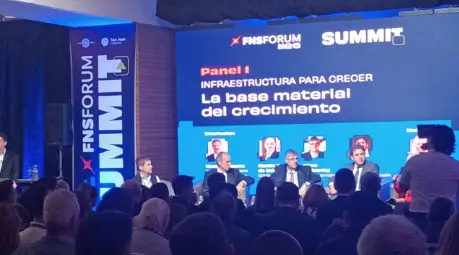
The Summit Forum 2026, held as part of the National Sun Festival, brought together representatives from Barrick, Glencore, ECIPSA and the provincial government to discuss infrastructure, water, energy and logistics as pillars of San Juan’s economic development.
The speakers agreed on the need to plan development beyond mining, coordinating public and private investment to strengthen agribusiness, energy and the knowledge economy.
By Panorama Minero
At the National Sun Festival’s Summit Forum 2026 in San Juan, a panel discussion examined mining activity in relation to other economic sectors. The panel comprised Marcelo Álvarez of Barrick, Vice-President of the Mining Chamber of San Juan; Martín Pérez de Solay, CEO of Glencore Argentina; Jaime Garbarsky, head of ECIPSA; and Gustavo Fernández, San Juan’s Minister of Production. The discussion centred on the theme “Infrastructure for Growth: The Material Foundation of Development”.
Moderated by Federica Mariconda of Grupo Andesmar, the discussion took place at the Del Bono Park Hotel and brought together leading representatives of San Juan’s business and economic sectors. Attendees included agricultural and industrial producers, mining companies, suppliers and representatives of multinational operators.
Marcelo Álvarez of Barrick emphasised that San Juan’s development priorities must focus on diversifying its productive economy. In this context, the executive outlined some of the economic contributions made by the Veladero mine throughout its operating life.
Among Barrick’s contributions, he mentioned support for the construction of the 500 kW power transmission line from Mendoza to San Juan, as well as the San Juan–Rodeo connection.
Álvarez stated that Veladero has contributed US$13.6 billion to the province and the nation throughout its operating life.
He also reported that Veladero currently works with 343 suppliers, receiving approximately US$600 million annually. The operation employs 2,450 workers, 92% of whom are from San Juan, with annual payments to employees totalling US$250 million.
Regarding contributions through the trust funds, amounting to approximately US$20 million annually, Álvarez indicated that the trust fund has reached 90% implementation, with ten projects under construction and another 30 already approved.
Among the projects being implemented through the trust fund, the executive highlighted the construction of the Hybrid Solar Park in the Iglesia department. This facility will provide greater energy supply certainty for the department, creating conditions for companies from different sectors to establish operations in the area.
Álvarez also announced that construction of another hybrid solar park will begin shortly in the Jáchal department, with the same objective of strengthening energy supply reliability in northern San Juan. It will be the second facility developed using this approach.
Martín Pérez de Solay, CEO of Glencore Argentina, described the El Pachón project as the centrepiece of the company’s investments in Argentina.
Expanding on his assessment, he explained that the world is moving towards greater electrification as part of the energy transition.
When discussing the main bottlenecks affecting the project, the executive identified three critical areas: water, power and logistics.
Pérez de Solay highlighted water as a particularly important resource. Although hydrological conditions have been different this year, he acknowledged the variability of Andean rivers.
Nevertheless, he stressed that mining does not seek to compete with other sectors for water resources.
The executive noted that the industry faces infrastructure challenges and argued that mining operators should work together to address them. In this regard, he suggested that companies should share their challenges to facilitate joint decision-making.
He also estimated that, once the major copper projects begin operating in the coming years, their combined electricity requirements will be comparable to the output of a large nuclear power station, illustrating the scale of future energy demand.
Jaime Garbarsky, property developer and head of Grupo ECIPSA, reflected on the changes he observed upon returning to San Juan after leaving the province more than 30 years ago in search of better professional opportunities.
He explained that, before the arrival of large-scale metallic mining, San Juan’s economy was largely driven by two factors: public-sector salaries and the economic activity generated by the wine industry.
Garbarsky observed that the province now has political leaders who are consistently focused on its long-term development. He noted that some politicians in San Juan concentrate their discussions not on politics itself, but on the province’s future.
For Garbarsky, planning San Juan’s future should not be limited to the arrival and development of mining projects. Instead, the province must consider its economic prospects beyond the mining industry.
He therefore called for mining companies, government authorities and business leaders to work together in shaping that future.
Gustavo Fernández, San Juan’s Minister of Production, Labour and Innovation, reviewed the measures implemented by the provincial government during its current administration, particularly those aimed at mining development and the strategic importance of copper.
The minister explained that Governor Marcelo Orrego’s administration has devoted a significant part of its term to building confidence.
The government’s economic strategy is based on the development of mining, energy and agribusiness, together with the knowledge economy.
Fernández acknowledged the need to advance infrastructure development and stressed that restoring confidence is essential to encouraging private-sector contributions and investment in economic growth.
In this context, he highlighted the agreement with Vicuña Corp. and the US$250 million advance payment, together with the issuance of a US$600 million bond and financing from international banks.
According to the minister, these mechanisms will provide more than US$1 billion for infrastructure development as part of the province’s long-term planning.
Among the major infrastructure initiatives announced in recent days, Fernández mentioned improvements along the entire length of National Route 40.
He also identified the San Juan–Caucete motorway as another important project.
In addition, he highlighted plans to restore railway services as an essential and cost-effective means of transport to support the province’s future development