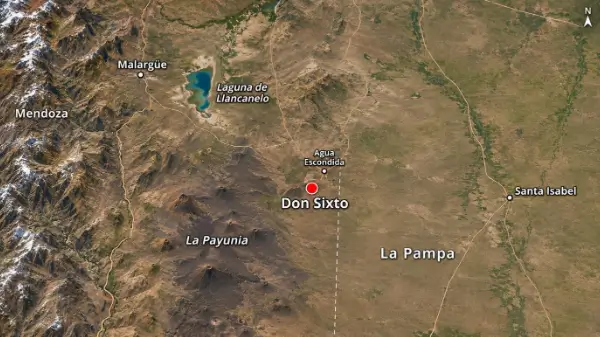
Patagonia Gold Corp., through its subsidiary Patagonia Gold Six Inc., has signed a definitive agreement with subsidiaries of Pan American Silver to acquire 100% of the shares in Cognito Limited. The company owns the Don Sixto gold and silver project, formerly known as La Cabeza, in the Agua Escondida district of Malargüe Department, approximately 350 km by road south of the city of Mendoza. The transaction also includes the surface land.
By Panorama Minero
The total consideration amounts to US$14.5 million in cash, payable in three instalments, plus a 2.25% net smelter return (NSR) royalty on future production.
The payment structure reflects the asset's regulatory situation. An initial payment of US$2 million is due at closing. A deferred payment of US$5 million is conditional on obtaining permits, with a maximum period of four years from closing. The remaining US$7.5 million is payable within six months of the commencement of commercial production. Consequently, more than half of the purchase price depends on the project reaching production.
The acquisition remains subject to the conditions set out in the definitive agreement. Patagonia Gold has described Don Sixto as a complement to its portfolio and an asset where it can apply the experience gained at Calcatreu, its principal project in Río Negro Province.
A Deposit with 545 Drill Holes
Don Sixto was discovered in 1996 and was acquired by Exeter Resource Corporation in 2003. It is a low-sulphidation epithermal gold and silver deposit comprising six zones: Cuello, Ojo, Luna, Mandíbula, CVS and Cachete.
The most recent resource estimate was prepared for Exeter in 2007, based on more than 59,000 metres of drilling across 545 holes. It identified 924,000 ounces of gold in measured and indicated resources, contained within 20.46 million tonnes at an average grade of 1.40 g/t gold, and 334,000 ounces in inferred resources, contained within 9.29 million tonnes at 1.12 g/t gold.
Patagonia Gold presents these figures as a historical estimate that has not been verified or classified as a current mineral resource.
The Framework Established by Law 7,722
Exploration ceased in 2007 following the enactment of Provincial Law 7,722, which prohibits the use of cyanide, mercury, sulphuric acid and other similar substances in mining processes and requires legislative ratification of every Environmental Impact Declaration (DIA) for metallic mineral mining.
In December 2019, an amendment to the legislation brought the project back onto the agenda, but the amendment was repealed a few days later. The deposit has remained inactive since then.
Mendoza Governor Alfredo Cornejo highlighted Patagonia Gold's involvement in what he described as “one of the most emblematic gold and silver projects in our province”.
He noted that the company is Argentine-owned, “fully understands Mendoza's stringent environmental legislation and is committed to studying technical alternatives that would allow the project to be developed within that legal framework”.
The change of ownership does not authorise mining activity. To resume work at the site, the company must submit an Environmental Impact Report to the Mining Environmental Authority.
The report must undergo an interdisciplinary assessment involving the General Irrigation Department and municipal authorities. This is followed by the Environmental Impact Declaration and its legislative ratification, as required under Law 7,722.
Patagonia Gold and Pan American's Assets
This is not the first time Patagonia Gold has acquired an asset from Pan American Silver in Argentina.
In 2018, it acquired Calcatreu for a total consideration of US$15 million. In 2024, it regained ownership of the COSE property in Santa Cruz, which had been held by Pan American. Don Sixto represents the third transaction between the two companies in Argentina.
The company has also previously used payment structures linked to regulatory changes. When expanding its portfolio around Mina Ángela in Chubut, it agreed to an initial payment of US$100,000 and a subsequent payment of US$300,000, conditional on authorisation for metallic mineral mining in the area.
A Historic Asset in an Evolving Portfolio
After almost two decades of inactivity, Don Sixto once again has an operator interested in advancing its development.
Unlike copper projects progressing in Mendoza under an authorised exploration framework, Don Sixto's payment structure and the company's commitment are focused on identifying a technically viable development alternative within the existing regulatory framework.