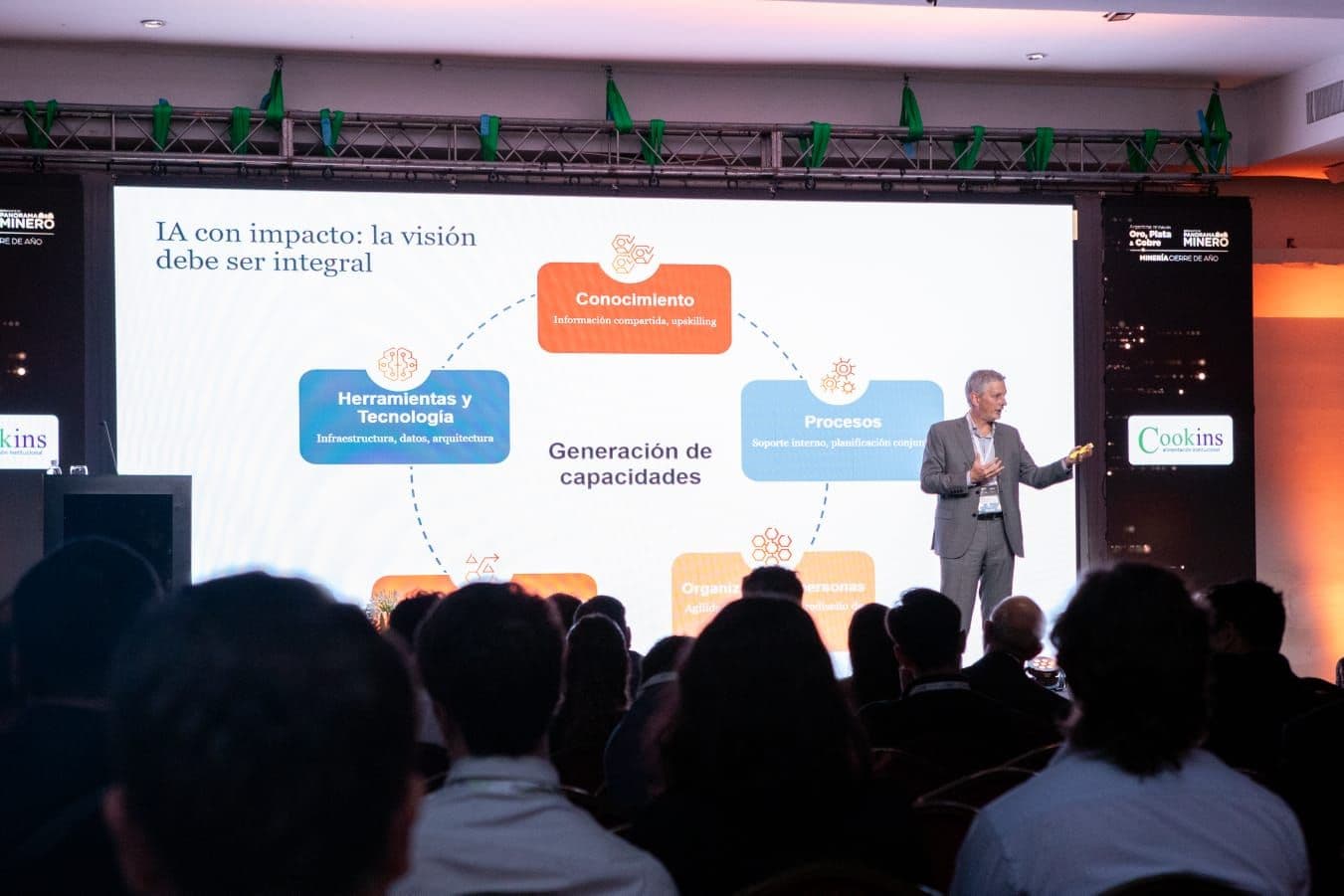
Within the framework of Argentina Oro, Plata y Cobre 2025, Roberto Cruz — Partner responsible for AI and Digital Innovation at PwC Argentina — presented the key insights needed to understand what works and what does not in more than seventy Artificial Intelligence projects applied across various industries, and how those lessons can transform the mining sector.
By Panorama Minero
In a panel marked by technological urgency, Cruz argued that after a decade leading more than seventy Artificial Intelligence projects, one conclusion repeats across all industries: the technology is ready, but organizations are not yet prepared to adopt it fully.
“AI has advanced so quickly that it is we, as organizations, who are being slow to adapt,” he noted. For Cruz, the challenge is no longer technical: the issue is cultural, organizational, and strategic.
PwC Argentina, he recalled, has nearly six thousand people working in professional services, but the focus is not only on implementing solutions; it is on supporting teams so they can change the way they work. “AI enables us to change processes, to perform tasks in a different way. We can keep doing them as we always have, yes, but that would mean squeezing out only a fraction of its potential,” he said.
Cruz reviewed the evolution of AI: from its historical foundations seventy years ago to the emergence of generative intelligence in November 2022, with technologies like ChatGPT. That shift gave rise to the concept of agents — systems capable not only of interpreting natural language but also of executing concrete tasks.
“Today, an agent can process an invoice, handle a shipment, or integrate into a system and take action,” he explained. What is new is not only autonomy, but also the ability to orchestrate multiple agents to transform entire processes: the so-called agentic workflows, “the latest trend,” but above all, a tool with real impact.
These workflows make it possible to review sequential tasks — often distributed across different areas — and decide whether it is better to automate them step by step or rethink the entire process. “The invitation is to break the paradigms of how we do things. AI lets us optimize, but also do new things we simply could not do before,” he stressed.
Efficiency, quality, and new business opportunities
During the panel, Cruz presented examples of projects with measurable results: shorter processing times, fewer hours of manual work, higher quality, fewer errors, and even revenue increases.
The latter is explained by AI’s ability to detect patterns, simulate scenarios, understand trends, and enable dynamic pricing. “AI can project demand with different probability levels and help us make profitable decisions based on simulations,” he elaborated.
According to PwC, there is no area today where improvement opportunities cannot be found: from customer service and human resources to exploration, mining operations, back office, and audits. Even compliance control — historically ex post — can become real time thanks to specialized agents.
The speaker summarized a decade of learning with a central idea: AI projects fail when they are treated as mere technology implementations. Technology can do its part; what is missing is transforming the company around it.
Cruz put it this way: “If we want to change the way we generate results, it is naïve to think that results will change just by adding technology. We need to rethink processes, teams, skills, and internal rules.”
One of the most practical contributions of the panel was to dismantle the anxiety around “where to start.” The path, Cruz said, begins with strategic vision: identifying which topics are priorities for the company (efficiency, environment, safety, profitability) and rereading its processes and metrics from that perspective.
That initial exercise — which PwC often conducts in discovery workshops — always produces concrete outcomes. “Historically, the range is between six and nineteen opportunities per company. In every case, we find at least six,” he stated.
From there, a roadmap of transformation cases is built, and the organization moves on to the “doing” phase — understood not as installing technology, but as developing capability: redesigning processes, training people, incorporating “trust by design” practices, and ensuring that teams understand their role in AI.
An urgent agenda for Argentine mining
In his closing remarks, Cruz left both a warning and an opportunity.
The warning: if AI is not integrated with processes and people, it does not generate results.
The opportunity: every company has more transformation potential than it believes.
“What matters is deciding what is a priority and starting there. AI is a catalyst, but capability is built by the organization,” he summarized.
In a sector like mining — where efficiency, traceability, environmental compliance, and long-term planning are critical conditions — PwC’s presentation left a clear message: AI is not the future; it is the infrastructure that will define how companies operate in the immediate present.