Cormine prepares for a structural transformation as the province promotes regulatory tools aimed at organizing and modernizing mining activity.
By Panorama Minero
The province of Neuquén is moving forward with a process to reorganize its mining policy, centered on the transformation of the Neuquén Mining Corporation (Cormine) and the updating of the regulatory framework governing the activity. The plan includes three core instruments: the corporate conversion of the state-owned company, the submission of a new Mining Procedure Code, and the development of a Mining Royalties Regime, with the aim of providing the sector with clearer rules aligned with the scale of current challenges.
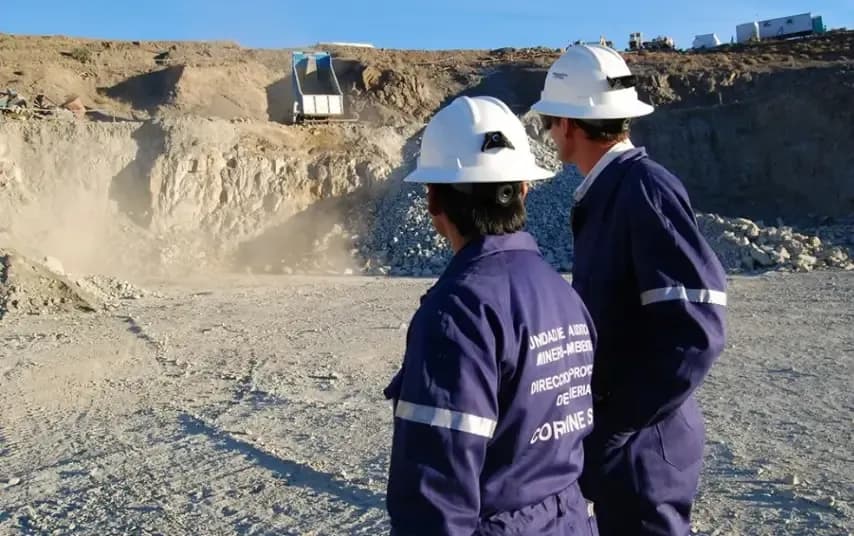
Cormine was created in 1975 as a Provincial State-Owned Company (Sociedad del Estado Provincial, SEP) and, under this structure, manages strategic mining assets in Neuquén. These include the Andacollo mine, one of the province’s most significant projects, as well as a set of mining concessions and properties that form part of the state’s assets. At this stage, the company seeks to redefine its legal structure in order to operate with greater flexibility, facilitate partnerships with private capital, and improve its management and financing capacity.
The conversion of Cormine from an SEP to a corporation (sociedad anónima) appears as one of the structural decisions of the plan. From a technical and institutional standpoint, the change would allow the company to have more agile tools to enter into contracts, structure public–private partnerships, attract investments, and actively participate in exploration and development projects. The objective is for the state-owned mining company to move beyond an exclusively administrative role and position itself as an operational actor within the province’s productive strategy.
In parallel, the plan includes the drafting and submission to the Legislature of a local Mining Procedure Code, a key tool to organize the administrative, environmental, and technical processes linked to the activity. The initiative seeks to update regulations that, in many cases, have become outdated given the complexity that mining projects now present, both in terms of environmental assessment and control and monitoring.
Another pillar of the framework is the definition of a Mining Royalties Regime, aimed at establishing clear and predictable criteria for the capture of mining rents by the provincial state.
During 2025, Cormine made progress in organizing its administrative and financial situation, a preliminary step considered indispensable to undertake transformations of greater scope.
Among the projects on the agenda, progress stands out in the design of the terms and conditions for the future public—national and international—tender of Andacollo, an asset that the provincial state seeks to reactivate under a competitive and transparent scheme. At the same time, other strategic mining concessions are being analyzed, and studies related to resources such as geothermal energy, lithium, uranium, and rare earths are being promoted, with the aim of diversifying Neuquén’s mining matrix.
The defined roadmap projects these changes toward 2026, the year in which the corporate transformation is expected to be completed, the new regulatory framework advanced, and an expanded portfolio of mining assets under state management consolidated.
A framework that aligns with Mendoza’s recent experience
Beyond the Neuquén case, the process Cormine is undergoing shows a clear convergence with the institutional path Mendoza has begun to follow in recent years. In both cases, the redefinition of the role of the state is associated with a corporate structure and legal considerations.
In Mendoza, the creation and consolidation of Impulsa Mendoza Sostenible S.A. as a corporation marked a similar turning point to the one Neuquén now seeks with Cormine. The decision to operate under a flexible corporate structure, rather than a traditional administrative body, allows the province to intervene, organize strategic projects, and act as a link between the state and the private sector, especially in initiatives such as the Malargüe Western Mining District.
There is also a parallel in the regulatory discussion. Just as Neuquén is moving forward with its own Mining Procedure Code, Mendoza has had to review and adapt its institutional framework in a context marked by particular regulatory restrictions. In both cases, the focus is on providing the activity with predictable procedures capable of sustaining long-term processes.
The issue of royalties completes the triangle of similarities. Both Neuquén and Mendoza face the challenge of defining rent-capture schemes that are fiscally efficient without discouraging investment. In this sense, the development of a Mining Royalties Regime in Neuquén aligns with the debates Mendoza has been holding on how to balance public revenues, state control, and the economic viability of projects.
Taken together, what emerges is a common pattern among provinces seeking to reposition mining within their productive matrix: state-owned companies with modern corporate structures, updated procedural frameworks, and explicit fiscal rules. In this context, the Cormine case does not appear as an exception, but rather as part of a broader trend of institutional reconfiguration, in which the state moves away from a merely declarative role and rebuilds concrete capacities to govern mining development.