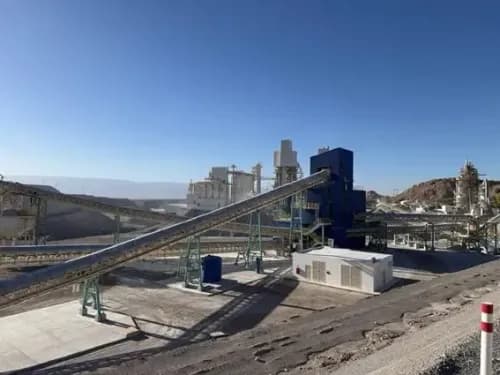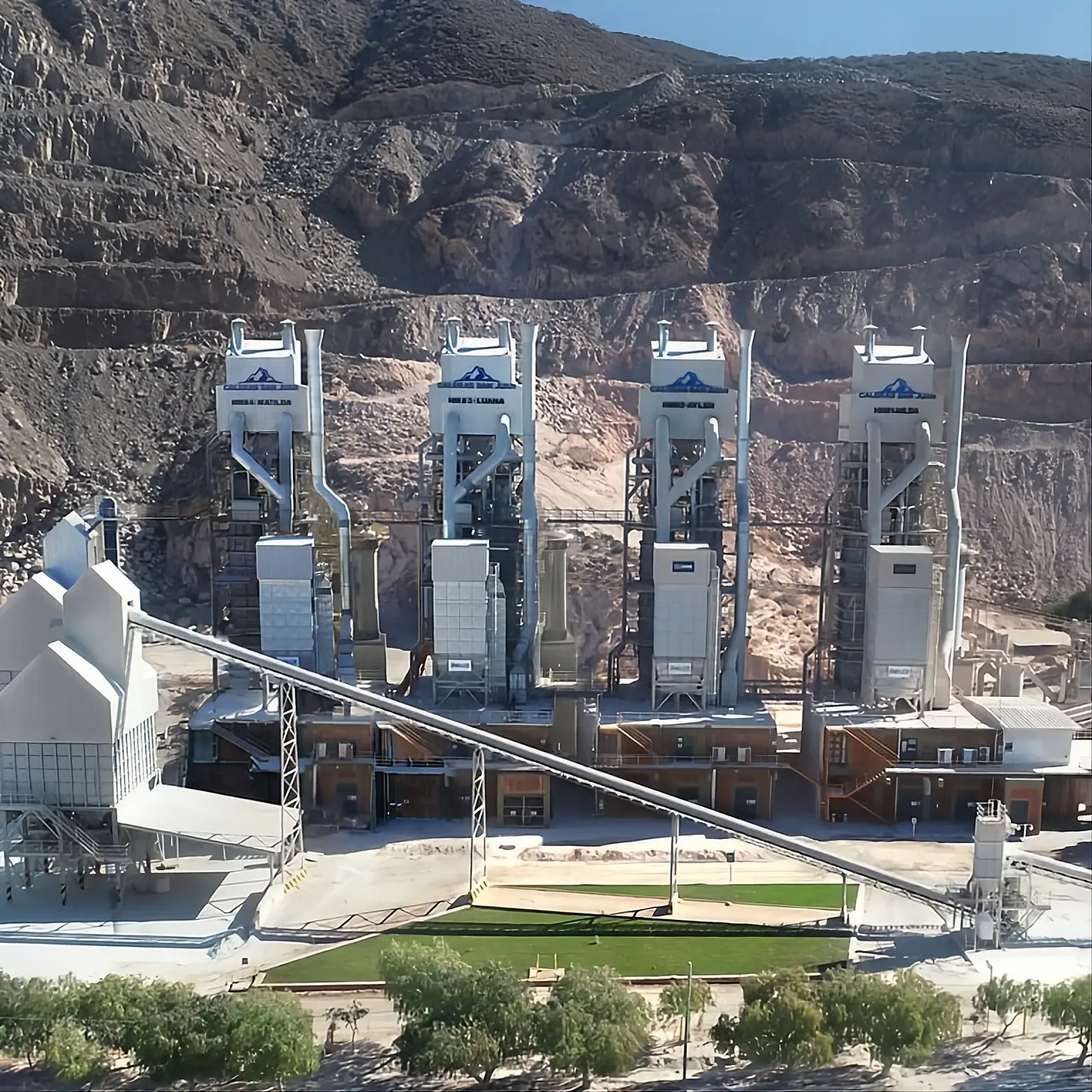
Caleras San Juan inaugurated Matilda, its fourth Swiss-technology MAERZ kiln, at its Cienaguita plant, completing the investment programme carried out between 2016 and 2026. With this addition, the company has a lime production capacity exceeding 600,000 tonnes per year, amid expectations of increased demand associated with the development of copper mining projects.
By Panorama Minero
The ceremony was attended by provincial authorities and representatives of Carmeuse, the Belgian company that acquired an 80% stake in the Caleras San Juan group, while the remaining 20% remains in the hands of local shareholders.
Carmeuse was represented by Jeff Bitiner, CEO for Latin America, and Rainer Regenber, Director of Business, Development and Planning. Representing Caleras San Juan were General Manager Raúl Cabanay; Operations Manager Germán Cabanay; Engineering Manager Caupolicán González; and Innovation and Development Manager Augusto Durante.
Four Kilns Added Between 2018 and 2026
During his address, Raúl Cabanay reviewed the investment programme that enabled Caleras San Juan to expand its industrial capacity through the installation of four 44-metre-high MAERZ kilns, characterised by their thermal efficiency.
The first, named Nilda, began operating in 2018. It was followed by Aylen in 2021 and Luana in 2024. The inauguration of Matilda in 2026 completes this phase of production expansion.
Cabanay explained that financing for the programme involved banks, customers and the provincial government, as well as negotiations with the Swiss company MAERZ to secure international financing for imported components.
According to Cabanay, approximately 65% of the investment corresponded to locally sourced components and work.
The executive also outlined various environmental initiatives implemented at the facilities, including the planting of 1,300 trees comprising native species and other varieties, as well as the incorporation of a photovoltaic plant designed to supply the company's production activities, with a reported capacity of 7 MWh.
Carmeuse and Regional Market Prospects
Carmeuse's entry as the majority shareholder represents another recent change in Caleras San Juan's ownership structure.
According to information presented during the ceremony, the Belgian group operates in 13 countries across four continents, produces more than 12 million tonnes of lime annually and employs over 6,500 people.
The company, which has a 166-year history, already had a presence in Argentina through CBB in Jáchal.
The Caleras San Juan group also operates in northern Argentina through Los Tilianes in Jujuy, and in Chile through Caleras San Juan Chile.
During his presentation, Cabanay discussed prospects for growth in lime demand associated with the development of copper mining in Argentina, Chile and Peru.
In this context, he indicated that the company would continue evaluating investments to expand its production capacity, both in San Juan and at its facilities in northern Argentina.
Call for Route 153 and Road Infrastructure Development
One of the main issues raised by Cabanay during the inauguration concerned the need to expand transport infrastructure to support industrial and mining development.
The General Manager of Caleras San Juan called on provincial authorities to consider developing Route 153, given its impact on logistics costs and San Juan's connections with other transport corridors.
"In this regard, Route 153 is of vital importance because of its impact on logistics costs and final prices in competitive markets," he stated.
He explained that the route would provide a direct connection to the Uspallata Valley, avoiding the need to pass through the city of Mendoza and reducing traffic on National Route 40.
He also mentioned its potential benefits for San Juan's exports, the transport of products from northwestern Argentina and Brazil, and tourism and academic activities associated with the National University of San Juan.
"I would like to take advantage of the authorities' presence to once again strongly urge them to consider this road so that our foreign trade can grow and become stronger," he said.
Cabanay also referred to the La Chapetona initiative, which, according to him, would shorten the journey to major copper mining projects in northern Chile by more than 330 kilometres.
Need to Expand the Gas Pipeline Network
Another issue highlighted by the executive was the availability of energy infrastructure to support future expansion of the lime industry.
Cabanay indicated that the company's technical team is evaluating alternatives for installing additional kilns to meet projected demand, both in San Juan and at Los Tilianes in Jujuy.
In this context, he warned about the limitations of existing gas pipeline infrastructure.
"Gas pipeline infrastructure is at its limit, and expanding it is essential to move forward with the new master plan," he stated.
He also maintained that gas suppliers must guarantee the supply required to support the planned industrial investments.
Finally, the General Manager said that Caleras San Juan's strategy includes continuing to expand its production capacity to meet the future requirements of Argentina's mining industry.
"Our role is to ensure that when the country's large-scale mining industry requires our products, local industry is prepared to supply them," he concluded.