Following the commissioning of its fourth MAERZ kiln and the completion of its Master Plan, the company is planning a new phase of investments aimed at meeting the growing demand for lime associated with the development of the mining industry.
By Panorama Minero
With the inauguration of the fourth MAERZ kiln, how would you summarize the journey since the beginning of the Master Plan?
With ups and downs. This plan was carried out over a ten-year period, from 2016 to 2026, and went through very difficult economic conditions, with a disordered macro economy, foreign exchange restrictions and high inflation. This lethal combination hit companies and their investments very hard. Then came the pandemic, which affected production, transportation and exports. However, Caleras San Juan never gave up and managed to commission the first kiln in 2018, followed by the other three in 2021, 2024 and 2026, respectively. It was undoubtedly a very consistent plan in which the main shareholders of Caleras San Juan agreed not to distribute profits and instead concentrate all resources on investment to achieve sustained growth.
What were the main challenges you faced during this process, particularly in terms of financing and execution?
There were many and varied challenges. The most complex was financing the first kiln. We needed significant support and went looking for it. Despite Argentina's weakened country risk at the time, together with our main supplier we were able, in 2016, to obtain international financing with a ten-year term, interest rates below 2% per year and a two-year grace period. This loan represented approximately 35% of the total investment. For the local works, we received strong support from our banks and our customers.
These financial institutions played a central role in making the company's Master Plan a reality, and we have responded by meeting all of our commitments on time and, step by step, building reputation and credibility.
What is Caleras San Juan's current installed capacity with its four kilns in operation?
Our production capacity is 600,000 tonnes per year. This allows us to meet a lime demand that will grow exponentially in Argentina, where the new large-scale copper projects will require more than one million additional tonnes of lime over the next 20 years. As you know, lime production in San Juan is approximately 1.2 million tonnes, but with the new investments planned by lime producers, production capacity is expected to reach 2.2 million tonnes per year in the coming years.
I would also add that additional demand for lime will come from Chile, a market that requires our products and is seeking to expand in response to demand generated by the energy transition, electro mobility, data centers and artificial intelligence.
Given the evolution of demand, is the company considering future expansions or the addition of new kilns?
We are closely monitoring market developments. A team of professionals at Caleras San Juan is preparing a new plan covering the 2026–2035 periods. It is our policy to add more kilns when demand reaches 80% of our installed capacity. Demand is becoming increasingly dynamic, so we must anticipate what will happen in the coming years in order to provide our current and potential customers with the certainty that they will have sufficient quantities of high-quality lime.
At Los Tilianes Lime Plant, in northern Argentina, where we are shareholders, we are building a large-capacity rotary kiln to supply Northwestern Argentina and provide lime to the large-scale copper and lithium mining industry.
What is the significance of the company's recent international triple ISO certification?
We are now in the fourth year of this certification, and the company must periodically undergo recertification. These ISO standards cover quality management, environmental management, occupational health and safety. Having these certifications is important because we work with large companies that apply very rigorous purchasing standards.
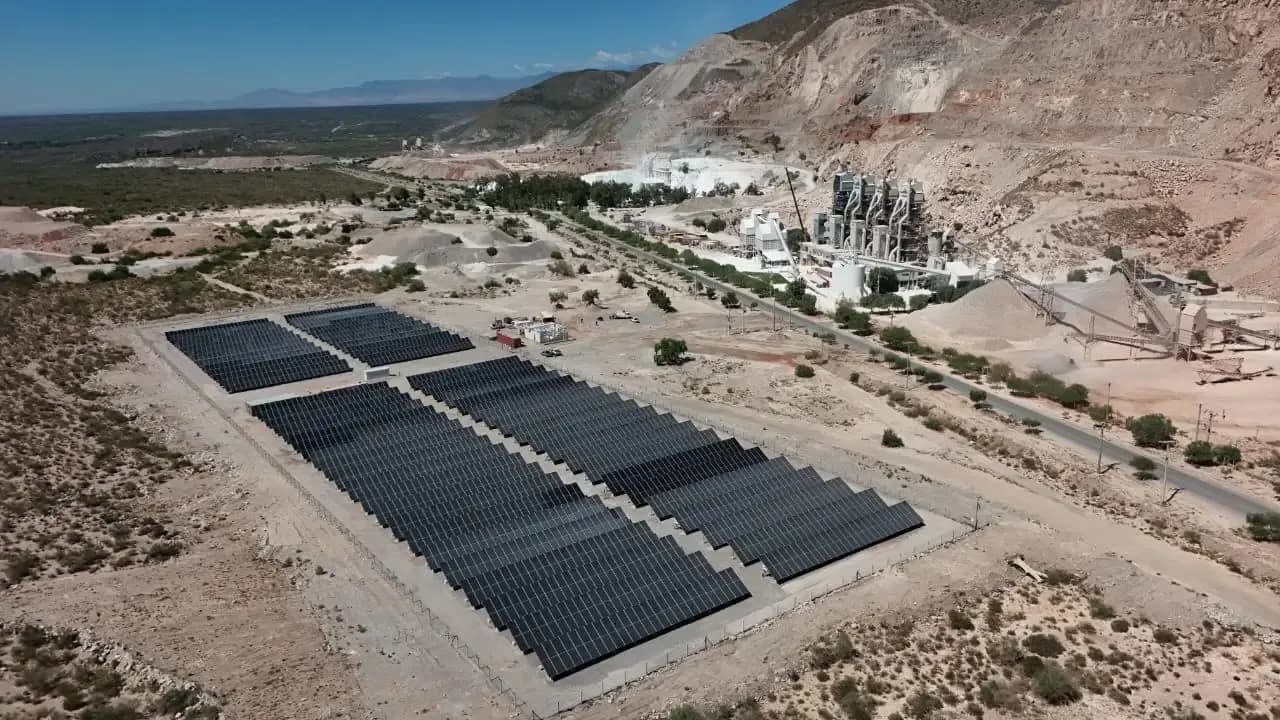
It also helps us that we have a strong sustainability project underway, including a photovoltaic park that will reach 7 MW of installed capacity to supply all of Caleras San Juan's productive activities. We have also planted 1,300 native aguaribay and algarrobo trees, together with four hectares of olive trees, all equipped with drip irrigation for efficient water use. All of these actions are aligned with the global transition toward a greener economy, and they are valued by both our customers and the local communities and residents of the province.
How is Caleras San Juan positioned in the domestic and international markets?
Positioning is the soul of a company. Above all, we practice Modern and Sustainable Mining. Modern because all of our production uses the most advanced technology available worldwide, offering high production capacity with a low carbon footprint. We operate four Swiss-made MAERZ kilns, and we are replacing fossil fuel-powered equipment with electrically powered alternatives.
Sustainable because of all the actions I have already described. We also reinforce our core message through our international ISO certifications.
How is Caleras San Juan's workforce currently composed in terms of local employment and women's participation?
Over the last decade, we have grown from 100 employees to just over 300, with 90% of them coming from nearby communities such as Cienaguita, Divisadero, Pedernal and Los Berros.
Women's participation is higher than the national average, reaching 22%, and not only in administrative positions. It is remarkable that three women operate our MAERZ kilns, while others operate heavy equipment and machinery. This is reflected throughout the company. Our Commercial Manager is a woman, an outstanding professional. I must say that the growing participation of women in the mining industry will continue to bring us great satisfaction.