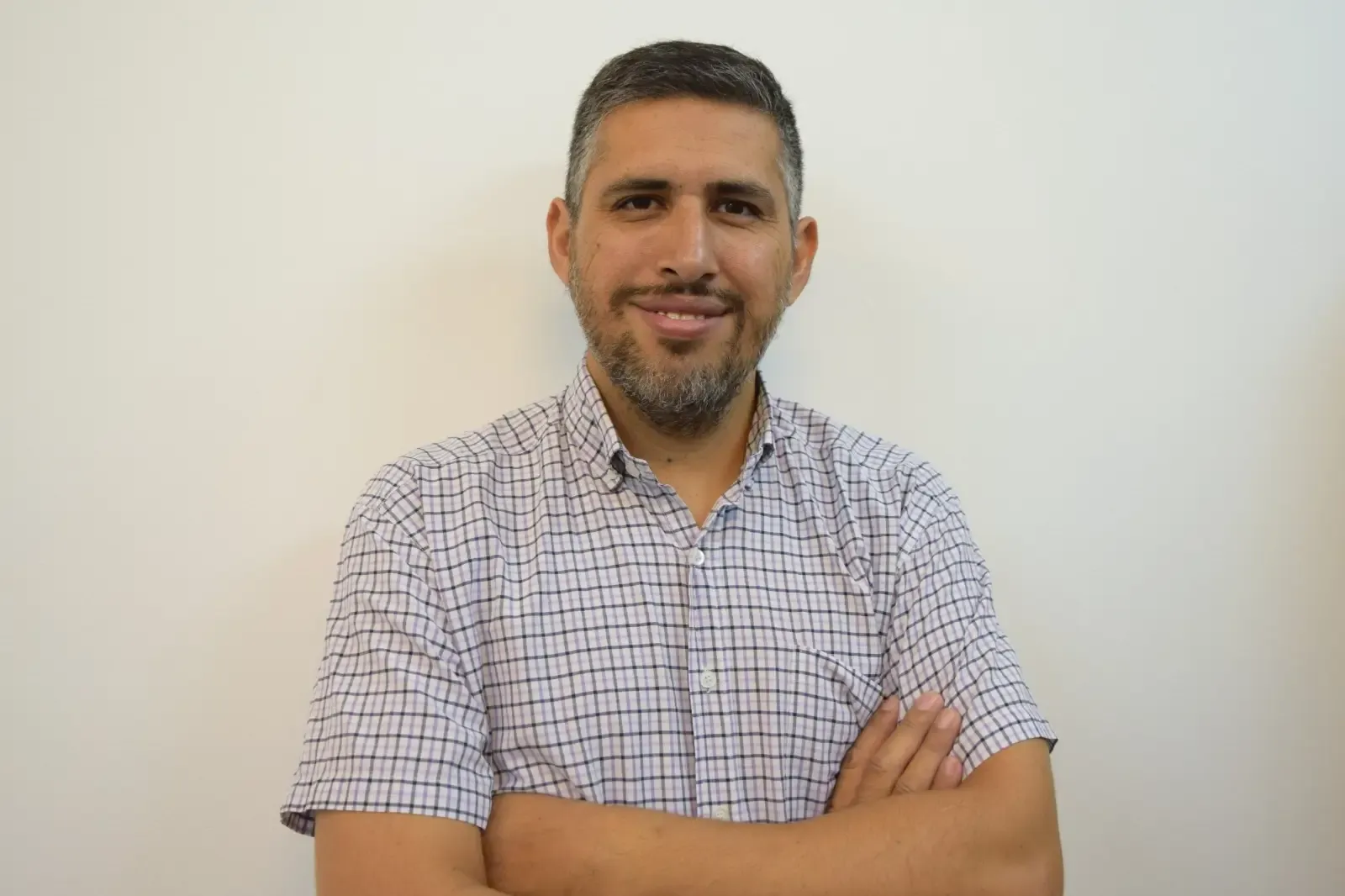
The Hydraulic Research Institute (IDIH) of the National University of San Juan (UNSJ) is advancing the international certification of its processes to standardize water measurement under globally recognized quality standards. Its Director, Eng. Omar del Castillo, emphasized that this initiative aims to ensure reliable and transparent data for public agencies, private companies, and the scientific community.
By Panorama Minero
The "Ingeniero García Wimer" Hydraulic Research Institute (IDIH), part of the Faculty of Engineering at the National University of San Juan (UNSJ), has established itself as a key institution in the study and management of water resources in the province, recently celebrating its 79th anniversary. Founded in 1947, it is the second-oldest research institute within the Faculty, surpassed only by the Mining Research Institute. Under the leadership of Eng. Omar del Castillo, the institution has undergone a significant transformation, evolving from a predominantly academic organization into a highly specialized technical institute with strategic importance for the productive and environmental development of San Juan.
The modern history of the IDIH and its close relationship with monitoring in high-mountain environments reached a turning point in the late 1990s and early 2000s with the implementation of the PASMA Project. This federal initiative sought to generate the technical information required to support mining investments in San Juan, prompting the institute's specialists to conduct fieldwork and establish a hydrological baseline in the Andes Mountains. It was in this context that hydrometric measurements and environmental studies began, providing a better understanding of the behavior of local watersheds.
As mining activity expanded, the demand for technical accuracy from both companies and government agencies increased, requiring the institute to seek formal validation mechanisms for its procedures. According to Omar Del Castillo, the need for international certifications arose from companies' requirements for data supported by globally recognized quality standards rather than relying solely on the university's reputation. This demand led to the creation of the Hydraulic Metrology Laboratory, a specialized unit within the IDIH dedicated to measuring critical variables such as flow rate, water velocity, and pipeline pressure.
The IDIH is currently advancing the certification of its field activities through a Social Technological Development Project (PDTS). The main objective is to standardize flow measurement techniques in open channels in accordance with the ISO 748:2021 international standard. This standard specifies scientific methods for determining flow velocity and cross-sectional area in open channels, enabling highly accurate flow calculations. According to the institute's director, implementing this standard is essential to establishing a common benchmark of reliability applicable to all stakeholders, including both private companies and public institutions such as the San Juan Department of Hydraulics.
The importance of certified procedures lies in improving transparency and reducing uncertainty in water-related measurements. As Omar Del Castillo explained, compliance with the standard ensures that any measurements conducted in Andean rivers such as the Calingasta, Castaño, or Los Patos Rivers are performed using the same methodology, quality standards, and instrumentation. This approach is intended to reduce uncertainty by establishing a common standard that ensures results are reliable and verifiable anywhere in the world.
Alongside process certification, the IDIH is conducting research aimed at understanding the hydrological dynamics of the arid and snow-and-glacier-fed mountain watersheds of the Andes. Through projects that integrate field observations, satellite information, and hydrological modeling, the research team studies the contribution of snow, glaciers, and other components of the hydrological system to streamflow generation. The objective is to improve estimates of water availability in these watersheds, whose physical characteristics and dominant processes require approaches different from those traditionally applied to lowland basins.
The IDIH has equipped itself with state-of-the-art technology and incorporated the use of Big Data and remote sensing. These tools make it possible to process large volumes of satellite imagery and hourly data collected by field sensors, improving the accuracy of predictive models related to water availability. The ultimate goal is to develop scientific methodologies that are both replicable and transparent, ensuring that the knowledge generated by the university can be verified and validated by the international scientific community.