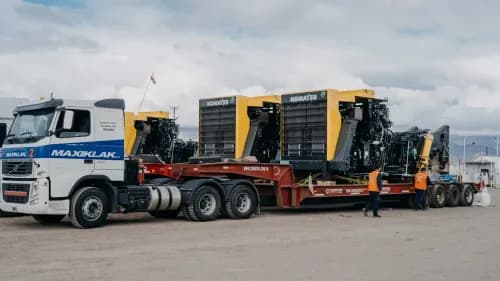
Waldino Acosta Zapata, President of QLABS S.A. and a member of CAPERFO, discussed exploration prospects, SME partnerships and supplier competitiveness.
By Panorama Minero
With the formal start of the exploration season in October in San Juan Province, industry operational estimates anticipate reaching approximately 500,000 metres of drilling, representing twice the activity recorded during the previous season.
This was stated by Waldino Acosta Zapata, President of QLABS S.A. and a member of the San Juan Chamber of Drilling Contractors (CAPERFO). The executive emphasised that the continuity of fieldwork is essential to sustaining the industry, based on the premise that “without exploration, there is no mining.”
Record Drilling Campaign at San Juan’s Mining Deposits
Acosta Zapata outlined the campaigns planned by various mining companies. CAPERFO brings together between 10 and 12 drilling companies based in San Juan. The planned campaigns at different mining projects include:
- Vicuña: Confirmed a drilling campaign exceeding 55,000 metres.
- La Coipita (Teck): Secured a three-year exploration contract covering 60,000 metres.
- Veladero (Barrick): Will deploy a record 15 exploration rigs operating simultaneously.
- Ongoing projects: Deposits such as Hualilán, Gualcamayo and Los Azules are continuing drilling activities.
Legal Certainty and a Long-Term Government Policy
The outlook for growth is supported by an institutional track record spanning almost 25 years in San Juan. Acosta Zapata recalled that, since the signing of Veladero’s Environmental Impact Declaration between 2002 and 2003, successive provincial administrations have maintained mining as a long-term government policy. According to Acosta Zapata, the continuity of provincial mining policy has helped provide predictability for investors.
Within this framework, San Juan has historically established itself among the leading Latin American jurisdictions in the Fraser Institute rankings — compiled by the Canadian organisation of the same name to assess confidence in mining investment — ranking alongside or above jurisdictions with longstanding mining traditions, such as Chile and Peru.
Local Supplier Development and Competitiveness
Beyond royalty revenues, the business representative emphasised that the main benefit of mining lies in the local supply chain for goods and services. Given the presence of international companies such as BHP, Glencore and Rio Tinto, Acosta Zapata encouraged San Juan SMEs to adopt partnership arrangements and temporary business associations (UTEs) to achieve the scale and competitiveness required.
Furthermore, referring to the participation of international contractors — particularly Chilean companies — he clarified that the Chamber of Drilling Contractors does not propose restrictions on the entry of foreign companies or protectionist measures.
Instead, he called for equal competitive conditions, enabling local companies to access bank financing rates and labour costs comparable to those elsewhere in the region.