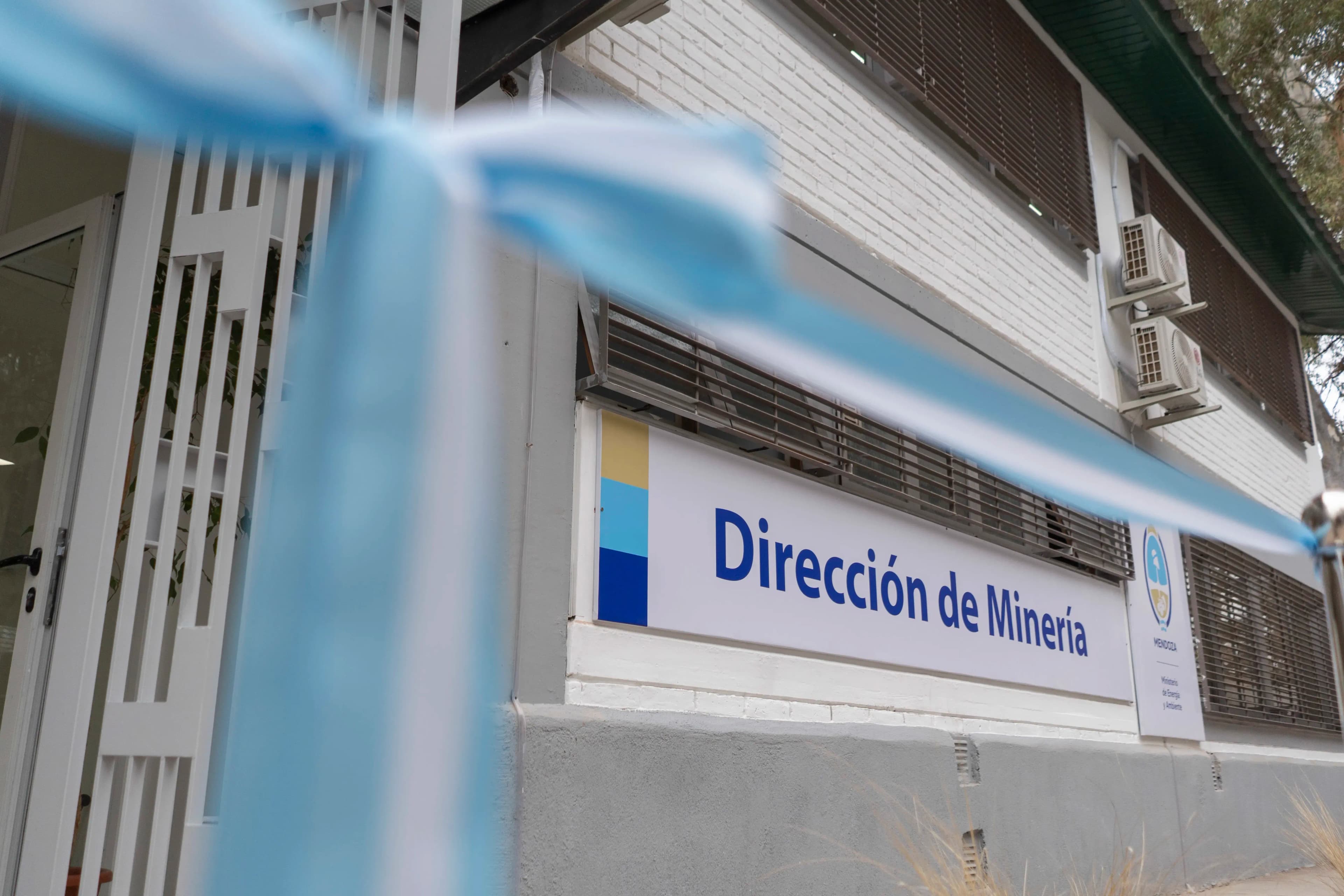
After years of marginal allocations, the budget of the Mining Directorate grew by more than 700% in 2025 and is projected to rise again in 2026, reflecting a structural shift in provincial public policy.
By Panorama Minero
For years, Mendoza’s mining policy shared a constant trait: the lack of real budgetary backing. The funding allocated to the Mining Directorate was, for a long time, marginal, insufficient, and in many cases inconsistent with the objectives that the provincial government itself claimed to pursue.
That situation began to change visibly in 2024 and is now being consolidated with the budget figures for 2025 and 2026. The shift is significant: not only are there substantial percentage increases, but there is also an explicit political decision to strengthen the State’s mining structure—something that had not occurred over the past two decades.
The contrast: when mining was not a priority
To grasp the magnitude of the shift, it is useful to look back. In 2023, the situation was telling. According to official data from that year, the budget allocated to mining promotion amounted to barely one million pesos per year—a figure that, even before the acceleration of inflation, was equivalent to less than US$5,000 at the exchange rate at the time. Following the subsequent devaluation, that amount fell to just under US$4,000.
The data became emblematic when compared with other provincial expenditures: Mendoza was allocating more resources to the dresses of the Vendimia queens than to institutional mining promotion. Beyond the symbolic impact of that comparison, the underlying issue was clear: mining lacked even the minimum resources required for the State to fulfill the role assigned to it by law.
In that same budget, the total allocation for the Mining Directorate did not reach ARS 54 million, within a provincial budget that exceeded hundreds of billions of pesos. The proportion was so low that it made it impossible to envision an active mining policy with technical capacity, territorial oversight, promotion, and long-term planning.
The 2025 leap: from neglect to institutional reinforcement
The first major turning point came with the 2025 Budget. The allocation to the Mining Directorate increased by 700% compared to the previous year, raising the area’s budget to ARS 846 million. This was not an inflation adjustment or an accounting correction; it was a real increase that placed mining at a different level within the provincial State structure.
This boost made it possible to begin strengthening key areas: oversight, technical evaluation, territorial presence, and support for the environmental and administrative processes that were beginning to multiply with the sector’s reactivation. Politically, the message was clear: mining was no longer a residual area, but a public policy with concrete budgetary backing.
Budget 2026: consolidation and continuity
The draft 2026 Budget confirms that this change was not circumstantial. For the coming fiscal year, the Mining Directorate will receive an additional 42% year-on-year increase, bringing the projected allocation to close to ARS 1.2 billion and consolidating the growth initiated in 2025.
In a context of tight fiscal constraints and broad public spending reviews, the decision to continue increasing resources for the mining area is, in itself, a political statement. This budgetary reinforcement aligns with a new scenario for Mendoza: progress in exploration projects in Malargüe, the implementation of more active environmental control schemes, the creation of specific management units, and a provincial strategy aimed at rebuilding state capacities after years of paralysis.
More than numbers: a signal to the sector
A budget does not produce copper, gold, or potash. But it determines whether the State is capable of governing mining development or merely acting as a spectator. In that sense, the change over the past three years has been profound: Mendoza moved from symbolic allocations for mining to gradually building a budgetary structure commensurate with the sector’s complexity.
The comparison with 2023 serves as a reminder of a key point: without resources, there is no possible mining policy. With a budget, however, the State can evaluate, regulate, plan, and—above all—sustain a long-term strategy. What the 2025 and 2026 figures show is that Mendoza has finally begun to assume that role.