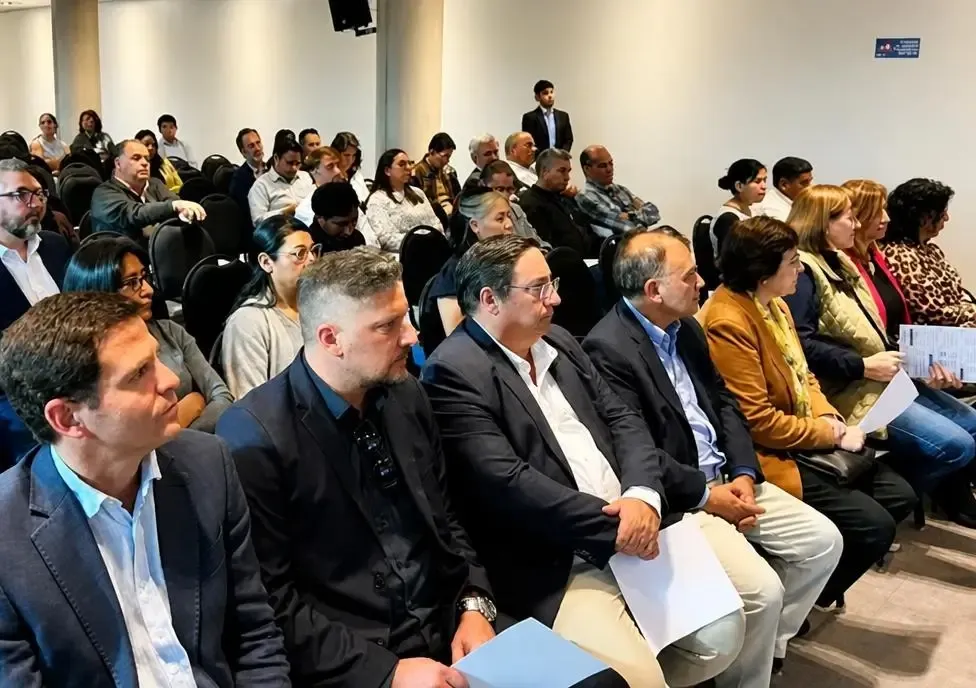
The event brought together representatives of the government, companies and universities to discuss progress on the initiative and the preparation of the Fifth Report.
By Panorama Minero
An information session on the Extractive Industries Transparency Initiative (EITI) was held in San Salvador de Jujuy. EITI is an international standard that promotes the systematic disclosure of information on the exploration and exploitation of natural resources, production levels, payments made by companies and revenues received by governments.
The event aimed to publicly present the implementation of EITI in Jujuy, report on the progress achieved and discuss the preparation of the Fifth Report, which will be presented nationally in December this year.
Jujuy’s Secretary of Mining and Hydrocarbons, Pablo Bergese, recalled that the province joined EITI in February 2025, becoming the seventh jurisdiction in Argentina to do so.
“Essentially, it calls for the systematic disclosure of information relating to the extractive industry, both mining and hydrocarbons, making it available so that the public can be informed about the results, benefits, concessions and everything related to the extractive industry,” he explained.
The provincial official stated that this process is particularly relevant because “mining has become one of the main pillars of the provincial economy”.
He recalled that several EITI guidelines were already being implemented through the publication of information on the Ministry of Mining’s website, including sector activities, the regulatory framework, mining concessions and information relating to royalties.
“Transparency is something that concerns us all,” he stated following the meeting held at the Cabildo.
In Argentina, EITI implementation is carried out through a group comprising representatives of the government, industry and civil society. Jujuy was selected, together with Santa Cruz, to participate in this national forum and contribute the provinces’ perspective to an agenda focused on transparency, governance and sustainable development.
The event brought together representatives of the three sectors involved in the initiative: government, companies and civil society. Academic participants included the National University of Jujuy (UNJu), the Catholic University of Salta (UCASAL) and Universidad Siglo 21. Private-sector attendees included representatives of the Jujuy Mining Chamber and companies such as EXAR and Sales de Jujuy.
“We are working jointly with the Jujuy Mining Chamber, the Mining Services Chamber (CASEMI), companies and universities,” Bergese stated.
He also highlighted the involvement of various provincial government bodies, including the ministries of Mining, Modernisation, Environment and Finance.
Bergese linked the participation of different stakeholders to strengthening the sector and improving access to information. He noted that the objective is to establish a process that is “more reliable, more genuine and more legally secure” for those involved in the industry and for potential investors.
Bergese considered dialogue essential to consolidating the process.
“We have a good turnout from companies, which view favourably this initiative that the provincial Governor, through the Ministry of Mining, decided to undertake in 2025,” he stated.
Participants included the President of the Jujuy Mining Chamber, Arturo Pfister; Administrative Mining Judge Pablo Read; officials from Jujuy Energía y Minería Sociedad del Estado (JEMSE); legislators; and representatives of public bodies and companies.
Bergese linked EITI implementation to ESG principles (environmental, social and governance considerations).
“These are the three pillars of sustainable development, in this case applied to mining. It is definitely one of our Ministry’s strategic priorities,” he explained.
He maintained that mining is undergoing a different phase from that of previous decades.
“We no longer have the traditional mining of the past, which was carried out without regard for the environment or communities. Today, it is quite the opposite: our foremost concern is the sustainable development of our communities,” he stated.
More Projects and Training
Referring to the sector’s current situation, Bergese stated that Jujuy is positioning itself as a mining province and highlighted the growth in exports associated with the industry.
He noted that the province produces lithium carbonate and silver, and also maintains copper production, although still on a relatively small scale.
He considered that the sector’s development would generate direct and indirect benefits for the people of Jujuy, through employment opportunities, demand for services and improvements in infrastructure.
He therefore stated that the province seeks to ensure that mining growth is accompanied by greater transparency, participation and the development of local capabilities.
Bergese noted that mining growth requires an increasingly skilled workforce and the creation of new jobs. In this regard, he mentioned that Universidad Siglo 21 had presented a modular study programme adapted to the industry’s needs one week earlier.
Finally, Bergese emphasised the importance of strengthening institutional coordination to support mining projects and create better conditions for public participation.