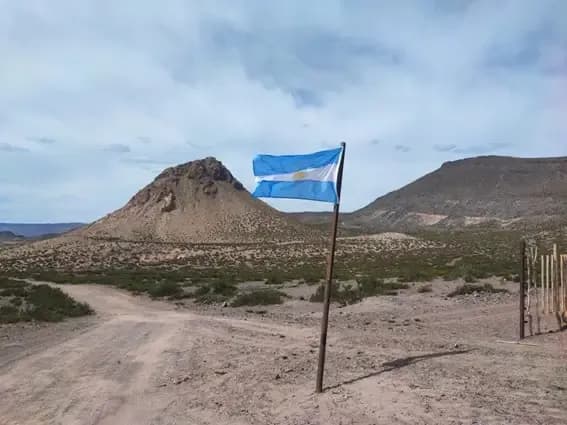
Cobre San Romeleo is awaiting consideration by Mendoza’s Chamber of Deputies of the ratification of its Environmental Impact Declaration (DIA) for mining operations, which received unanimous preliminary approval in the Provincial Senate. The initiative involves the rehabilitation of a quarry located in Malargüe, with a history of mining dating back to the 1960s.
By Panorama Minero
The property is located at Puesto Aguas de Isaac, in the Río Barrancas district, approximately 160 km south of the city of Malargüe, in southern Mendoza, and has a history of mining dating back to the 1960s. The project proposes rehabilitating the quarry.
The first stage aims to produce approximately 222 tonnes of copper oxide annually at the site. The second stage includes an industrial plant in Malargüe to convert that oxide into approximately 710 tonnes of copper sulphate pentahydrate annually.
Mendoza consumes approximately 1,000 tonnes of copper salts annually, which are currently imported. These are used to control fungi and bacteria in fruit trees, vegetables and, particularly, vineyards, where copper sulphate is the basis of Bordeaux mixture. Once the second stage is operational, San Romeleo could meet approximately 70% of that demand.
Observations Regarding the Exploration Approval Process
The same property forms part of Malargüe Distrito Minero Occidental III (MDMO III), which comprises 71 projects within an area of approximately 18,754 km² and whose environmental assessment for exploration remains under review.
The technical assessment issued by the Faculty of Applied Sciences to Industry (FCAI) at the National University of Cuyo (UNCuyo) determined that the report partially complies with regulatory requirements.
For San Romeleo, the FCAI requested the correction of an overlap of approximately 0.57 km² with the Pórticos project, part of MDMO I, and the inclusion of the cumulative environmental burden of the copper oxide plant in the exploration assessment. It also required preliminary mapping of exclusion areas before any authorisation is granted.
The Deposit and Processing Method
San Romeleo plans an investment of US$3 million to process 40 tonnes of ore per day, based on reserves of 257,000 tonnes with an average grade of 1.29% copper, over an estimated operating life of approximately 20 years.
Mining will be carried out by open-pit methods, using benches between 2 and 4 metres high and mechanical excavation. The ore is predominantly oxidised, with minimal sulphide content.
The processing method involves closed-circuit alkaline ammoniacal leaching using ammonium carbonate, compatible with the restrictions established under Law 7,722.
Planned Exploration at Depth
Within MDMO III, San Romeleo is listed as Project No. 68 and is being assessed solely for exploration activities: geological mapping, sampling, geophysics and diamond drilling.
The targets are deep geological structures and a possible copper porphyry system, in an area dominated by units of the Neuquén Group and the La Payunia Volcanic Massif.
Ratification will authorise the mining stage, although the DIA establishes obligations that must be fulfilled before construction. The company must submit an Environmental Baseline Study, obtain a water-use permit from the General Irrigation Department and present the engineering designs for the tailings storage facility, waste rock dumps and spent ore pond.
With the vote in the Chamber of Deputies, San Romeleo will complete the legislative process for its surface mining application: a copper oxide operation producing a product intended for the provincial agricultural value chain.
Exploration for a porphyry deposit at depth is proceeding separately under MDMO III, with technical observations still to be addressed.