The provincial government highlighted that the two newly commissioned plants represent a combined investment of approximately US$1.4 billion in Antofagasta de la Sierra.
By Panorama Minero
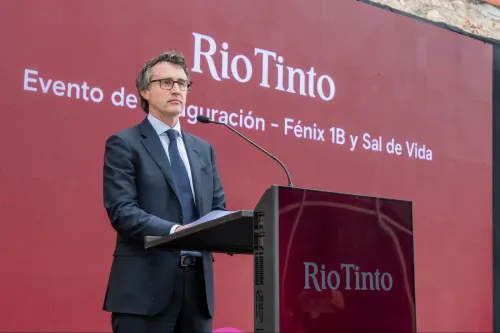
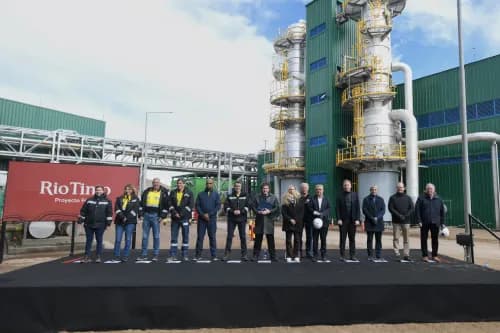
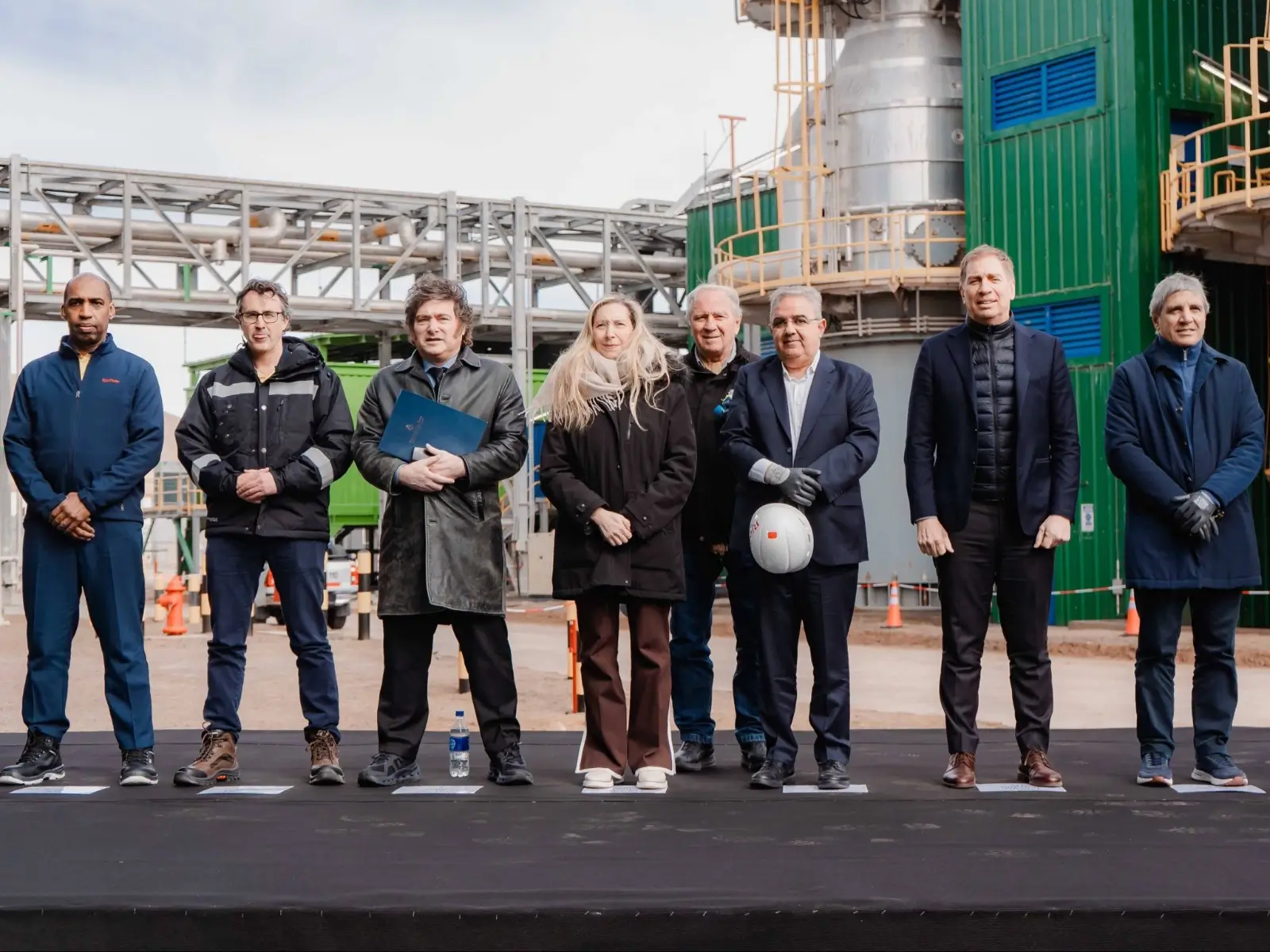
With President Javier Milei and Governor Raúl Jalil in attendance, Rio Tinto inaugurated the Fénix 1B expansion and the Sal de Vida plant at the Salar del Hombre Muerto in Antofagasta de la Sierra. The event coincided with Miners’ Day, celebrated every 28 October. According to the provincial government, these developments bring the company's lithium carbonate production capacity in Catamarca to 55,000 exportable tonnes per year.
“These are investments that expand our production capacity and create new employment and development opportunities for the people of Catamarca,” said Governor Raúl Jalil after attending the inauguration of Fénix 1B and Sal de Vida alongside President Javier Milei.
The ceremony was led by Rio Tinto's global CEO, Simon Trott, and the company's CEO in Argentina, Ignacio Costa. Also attending were Chief of Cabinet Diego Santilli; Minister of Economy Luis Caputo; Secretary General of the Presidency Karina Milei; and the Mayor of Antofagasta de la Sierra, Mario Cusipuma, among other officials.
The provincial government emphasised that the combined investment amounts to approximately US$1.4 billion, adding 25,000 tonnes per year of additional targeted lithium carbonate capacity. The plants achieved first production in the second quarter of 2026, ahead of schedule, and remain in the commissioning and gradual production ramp-up stage.
Fénix 1B and Sal de Vida
Fénix, located at the Salar del Hombre Muerto, began operations in 1997 as Argentina's first lithium plant. The Fénix 1B expansion adds approximately 10,000 tonnes per year of lithium carbonate equivalent (LCE), increasing the plant's total target capacity from 30,000 to 40,000 tonnes annually.
The expansion includes new selective adsorption facilities, lithium carbonate production facilities and mechanical evaporation technology, which, according to the same document, eliminates the use of concentration ponds.
The Sal de Vida project was established in 2009 at the same salt flat and underwent exploration, pilot testing, permitting and construction stages. It uses solar evaporation ponds and a lithium carbonate plant.
According to the official statement, the project began production ahead of schedule, completed its first shipments and is progressing towards a target capacity of approximately 15,000 tonnes per year of LCE.
The RIGI, According to the Provincial Government
Fénix 1B was approved under the RIGI through Resolution 431/2026, with a total investment plan of US$531 million, according to the statement.
Jalil described the regime as “a tool for productive federalism”.
During the inauguration, he stated: “The RIGI has enabled us to accelerate all investments.”
He added: “Above all, the RIGI promotes federalism because we generate employment and investment in the province.”
Speaking to the press, the Governor stated that Catamarca would receive approximately US$9 billion in investment under the RIGI.
According to Jalil, “four lithium plants were inaugurated in a single location”, and he emphasised that “mining represents a major opportunity for employment and development”.
Employment, Suppliers and Other Industries
Jalil highlighted that “in Catamarca, we are working to ensure that mining growth translates into more jobs, local suppliers and development for our communities”.
In this context, he welcomed the visit by Rio Tinto's global CEO, who, he said, “was able to see first-hand Catamarca's potential, the work of our local suppliers and the opportunities our province offers for new investments”.
Speaking to the press, the Governor also noted that mining coexists with other industries.
He stated that “we are about to inaugurate the Antofagasta de la Sierra hotel”, referring to tourism development in the area.
Regarding copper, he said that “it is essential to the energy transition, just like lithium”, and stated that Catamarca would be the first province to begin producing it next year.
Milei's Remarks
In his speech, the President thanked the company and the province:
“I want to recognise Rio Tinto, the province and the communities, which are promoting unprecedented coordination for infrastructure development.”
He added: “They have managed to revolutionise the quality of infrastructure thanks to the productive efficiency of the private sector and community coordination.”
For his part, Jalil posted that the visit by the President and Argentina's Secretary of Mining, Luis Lucero, provided an opportunity to “share our vision of mining that grows alongside communities, with more employment, infrastructure and better services for the people of Catamarca”.