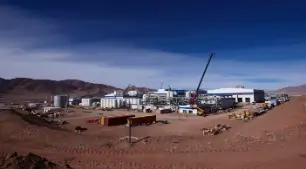
The Cauchari-Olaroz expansion is beginning to generate employment and business opportunities for suppliers in Jujuy. The new stage, which involves an investment of US$1.2 billion and the incorporation of direct lithium extraction (DLE) technology, will require workers with a range of technical and professional skills. Arturo Pfister, Legal Affairs Manager at Minera Exar, highlighted the participation of local companies grouped in a temporary joint venture (UTE) and the initial demand for around 150 workers for the first construction works.
The approval in July of Minera Exar’s entry into the Large Investment Incentive Regime (RIGI) enabled the Cauchari-Olaroz project to advance into a new stage of expansion.
By Panorama Minero
Arturo Pfister, Legal Affairs Manager at Minera Exar and President of the Jujuy Mining Chamber, highlighted the shareholders’ decision to continue investing in the province.
“Cauchari-Olaroz has an installed capacity of 40,000 tonnes of lithium carbonate. In the middle of the year, the RIGI was approved for Minera Exar for the additional US$1.2 billion, the first RIGI approval for the province of Jujuy, and what you were able to see last week was the start of the first construction works under the RIGI scheme introduced in the province,” he explained.
He specified that the expansion aims to achieve a production capacity of 85,000 tonnes of lithium carbonate per year through the incorporation of direct lithium extraction (DLE) technology, which changes the production process used to date.
“It will use a new method, the DLE system, which involves direct extraction. Rather than those turquoise ponds, the brine goes directly from the salt flat to the plant, where it is processed to produce lithium carbonate,” he explained.
Participation of Local Suppliers and Communities
Pfister highlighted the participation of local suppliers, as the first construction contract associated with the expansion was awarded to a temporary joint venture comprising companies from Jujuy.
“It is gratifying that the first construction contract under this scheme was awarded to a joint venture from Jujuy, with several local companies joining forces to provide this important service to Minera Exar. The aim is to ensure that the greatest possible benefit remains within the province,” he stated.
In this regard, he highlighted that the Jujuy Mining Chamber is working to encourage its member companies to prioritise the recruitment of local workers and the engagement of local suppliers. He acknowledged that not all services are available within the province, but considered it essential that a significant proportion of investments generate opportunities for the provincial economy, particularly in the communities where projects are being developed.
“If mining is carried out sustainably, by employing people, engaging and developing suppliers and, of course, ensuring that production takes place with due care for the environment, mining can be done, and it can be done well,” he said.
Pfister noted that supplier development also encompasses training programmes aimed at strengthening the capabilities of communities located near mining projects. These initiatives include training in service provision, leadership development, programmes to help participants complete their education, and scholarships.
In Exar’s case, he highlighted the operation of a Dialogue Roundtable involving representatives of the seven communities within the project’s area of influence. This forum enables participants to exchange information on recruitment requirements, raise concerns and seek joint solutions.
“This is where the company communicates, for example, its workforce recruitment requirements, and where discussions take place and solutions are developed and sought for both the communities and the company itself,” he explained.
Labour Demand and Training
Regarding the labour demand generated by the expansion, Pfister stated that the construction stage requires considerably more workers than the subsequent operational phase. The initial construction works require around 150 people in direct employment.
Among the skills required, he mentioned university graduates, welders, logistics personnel, machinery operators and lorry drivers, among other trades and technical specialisations.
The company maintains relationships with academic institutions and training organisations, including the National University of Jujuy (UNJu), Siglo 21 University and the Provincial Labour Directorate, with the aim of communicating the sector’s needs and promoting training programmes aligned with labour demand.
Pfister noted that Exar’s investments under the RIGI have a five-year implementation period, which began following the approval of its entry into the regime in July.
“Everything is not going to be built overnight; these are long-term investments,” he explained.
Regarding the composition of Minera Exar’s workforce, he noted that 30% come from communities within the project’s area of influence and more than 70% are from Jujuy.
“We always prioritise workers from Jujuy and from local communities,” he emphasised.
Infrastructure Is Key
Another issue raised by Pfister was the need to improve energy and logistics infrastructure to support the growth of mining activity in the Puna region.
Regarding energy, he explained that Exar obtains electricity from the grid connected to the Cauchari solar power plant and also uses natural gas. The expansion is expected to continue using solar energy. According to the executive, 99% of the energy currently used by the company is clean.
He also mentioned that the company is assessing the incorporation of its own energy storage systems using high-capacity batteries, which can store energy generated from solar and wind sources. He noted that one of Exar’s shareholders manufactures these devices.
Regarding road infrastructure, he referred to the condition of National Route 52, which is essential for mining-related transport and international traffic towards Chile.
“What we are seeing is lorry traffic, not only from the mining companies themselves but also from those travelling towards Chile, and there is already a considerable volume of traffic. The road is not in adequate condition,” he stated.
He explained that the Mining Chamber continues to engage with the national and provincial governments to improve the condition of this transport route.
He also highlighted the importance of restoring the C-14 and C-15 railway lines, which could provide alternatives for transporting supplies to mining projects and minerals to Chilean ports. However, he noted that the necessary investments are not included among the obligations envisaged under the Belgrano Cargas railway concession.
In addition to these difficulties, he pointed to the cost of natural gas in northern Argentina, which he considered higher than in the central and southern regions of the country.
“We are always pushing for regulations and operating conditions to be more similar for those of us in the north and those in the south,” he said, noting that this difference affects the competitiveness of mining, agriculture and other industrial activities.
The International Lithium Market
Pfister also acknowledged that the international market presents challenges for the sector. In particular, he noted that falling lithium prices could delay investments in some projects that were close to moving forward.
“A few months ago, we had favourable prices for silver, gold and, above all, lithium. However, lithium prices are falling considerably worldwide, which may also cause other projects that were close to moving forward to slow down or wait a little longer before committing those investments,” Pfister stated.