The company showed how the project evolved from identifying high-grade veins to interpreting a large-scale mineralized system with multiple styles of mineralization and a new Cu-Au porphyry component.
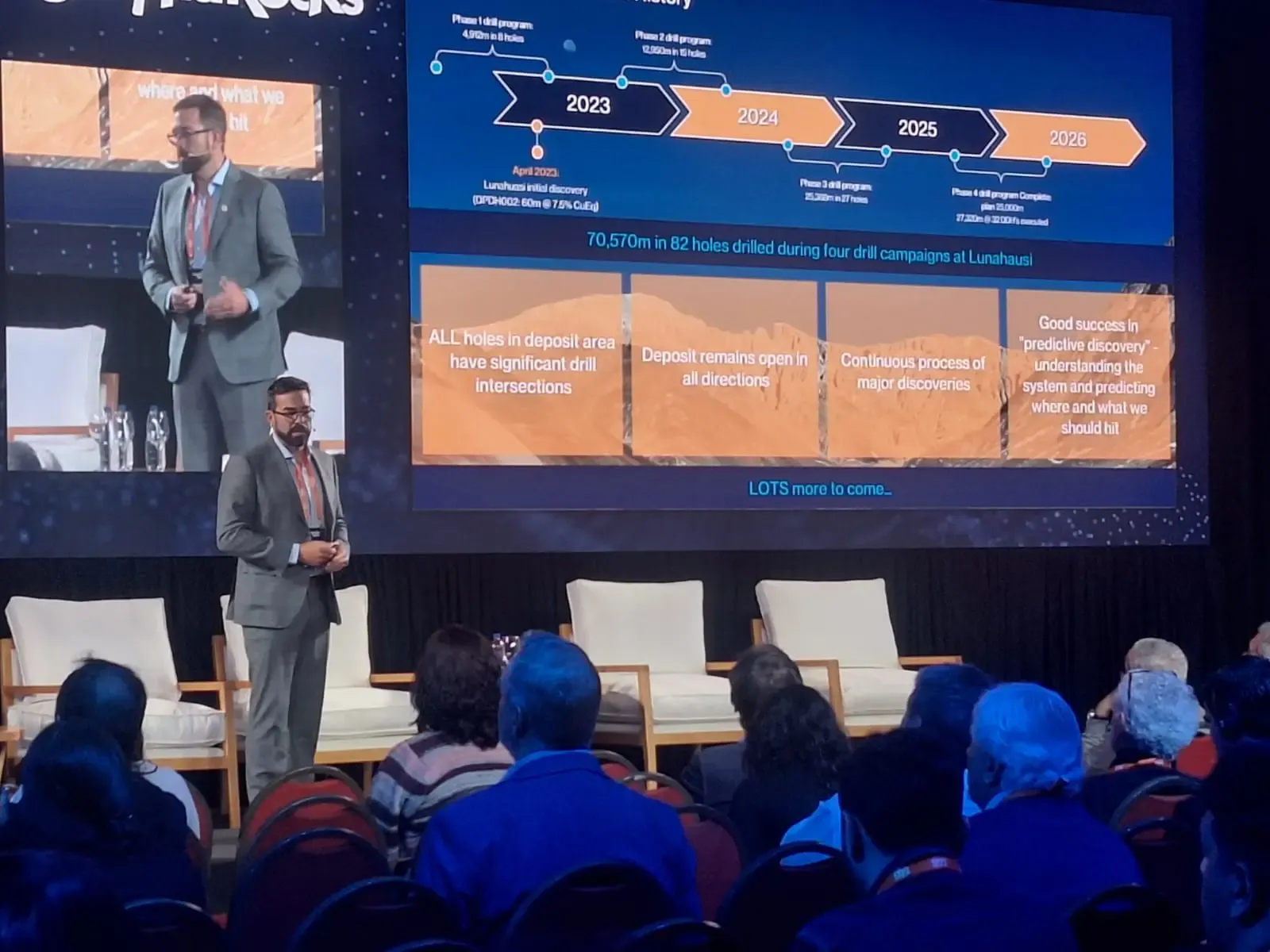
“We are seeing an important change in the interpretation of the project.” With that statement, Federico Wendler, Exploration Manager at NGEx Minerals Ltd., summarized at Argentina Rocks the exploratory evolution taking place at Lunahuasi, the project located in San Juan within the Vicuña District, where the company presented a geological reinterpretation based on four drilling campaigns, more than 70,000 meters drilled, and the identification of multiple mineralization styles coexisting within a single system.
By Panorama Minero
During the technical presentation, the company reviewed how the project evolved from an initial discovery associated with high-grade veins into a much broader and more complex system, where high-sulfidation epithermal domains, Cu-Au-Ag stockwork zones, and a copper-gold porphyry-related component began to be recognized.
More Than 70,000 Meters Drilled and an Open System
NGEx reported that 82 drill holes totaling 70,570 meters have already been completed at Lunahuasi, distributed across four exploration campaigns carried out between 2023 and 2026. According to Wendler, all drill holes completed within the deposit area intersected significant mineralization, and the system remains open in all directions.
The images presented during the session also showed how the mineralized volume expanded north-south, east-west, and vertically, while the company continues refining its geological interpretation with each new drilling campaign.
Another key point involved the coexistence of different mineralizing environments within the same system. The company presented “four distinct styles of mineralization within a giant system,” including high-sulfidation disseminated and Cu-Au-Ag stockwork mineralization, high-grade Cu-Au-Ag veins, epithermal gold mineralization, and a Cu-Au porphyry-related component.
The Highest-Grade Intersections
Among the technical results presented were some of the most significant drill intercepts identified to date at Lunahuasi. One highlight was an intersection of 1**,619.4 meters grading 0.86% CuEq** (copper equivalent), including an interval of 743 meters grading 0.56% CuEq associated with the discovery of a Cu-Au porphyry system.
The company also presented intersections of 823.1 meters grading 1.17% CuEq, 876.4 meters grading 1.13% CuEq, 772.5 meters grading 1.60% CuEq, and 429.4 meters grading 2.31% CuEq.
At the same time, NGEx highlighted very high-grade gold zones associated with epithermal mineralization. Among the reported results were intersections of 1.5 meters grading 115 g/t Au, 2.3 meters grading 149.78 g/t Au, and 1.1 meters grading 151.50 g/t Au.
One of the most extreme results presented during the conference was an intersection of 2 meters grading 1,740 g/t gold, equivalent to approximately 1.74 kilograms of gold per tonne of rock, within a high-grade bonanza zone. The company also reported an interval of 1.55 meters grading 504 g/t Au and 28 g/t Ag.
NGEx linked part of this geological behavior to high-sulfidation epithermal systems similar to those historically developed in the El Indio Belt in Chile, where bonanza-type gold deposits reached exceptionally high grades.
The Geological Evolution of the System
During the presentation, Wendler reviewed the conceptual evolution of the project from the initial 2023 campaign to the present. According to the company, the first drill holes identified high-grade copper, gold, and silver veins that were initially interpreted as part of the outer zone of a porphyry system.
Subsequent campaigns significantly expanded the mineralized volume and incorporated evidence consistent with stockwork-style mineralization and a new Cu-Au porphyry system, progressively modifying the overall geological interpretation of the project.
In this context, the company stated that Lunahuasi continues to incorporate new mineralized zones and that the system remains open both laterally and at depth.