The Executive Branch of Mendoza submitted the Environmental Impact Declaration (DIA) for the Cobre San Romeleo project to the Legislature for ratification. This is the first small-scale copper mining project to reach this stage in the province’s new phase of mining development. The project aims to produce copper oxide in the department of Malargüe as a raw material for copper sulphate and other agricultural fungicides, including those used in viticulture.
By Panorama Minero
The project owner is LABSA S.A., and the operation will be carried out by AREX Mining S.A. The DIA was approved by the Mining Environmental Authority (AAM) for the metalliferous mining exploitation stage, and its validity now depends on legislative ratification.
The Provincial Government presents the project as a link between mining and agriculture. “It is a small-scale project that also has a concrete connection with another strategic productive activity for Mendoza: it seeks to generate in the province the raw material needed to produce copper sulphate used in agriculture, particularly in viticulture,” said Minister of Energy and Environment Jimena Latorre.
Minister of Production Rodolfo Vargas Arizu raised the same point in terms of productive integration: “Producing in Mendoza part of the inputs needed by our agriculture means moving toward a more integrated productive matrix, generating economic activity and reducing external dependencies.” Director of Mining Jerónimo Shantal stated that the project seeks to “locally produce the raw material for the manufacture of copper sulphate used by viticulture and other crops, adding value to a provincial mineral resource and generating economic activity and the hiring of services in Malargüe.”
A Small-Scale Oxide Deposit
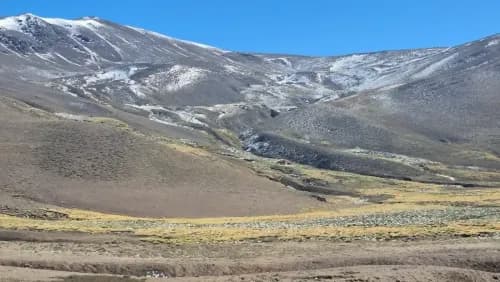
The project is located at Puesto Aguas de Isaac, Quebrada de San Romeleo, Río Barrancas district, approximately 160 km south of the city of Malargüe. It envisages a processing capacity of 40 tonnes of ore per day based on estimated reserves of 257,000 tonnes with an average grade of 1.29% copper. The exploitation horizon is approximately 20 years, and the estimated investment for start-up is US$3 million.
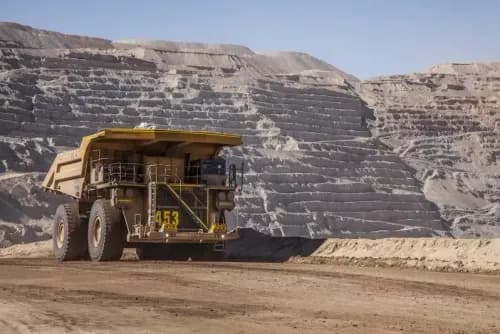
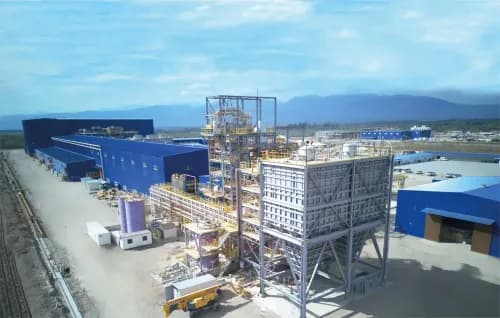
The mineralization is predominantly oxidized, with minimal presence of sulphides, which reduces the risk of acid drainage generation. Extraction will be carried out in an open-pit quarry with low benches and mostly mechanical excavation, supplemented by low-frequency blasting. The ore will pass through a crushing and classification plant installed on the site, with dust control through water spraying and bag filters.
Closed-Circuit Ammoniacal Leaching
The central process is closed-circuit alkaline ammoniacal leaching. The ore is treated in closed reactors with an ammonium carbonate solution, and the copper-rich solution is then subjected to thermal decomposition to precipitate cuprous oxide as the main product. The gases generated are captured, condensed and reused to regenerate the leaching solution, reducing reagent consumption and effluent generation. A subsequent stage contemplates the production of copper sulphate from this oxide.
Conditions Before Construction
The DIA organizes the obligations into five stages: pre-construction, construction, exploitation, closure and post-closure. Before beginning activities, the company must submit an Environmental Baseline with wildlife protection protocols, an Environmental Monitoring Plan covering water, soil, air, flora and fauna, a Social Monitoring Plan, a Contingency Plan and a guarantee for the remediation of any potential environmental damage.
Before construction, it must obtain a water-use permit from the General Department of Irrigation. It must also submit the engineering design for the tailings dam, waste dumps and spent ore pond, including their waterproofing, drainage and containment systems, as well as studies on leaching potential and metal mobility. Closure includes a Technical Closure and Environmental Closure Project and post-closure monitoring for at least five years, extendable depending on the evolution of the site.
The Second Track: Exploration Within MDMO III
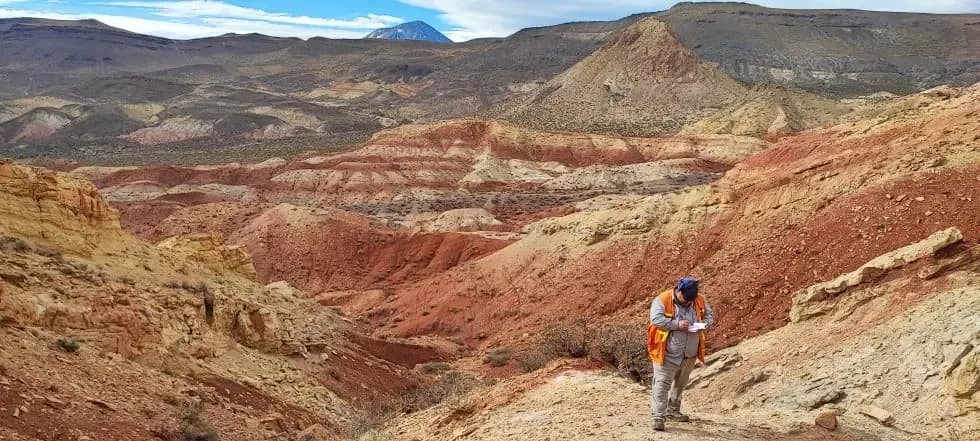
In January, Panorama Minero reported that San Romeleo is advancing along two administrative tracks over the same deposit. In addition to the production file, the property forms part of the group incorporated by Impulsa Mendoza Sostenible S.A. into the Malargüe Western Mining District III (MDMO III). Within that district, it appears as Project No. 68 and is being evaluated only for prospecting and exploration: geological mapping, sampling, geophysics and diamond drilling. The objective is to investigate deep structures and potential copper porphyry-type systems. This track remains under environmental assessment, with a technical opinion from the FCAI.
Small-Scale Mining for Agricultural Use
Cobre San Romeleo combines a limited scale, a product with a defined destination within the provincial agricultural value chain and a closed-circuit hydrometallurgical process. With the DIA before the Legislature, the oxide project is one step away from obtaining its environmental authorization. Deep exploration continues along its own track within MDMO III.
Cobre San Romeleo combines a limited scale, a product with a defined destination within the provincial agricultural value chain and a closed-circuit hydrometallurgical process. With the DIA before the Legislature, the oxide project is one step away from obtaining its environmental authorization. Deep exploration continues along its own track within MDMO III.