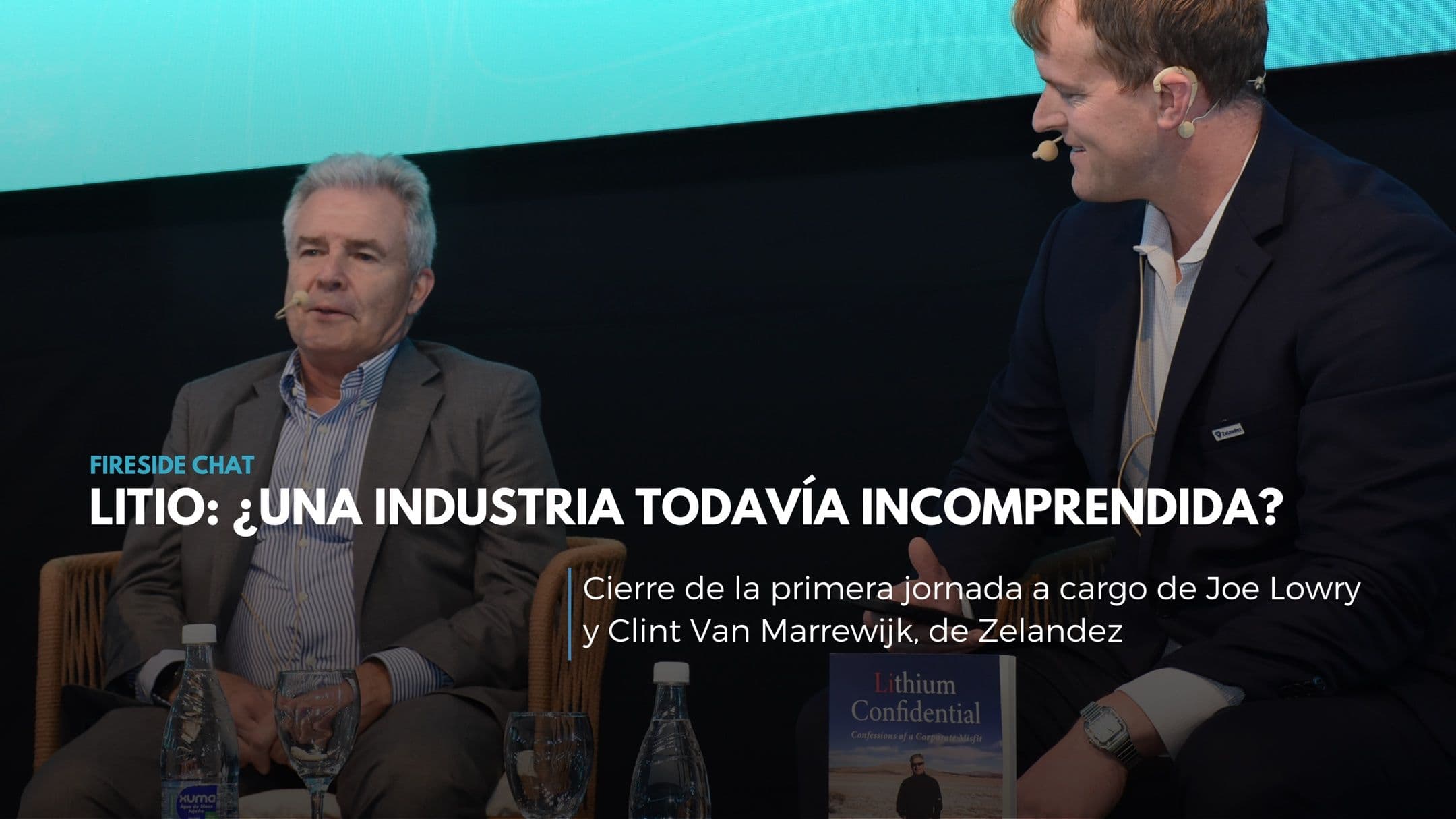

Litio: ¿una industria todavía incomprendida?
7 de octubre de 2026 · Duración 24:22 · 2 oradores
Más que una lectura del mercado: El nuevo rol estratégico de Argentina, los desafíos reales y las relaciones que formatean la próxima década
Oradores

Joe Lowry
Founder, Global Lithium LLC · Autor de Lithium Confidential: Confessions of a Corporate Misfit

Clint Van Marrewijk
Co-founder, Zelandez
Transcripción
Leer la transcripción completa
0:21All right, 30 years in lithium. the industry calls Mr Lithium. The book recently released is available I think via signing later in the cocktail tent. But my first question is a personal one. Your podcast has been running for 10 years, probably before podcasts were popular. You've done hundreds of interviews. From time to time you're quite from time to time, people might threaten to sue you.
1:01So my question is, what did your lawyers tell you you could not put in the book? Well, I wasn't going to have a lawyer look at it, but my daughters insisted because they say, we know who you are, Dad. And so I tried to be... candid in this book without being nasty. But my lawyer thought talking about certain people's drinking habits or applying excessive adjectives to former bosses may have gone too far. So I had to do some edits. In order to get insurance for the book I had to have a lawyer write a letter saying that there was no reasonable claims.
1:52I mean, anybody can make against me. So it was things like that. Insurance is probably a good idea. So back to the beginning, when you started for the audience that's almost, well, bar none, newer in the industry than you, what did the industry look like at the very beginning when you walked into it? You know, that's the interesting thing because I really do believe now, as Mr. Lucero...
2:19This... Secretary of Mining said, you know, this is a special moment now for Argentina. But, you know, this guy who can't speak Spanish was the first guy to sell Argentina's lithium in the global market. I had the honor of selling the Phoenix lithium in Asia all those years ago. But at that time, there was only the Atacama and Greenbushes. And. Argentina was the high-cost producer, by far the high-cost producer.
2:54So at that point in time, it didn't look like Argentina was going to be able to make a go of it in lithium. And in fact, the FMC shut down the carbonate plant within months of starting it up. And the only reason they restarted it, and I tell the story in the book, is I begged the CEO because we were the only qualified supplier to the battery industry that had... started in Japan and that's why I think it's Argentina's moment now because if you looked at and I have a huge amount of respect for Andy Leland who just spoke and I agree with most of his numbers we might quibble on the margins but the Argentina's place in a market that will be that was when I started in the industry less than 40,000 tons was the whole global market So the whole thought was, why do you need Argentina?
3:47You got the Atacama. Nobody believed, even the lithium producers didn't believe in lithium-ion batteries. At first, only the Japanese did. This is long before China even started. So now we see it in a completely different light. Argentina's got a great place on the cost curve. Argentina's got great resources that aren't developed. I advise one of the largest oil companies in the world.
4:12world on lithium for a few years and the first thing i said is you ought to go to uh argentina not just smack over hint hint and um they said at that time a few years ago that well argentina's a no -go zone and now with all the changes that have recently happened argentina's no longer a no -go zone for investment expanding on that obviously chile had the advantage um well ahead in Bryan. And now Argentina has the momentum. What would you say Argentina's got right or vice versa, Chile's got wrong, if you had to pick a few things?
4:54Well, I really think it's more about the size of the market and the growth in the market. Because I think the Atacama is the Atacama, and you can't argue with that. But if you look at a three million ton market. Plus in 2030, three or four hundred thousand tons out of the Atacama doesn't get the job done. And what Argentina has is more diversity of resources, a better royalty regime.
5:23And we don't know what will happen with new projects in Chile as far as royalties go. But it's, you know, very SQM and Abomar will pay a lot of money to the Chilean coffers. price of lithium is over 20 ,000 so I mean you know you just think with all the changes and I don't know if this translates I think most of the people left here are English speakers anyway but I think Malay's bromance with Trump and Elon isn't hurting things either you've you've actually got a lot of experience with China Japan Korea how have you seen China's those executing in the market change over time from when they first entered the market through to today? Have you noticed change? That's an easy, that's really, when I lived in China from 2005 to 2011 and four or five years before that I lived in Japan and went to China every month. Nobody in China made a lithium chemical.
6:33that anybody outside of china would buy and in those days the battery market was mostly the japanese and the koreans so china actually was kind of late to the party it's just that when they got in it was part of a national initiative uh they picked certain champion industries and the lithium-ion battery supply chain and evs was one of them so I watched a couple of very poor guys become billionaires, the guy who started Gangfin, the guy who started Tanshi.
7:10I knew him. I did business with him. I was doing business with BYD 26 years ago. I advised CATL, and once they started, it became very clear who the winner would be because when I lived in Japan, I would go to China. every month and come back and say to the Japanese, you better start paying attention. And they said, oh, Laurie-san, they are just Chinese. And I'd say, well, they're just Chinese until they're not.
7:39And clearly, we saw how that's ended. Japan is almost a non-player in the lithium industry now. Last year, they sourced 35 ,000 tons of LCE, which is, in this market, almost nothing, when 20 years ago... dominated it. So China runs the midstream what does a South American producer do to diversify? You know I think if you look at Andy's numbers I think he said 77 percent of cathodes made in China. Well that means by my count 23 percent is not which would go to Korea, Japan and a few other And if you look at how big this market is, you could triple Argentina's production and still not have to sell to China.
8:34So there are options out there. And I'm not saying that there's any reason not to sell to China, but I'm also saying you don't want to be in a position where, like Western Australia, for the most part, the only game in town for their Spajamine is selling it to China. converters and that's why I may quibble with Andy a little bit about making battery grade. Argentina was making battery grade in 1997 when Phoenix started. They didn't make all battery grade and the specs weren't as tough as they are now. But I sold that material to Sony, Masushita, Panasonic if you will and by lot selection we always had enough.
9:21uh for that market in the early days so it's not that you can't make battery grade here um it's just do you want to make that investment or not and you know i think andy you know laid it out pretty well so i won't won't go too far down that road so you started when lithium was truly a specialty chemical it still is would you say it's when would you say it's going to be a commodity the only that can make it a commodity are the battery producers if the battery producers got together and said see the whole misnomer is is that if it's 99 .5 percent lithium carbonate it's battery-grade and I've been saying this for over a decade in in these kind of events that it's the 0 .5 that matters and how stable what's in the 0.5 is how stable the sodium is how stable the calcium is and battery industry said, okay, if you produce this published spec, we will buy it, then it's a commodity. But by definition, since it's not a fungible
10:29good, it's not interchangeable at this point in time, it's not a commodity. Even though I am the voice crying in the wilderness about that because everybody else wants to call it a commodity. With your podcast 247 interviews I think you said 245 doing podcast tomorrow is Carlos Ghali here for 246 doing podcast before podcasts were cool um do you have a particular favorite interview or a particular moment that stands out I am looking at the guy who is my favorite and his father recently passed away I did a Father's Day episode with her and I Solorio and Ignacio and I also did one with Daniel and Carlos Ghali but same time put them out as the Father's Day podcast and I would have to say The generational angle on that I Really loved just so speaking to that. I mean this book is called lithium confidential confessions of a corporate misfit I think we know who the Misfit is.
11:45You're looking at him. What was some of the motivations behind writing the book? What was the reason, I guess, for wanting to get it out there? On January 1st, 1982, I wrote down five life goals. And I had accomplished four out of the five. And on May 23rd, 2024, I had my first grandchild. And, you know, who knows how long you're going to be around. And so I had always wished that, you know, my dad went over on D -Day Plus One, liberated a couple of concentration camps.
12:23He never wrote about his life. I had an uncle, and I read about it in the book, that had one of the first landing crafts in it, Iwo Jima, took some of the first bodies off. And those guys never told their story. And once, if I had been doing a podcast. they had passed I would have sat down with them and just made them talk about it. That didn't happen and I just wanted my granddaughter to have something that if she cares when she's a little older she can know. So it wasn't about trying to sell a lithium book but since most of my life career was spent in the lithium industry it makes sense but this isn't this book is about a lot more than lithium. Yeah I'm actually interested in the first sale you made in lithium and perhaps just sharing a little with the audience how america's journey with lithium has changed because there is there is a journey there well we yeah i mean the lithium industry was started basically
13:24to get the trigger for the hydrogen bomb and i i write about that in this three companies were put in business u .s u .s borax who quit quickly and then what's now Abomaral and what's now the part, the FMC lithium that is now part of Rio Tenno. And they made lithium hydroxide to be taken to Oak Ridge, Tennessee, to be converted there. And when they had stockpiled roughly 90 million pounds, they said, hey, we don't need this stuff anymore. So then the two lithium producers were faced with what And then fortunately, about the same time, the aluminum industry started using lithium as an additive, and it was always used in glass and grease, so those things grew.
14:15But it was two little companies in North Carolina. When my older daughter was in kindergarten, her best friend's dad had my job for our competitor. We housed that for the CFO of our competitor. I mean, it was, the industry, our customers didn't like it because they knew we played golf with each other. I mean, it was a very incestuous industry, and, you know, I'm, I think probably my former employer wouldn't like me telling the story, but I think the statute of limitations has run out on all that stuff, so I think we're good.
14:49But it was a very clubby little world, and it didn't change until SQM entered in the late 90s, and then there were. three producers and that changed everything because SQM took the price down you know I was selling product for two dollars and two cents a pound because we we were using pounds back then forgive us and SQM couldn't sell it at 90 so they took it down to 68 cents and sold a bunch to the guy who's no now vice or the leader of gang fan Wang Shao Shen one of the leaders and he was the first big buyer of SQM's material and then I was the second because we did a tolling arrangement with SQM. I bought 17 million pounds on a three -year contract. We gave them Sodash and they gave us lithium carbonate back. So I tried to rebrand FMC not as the high -cost producer but as the lithium superstore because I had what's now Apple Marles.
15:54because we had swaps with them and I had SQM's material and I had ours so I said I can sell you anything and our lawyers didn't like that much either but that's another story yeah and then I'm interested in the relationship between Japan and Argentina there's some history there obviously and perhaps some to come but maybe step through a few of the deals you've seen or how Japan has interacted with Argentina through the decades?
16:26You know, it really was not about, they didn't really care where the lithium came from. They liked the two supplier world. They trusted FMC, because when I started, we were doing hard rock lithium in North Carolina. That's what I first sold to the Japanese battery industry. They had to go through the change. They came here, they went up to Ombremerto, you know, they always wanted, we would take them up in the plains to Phoenix, I always would take golf balls in clubs so they could be Tiger Woods at altitude, even though all it was doing was bouncing off rocks, but they love Malbec and beef, but they really didn't care where the lithium came from.
17:23um well back on argentina um a hell of a lot of momentum as we is discussed uh what does argentina have to do right from here to be the world leader in brian and be undisputed you know i i can't tell argentina what their goal ought to be but it did it did sound today like there's a there's a lot of ambition and i think there's there's really two things there's great resources here but there has to be consistency of policy and i think the other things that were talked about all through the day education but the thing i didn't hear emphasized enough i think is still infrastructure because if you want as many trucks up in the puna with raw materials coming going and shipping. I think infrastructure, gas pipelines, but that's just the practical reality if your ambition is to go from, I think it was 116 ,000 tons sold last year from Argentina. If you want to go to 500 ,000, you're going to have to have a lot of improvements
18:39in that, but you also have to have a consistent policy. Riggi does that, and I have been preaching about Argentina being the next great producer for 10 years, and I think I'm finally going to be right.
19:02I think you called the move to LFP quite early, before it was accepted. wisdom i suppose are there things that you think now things you might be calling or thinking are going to happen that the market doesn't appreciate well no i mean probably the lfp call when when in 2017 when everybody said high nickel was going to be the winner and i said that in 2025 carbonate would still dominate in 2030 carbonate would still dominate And, you know, that was, in terms of changes in the market, 2017 was a long time ago.
19:45And I just believed that LFP would find its way. And I also believe that China, and I think Andy talked about this, you know, not too, you know, half an hour ago, that the Chinese, they got a great high-speed rail infrastructure. They don't need 500-mile range. They don't have the range anxiety problems. LFP works, and then for BESS, and one of the comments that Andy made that I really liked was that, you know, the reason sodium ion may take share in BESS isn't because of how good it is.
20:22It's because there's not going to be enough lithium, and if you look at the price range that Andy put up there, and I agree with that. I mean, when I'm advising people on long-term lithium forecasts, I'm at least... 22 he I think he said he was at 21 and every decent project in Argentina and Chile can make a lot of money at $22 ,000 lithium as an average price but Andy's logic I think is unassailable if you look at the cost curve he showed I think you get to a million seven and it's the curve goes up pretty steeply and Honestly, Spadjamine stays at $1,500.
21:10It's a great world for brine producers in Argentina or anywhere. It's just you have enough high-quality assets here. Nobody cares about the Atacama comparison now because the Atacama is always going to be the Atacama, but if you can get $500,000... out of here in 2030 you're still only doing a sixth of the market well there's a lot of potential there joe what a pleasure to interview the interviewer of the industry um as as mentioned the lithium confidential book is available i think there's a signing that's going to go through and there's a zoland's table out where the cocktails are and i i'm abundantly aware that i'm the only thing keeping you from alcohol right now and i think i just want to end this uh joe with your famous lightning round that you have uh inflicted on many guests yeah sure so joe lowry what's your favorite movie deer hunter last book you read that's not your own last book i read that is not my own
22:26i'm reading like three books right now, so I'm reading fiction and non-fiction, so I'm blanking on titles. Gotcha, good one. If you had to choose, last one, if you had to choose, would you choose Japanese food, Chinese food, or Korean food? I would not choose any one of them. I would mix it. I would have sashimi, and I would have kimchi, and I would have a little Kobe beef, and I would have mabodofu as well.
23:07Well, I mean, I also want to just thank you, Joe, for your part in making our industry accessible and helping to educate many of us with your podcast, and I look forward to having a beer or wine with you this evening. Thank you very much, Joe. I want to thank you guys for hanging out. around and i also i want to say a couple things too is that congratulations to panorama minero on 15 years of this event this event has improved a lot i haven't been speaking for 15 years but i have been uh speaking for the last eight and congratulations to them also on the 50th anniversary of panorama minero i am always delighted to come down here and not speak spanish i'm very sorry but um you know you guys get abused at the end you get two English speakers you're good sports so thank you thank you very much Joe Lowry thank you sir
24:19You
Más de este evento
 Duración 40:29
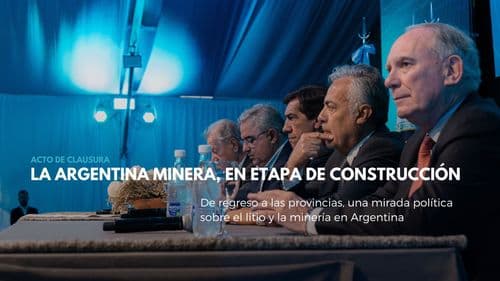
La Argentina minera, en etapa de construcción
8 oct 2026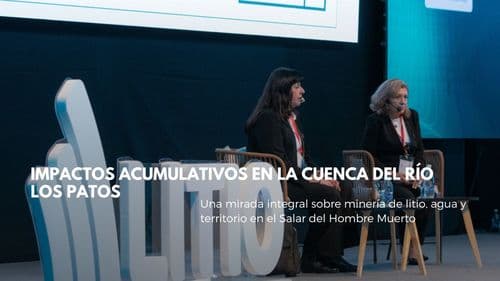 Duración 22:44
Impactos acumulativos en la cuenca del río Los Patos
8 oct 2026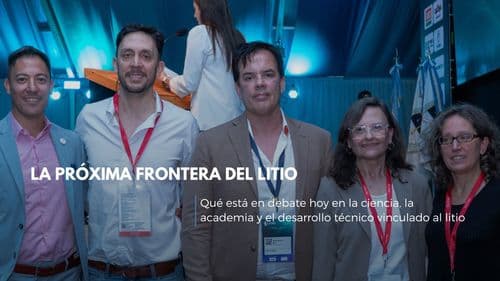 Duración 53:21
La próxima frontera del litio
8 oct 2026 Duración 53:32
Lo que viene después del salar
8 oct 2026 Duración 30:08
Rincón, mucho más que una planta de litio
8 oct 2026 Duración 52:01
El mercado, desde múltiples miradas
8 oct 2026 Duración 17:22
Formentera: avances y hoja de ruta hacia la producción
8 oct 2026 Duración 20:28
Más allá de la extracción directa: optimización integral del proceso, desde la salmuera hasta el producto final
8 oct 2026