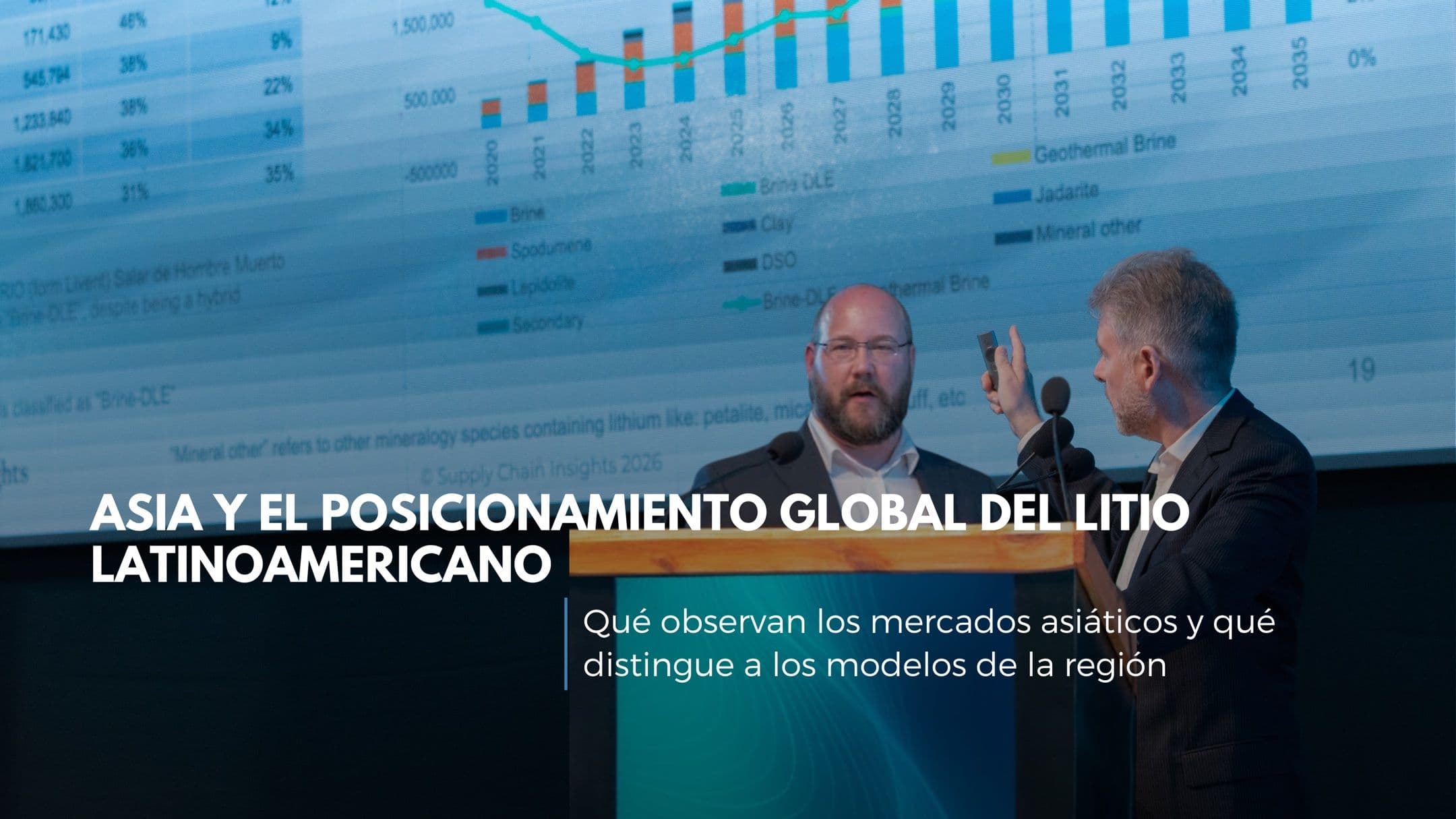

Asia y el posicionamiento global del litio latinoamericano
7 de octubre de 2026 · Duración 45:08 · 2 oradores
Qué observan los mercados asiáticos y qué distingue a los modelos de desarrollo de la región
Oradores

Andrew Leyland
Founder, SC Insights

José Hofer
Lithium Supply Chain Specialist, SC Insights
Transcripción
Leer la transcripción completa
0:00Good afternoon. So I'm going to be speaking for about 20 minutes, unfortunately, in English, and then I'll be passing over to my colleague, José, for a final 20-minute presentation, which he will go back to Spanish for. Let me see if we can get the slides up.
0:58We're going to be discussing whether China's the natural partner for Argentinian lithium products, what products they should be, and also whether the wider lithium triangle is a natural partner for China or for other areas of the world, both in terms of investment and the ability to place product and make a good return on the capital invested. For those of you not familiar with SC Insights, we are an independent research and consultancy. The three main types of work that we do. The first is we do a huge amount of support for debt financing into the supply chain, whether that be for mining, refining, cathode production or battery cell production. Here we advise a lot of governments, export credit agencies and commercial banks on what it takes to get the billions of dollars that this industry needs. We also do a huge amount of work supporting term sheets and off-take contracts. So for a lot of the world, effectively, it's very
1:56difficult to raise debt finance unless you have some type of take or pay off-take contract and we advise on best practice in those contracts. And between those two things, it gives us a really unique insight into the way that the financing world is working and what projects are more likely to go ahead than not. We also additionally have some subscription services of long-term market forecasts. So I think first, when we want to understand whether China is the natural partner for Argentina and the wider lithium triangle, it's first important to understand, you know, why China controls so much of the current battery supply chain. And you can see on the chart there, you've got effectively on the blue line, Chinese battery production versus the entire rest of the world. So for a start, China moved first, it moved quicker and it's already, you know, three to five years ahead of the entire rest of the world, which is catching up, albeit with some Chinese investment. But it's not just that battery production where China controls just over 70% of the supply chain. China also
3:06controls 77% of the most important part of the supply chain. This is the most important part of the supply chain and the one that we often overlook. This is where the lithium is consumed. You can have all the battery production in the world, but if you don't have cathode active material production, you're going to have to ship your lithium to China to be processed. And China controls 70% there. It also controls 65% of the lithium refining capacity and about 18% percent of current production in terms of lithium units extracted from the ground, whether that be hard rock, spodumene, etc. So why has the rest of the world been a lot slower than China is probably a better way to look at this question. And for the 25 or so years I've been doing this, working on project finance both inside China and outside, one of the key things is just I think there's almost some philosophical differences about the way that the Chinese finance a lot of the industry.
4:06There's more focus, particularly when it comes to provincial subsidies on job creation versus just return on capital. China also tends to have a greater focus on security of supply rather than just getting the lowest price. And you see this again and again when Chinese companies outbid Western companies when it comes to resource assets, particularly in Africa and South America.
4:31You also get what I referred to earlier in terms of the off-take contracts. So very difficult to get anything financed in South America, Australia, Europe, the US, etc. without some kind of take or pay off-take contract, some kind of guarantee that somebody will buy your product. Whereas the Chinese industry tends to be a little bit more spot-based and that means that investment decisions can be made quite a bit quicker.
4:55And also it's worth pointing out that quite often the margin acceptability is lower. So a lot of Western investments will want at least a 20% IRR return on the capital invested, whereas quite often that's a lot lower, particularly if it's part of a supply chain investment with inside of China. So what impact does that have? Well, what it tends to mean is without all of that planning, with just this philosophy of let's just expand and expand, you get a lot of overheated sectors.
5:27And we've seen this in steel, in aluminium, in solar panels, in batteries. And where we've seen it a lot is in cathode active material. So the right-hand chart there shows the capacity utilization of the next three steps of the lithium supply chain after extraction. And you can see the purple line, we've got lithium conversion. This is turning your, you know, your chlorides and your spodumines, etc. into carbonates and hydroxides.
5:56That industry operating about 90% capacity globally, relatively comfortable. The dashed line is your cathode active material, where you've got this huge oversupply of capacity, and almost all of that oversupply is inside of China. And what that's done is it's pushed down the margins. It's taken away any kind of negotiating position that cathode active material producers have, and really squeezed the margins.
6:22And when you have an industry that exists, and in many cases is fully depreciated, they can accept a much lower margin than an industry that needs to justify the investment from happening. And what this is doing is it's undermining the investment case for a lot of the cathode active material plants in places like North America and Europe, which may otherwise be looking to buy Argentinian or other South American lithium products.
6:50So, a big impact there from this over-investment and over-capacity that we've seen from China. And you can see that here. So, effectively, these two charts show the European forecast for the industry and North American forecast on the right-hand side. Two industries very similar, but effectively the European industry a couple of years ahead of the North American industry after subsidies were removed in the U.S.
7:20And what you can see is we've got a lot of battery plants going up, both in the U.S. and in Europe. But, effectively, the cathode active material plants aren't happening. So, your lithium consumption is your dashed line, not your solid line there, and it's running quite a bit lower. And you can see that again shown here on a map, and I'll show you the U.S. map in a moment, or the North American map in a moment.
7:45The majority of the lithium consuming assets in Europe are either cancelled or delayed, or they haven't got financing yet. There are very few in operation. Those that are in operation need to have a much higher processing fee or ask for a much higher cost than if you could freely import from China. Because that Chinese industry already exists is depreciated, depreciated often, and operates at scale.
8:14And even where we see Chinese companies investing outside of China, so you have this cluster in Morocco, we also have investments in places like Indonesia, a lot of the Chinese firms have to charge a premium over their own material which would come from Chinese assets. So, effectively, what you've seen is there's a premium for non-Chinese Chinese material, which can be sold into the European market.
8:40The North American market, slightly different, but a very similar color scheme in terms of projects that have been put on hold or cancelled, those which haven't got financing, and those that have made it through to production. So, again, really difficult here, even though there are more safety measures taking away from potential Chinese imports into the US, where, effectively, you have quite a high import tariff, and then, also, potentially, if you're buying from a company with over 25% Chinese control or based in China, then, the rest of your supply chain may not get its manufacturing credits and, effectively, negates the ability to sell Chinese material.
9:24But, still, there's a big issue with the North American market there. You know, North America has a huge amount of lithium. And, what you will see in the next couple of years is that the lithium which they start producing will actually be sent to China, because that's the only market that can produce it. America, I think, you know, eventually will become a net exporter on purpose, but, effectively, you're going to have America becoming a lithium exporter by mistake, while the rest of the supply chain is built to process the material.
9:58They know this. We don't publicise it a lot, but it's well known. And, then, potentially, from the mid-2030s, given the number of assets, if the DLE technologies and the smack-over formation work well, then I think it's pretty fair to say that the USA will be quite a large international exporter. So, okay, if you're going to be selling material, do you want to know what material is worth selling?
10:26And, I think it's important to know here, you know, there's a big debate as to whether you should be selling battery-grade chemicals or an intermediate product or a raw material product. And, the industry's business model has changed here over the last three to four years. So, what happened when prices were coming down after the bull market is a lot of the Chinese converters didn't want to take on price risk, so they moved to a toll-refining business model.
10:53And, that toll-refining business model is now the standard globally for conversion into battery-grade chemicals. And, you can see here the calculated margins at a Chinese refinery. There used to be some super profits when prices were high. This is the green bar on the sleeve. But, when spodrumine prices have come back up, the proportion of value which is kept at the conversion to battery-grade chemicals has now declined.
11:21The super profits are now more likely to be kept at the extraction stage of the supply chain. And, we've seen that particularly in the spodrumine market and also in this developing lithium chloride market, which I'm sure you would have discussed today already. It's also worth looking at whether some of the, what technologies are sort of, you know, winning at the moment. Because, we're actually seeing a slowdown of the technologies which are being adopted in the battery industry, or at least those which are reaching mass commercialization.
11:57And, that gives us a little bit more certainty, again, as to what products should be produced and sold to the market. If we go back five or six years ago, there was a lot of debate between, you know, whether the industry would be predominantly hydroxide or carbonate. And, obviously, carbonate sort of won out on that, but not completely. And, if we look at ground transportation, there's very much, you know, two schools.
12:25You need a premium product and a non-premium product. The premium product is your high nickel, NCM type cathode material, which would consume lithium hydroxide. And, then you've got your mass market, LFP, LFMP market, which is happy with a much lower energy density. And, to be honest, the level of commercialization of technologies is very much on those two technology roadmaps. So, now, going, introducing Gen 4 LFP with Gen 5 in the pipeline and going from either mid-nickel to 811 or 9.5.5 on the NCM side of things.
13:06The storage market, where we see the biggest growth in terms of gigawatt hours at the moment, very much LFP, you know, over 98% LFP-based batteries at the moment for mass commercial storage. What we will see there, though, is that sodium ion will start taking a lot of market share. There are various reasons for that. I'm sure we've got some content out there showing the differentials between lithium and sodium ion.
13:36But, effectively, the big thing is there simply isn't enough lithium being produced to meet a lot of the optimistic demand forecasts out there. And, the only other realistic solution you have is being able to mass commercialize sodium ion if you physically can't get enough lithium. And, that's certainly what CATL have been planning for. So, when we look at some of the other more sort of high growth markets, more of the exciting markets, particularly in terms of aviation and in terms of robotics, I think, in aviation, that's where we're seeing the sort of more exciting technological advancements.
14:15A lot of those are using high nickel cathodes at the moment, but certainly we have a view to introduce solid-state, semi-solid-state, lithium-sulfur. Really niche batteries where cost isn't hugely an issue versus energy density because you've got to get the material airborne. So, the dynamic for the aviation industry is completely different to moving boxes around on wheels or putting boxes in fields.
14:40Finally, it's worth mentioning the robotics industry. It's relatively small at the moment. And, interestingly enough, we're not seeing a lot of cutting-edge batteries going into the robots that you see at the running marathons or dancing, etc. They tend to be actually just using NCM or LFP cells at the moment. I expect that will change in the future, but at the end of the day, it's relatively easy for these robots to either plug themselves in or to replace their batteries.
15:12So, when we're looking at what does China want to buy, well, about 70% or over 70% of the Chinese market is LFP-based at the moment. And it's worth mentioning, China's industry will develop differently to the rest of the world. China has a much younger grid infrastructure than places like Europe, South America, or North America. It has a much higher population density. It has fast charging infrastructure.
15:45Many of the cities have battery swapping infrastructure. And there's also a very developed high-speed rail network. All of that means that you take less long car journeys. And the way that people drive in China and the distances they drive is very different to Europe and certainly very different to North America. And that actually changes the dynamic of whether you want an LFP battery, whether you're happy with a 250-mile range, or you want an NCM battery with close to 350-mile range.
16:15China also has the ability to process material, an excess of processing capacity, and a shortage of raw materials. So, again, all of these things point to them having more carbonate demand. But because of that disconnect between the amount of processing that they have versus raw materials, it also means that the market for exporting an intermediate product to China is three times higher than, or three times bigger, than the market for shipping a battery-grade product to China.
16:48It's also where more of the profits are kept. So, the sort of obvious conclusion from that is, well, if you have a standard project here in Argentina, the obvious thing to produce is an anhydrous lithium chloride and to ship that. And you also then take on less capex and less technical risk with the potential that in the future, when you actually have cash flow, you can then expand into battery-grade products.
17:13And it's a hell of a lot easier to get investment when you've got cash flow. So, just final two slides from me before passing on to Jose. I don't know how I'm doing on time, Jose, because I can't actually see the clock from here. What price is China going to pay? So, we've got our long-term forecasts up there, which are between $21,000 and $25,000 per tonne, but very volatile over the time period.
17:42One quick thing I wanted to show, though, is what CATL's view of this market is. And we can get some interesting views from some of the deals that they've done in the past. So, if you look at the blue line there, the number one, this is CATL, Shan Xiaowe's production cost before the mine was shut down. It's about $14,000 per tonne for a battery-grade lithium carbonate. And that shows, I think, reasonably what they view, what the world's largest consumer of lithium views as a reasonable price for the product.
18:14You've then got number two, which was back in 2023 when prices were very high. They offered some of their customers a fixed-price deal at $29,000 per tonne. So, I think, again, it's realistic that the biggest consumer of lithium, the biggest producer of batteries, view $29,000 as a high price. And you can see that our forecasts are somewhere in the middle of those two. But, again, it does give a good sort of view on the sort of psyche of the Chinese industry as to, you know, that fixed-price deal and the price they were willing to keep lipidolite operations open at.
18:52Just finally, for me, I was asked to compare a little bit between, you know, whether a lot of the Chinese material was likely to come from South America or from Africa. You know, the vast majority of the African resources are controlled by Chinese companies, but all of them come with some type of problem. And the issue is that a lot of the supply in Africa is not reliable in the long term, but it is more reliable in the short term.
19:19So, a lot of the unbeneficiated ores that you get in Africa can actually respond to higher prices in a three- to six-month time period because they don't necessarily have to go through pre-feasibility studies and environmental permits and EIAs and FSAs and bankable feasibility studies and 43101s and all these other things. A lot of the low-grade material can be shipped quickly.
19:43We've seen that in the past from Zimbabwe and we've seen it in the past from Ethiopia and Nigeria as well. There are plenty of hard rock deposits around Africa. The issue is, as I said, each country comes with its own challenge. And just quickly going around, you know, if we look at Mali, there's effectively an insurgency which is countrywide happening there. In Nigeria, you're very likely to see restrictions on the low-grade exports that you have at the moment.
20:11They'd be crazy if they didn't follow the Zimbabwe export ban, enforcing beneficiation of the material domestically. In Namibia, very low-grade materials. Hasn't managed to attract a huge amount of investment at the moment. Ethiopia, again, an ongoing conflict which quite often restricts access to ports. The DRC, where we're starting to get material out, you've seen lithium put on a critical minerals list.
20:39Again, that tends to mean that you're more likely to see an increase in free carry stakes, where typically African governments will take a percentage of a project as it moves closer to production. And you're also more likely to see import tax, export taxes, and quotas coming onto the market as well. So Africa has a huge role to play, but for us, it's very much as a swing supplier to the industry.
21:02Whereas the solid supply, the year-on-year supply is more likely to come from places such as Argentina. And with that, I'll pass over to my colleague Jose.
21:20Y en todas las cosas, felicitaciones por el enorme éxito que tiene Argentina, que ha tenido Argentina durante toda esta última década en términos de desarrollo de proyectos de litio y también principalmente el aumento de la producción, lo cual es impresionante. Andy ya tocó varios de estos temas, pero solamente nos gustaría recalcar que nosotros como SC Insights hacemos una gran cantidad de trabajos de asesoría en contratos, también evaluación de proyectos y finalmente tenemos una de las mejores bases de datos georreferenciadas de la industria de los materiales de batería y materiales críticos.
22:05Nuestros clientes son bastante variados, dentro de esos partimos con los de petróleo y gas, lo cual muestra que existe interés no solamente de las mismas empresas de litio, sino que también empresas fuera del mercado que han invertido seriamente, no solamente en Argentina, sino que en Estados Unidos es el caso más patente. Otros clientes, como ven ustedes, fondos mineros, compañías mineras, refinadores, recladores, compañías de LED, productores de precursores, catos, manufacturadores de vehículos eléctricos y finalmente agencias de gobierno.
22:38Para entrar en materia derecha y hacer una bajada de recursos complementando lo que presentó mi colega Andy, es bueno mirar todos los materiales críticos con una ventana, con un prisma más amplio. Y dentro de eso nos damos cuenta que existen materiales críticos, materiales críticos que son más críticos que otros, no todos son hechos de la misma materia. Es así como hay algunos que son bastante comunes, esta es una clasificación occidental, ustedes la pueden ver repetida entre Estados Unidos y Europa, se van a dar cuenta que hay algunos que son muy comunes, otros mercados que son muy pequeños.
23:23Hay otros que donde están altamente concentrados y litio, junto con tierras raras, cesio, cobalto, cobre, tántalo y tungsteno, se encuentran en los que tienen suficiente mercado y suficiente tamaño para ser explorados íntegramente. Ahora, litio es un material crítico que crece a niveles sustentables, bajo dos dígitos, no es tan sustituible, pero existe un sentimiento un tanto pesimista durante el mercado.
23:53Y eso no es necesariamente culpa del litio, sino que también se debe a que elementos como el cobre o las tierras raras se han vuelto muy sexy y le generan bastante sombra al litio. Si nos vamos, si miramos en detalle la oferta del litio, nos damos cuenta que al lado izquierdo, eso es lo que tenemos bajo un escenario conservador, y al lado derecho es si todos los recursos minerales bombean todo lo que es el material al mercado, y nos damos cuenta que ya se ha descubierto todo el litio que necesitamos para esta transición energética.
24:36Es decir, no hay un déficit geológico, sino que nos vemos enfrentados simplemente a la capacidad de ejecución que tienen los distintos proyectos hoy en día y la facilitación que pueden ofrecer los distintos gobiernos para desarrollar esos proyectos. Facilitación que en el caso de Argentina ha sido exitoso y ha sido fluido. Si miramos el mercado desde la perspectiva de las decisiones finales de inversión o los estudios de factibilidad definitivo, nos damos cuenta que estos cayeron significativamente desde el año 2023, donde los precios estaban bastante atractivos al 2024, donde los precios decayeron y el 2025, donde tocamos fondo.
25:21Hoy en día tenemos 12 en el mercado de decisiones finales de inversión, lo cual remonta un poco al sentimiento negativo del año 2025, pero no es necesario, no es suficiente. Y al mismo tiempo nos habla mucho de una de las razones principales por las que los precios iban a rebotar durante finales del año 2025. Esto era inevitable y nosotros lo pronosticamos durante todo el año hasta que sucedió en el último trimestre del año 2025.
25:52Si vemos la oferta por fuente, es decir, tanto minerales como de salmuera, e incluyendo reciclaje en la parte de arriba de la curva de oferta, nos damos cuenta dos cosas. Una negativa, que es que a lo largo de los años, en la tabla que ven ustedes a la izquierda, la participación de salmuera, incluyendo las todas, ha ido disminuyendo. En el año 2015, de un casi un 60% ha ido bajando a los 40, después a 38 el año 2025, y estabilizándose entre 35 y 31.
26:29Esa es una muy mala noticia, pese a que la producción desde salmuera tiene menor huella de carbono, tiene menor intensidad de uso de agua y tiene menor intensidad energética. Sin embargo, hay una buena noticia, y esa noticia tiene que ver con lo que se habló en la mañana, de que la participación de DLE dentro del sector de salmuera aumenta. Ustedes ven en la segunda columna, de un 12% o 9% va subiendo finalmente a un 35%.
26:57Y eso se debe a que la mayoría de los recursos de salmuera de alta ley o con una geografía muy fácil de explotar se están acabando. Y los yacimientos, los proyectos, cada vez son más difíciles desde un punto de vista de concentraciones de litio, mayor concentración de contaminantes, pero también porque la geografía no lo permite. Eso lo ven ustedes en estos dos gráficos a la izquierda, la disminución no tan notoria de salmuera como todo un grupo integrado, pero a la derecha una mayor participación de DLE dentro de la industria completa.
27:35Y eso es muy positivo para todos nosotros acá y para el continente completo, especialmente en el triángulo del litio. Si nos vamos a los proyectos emblemáticos, nos damos cuenta que existen compañías muy grandes detrás de estos proyectos de DLE, lo cual es muy positivo. Sin duda alguna hay menos proyectos de, menos compañías de DLE que proveedores de DLE. Ustedes tómenlo como les plazca esa información.
28:06Sin embargo, es difícil desarrollar un proyecto de DLE. Nos damos cuenta que proyectos que entraron en los años 90 comenzaron su desarrollo de patentes a fines de los 70, a principios de los 80. En el caso del primer proyecto, 100% de DLE que entró en el año 2025 se entraron a ratones. Existe una enorme cantidad de recursos e inversión en I más D y al mismo tiempo una buena cantidad de años que han tenido que transitar para llegar al mercado.
28:35Lo mismo pasa para empresas que están en Estados Unidos como Standard Lithium, Río Tinto, en Argentina a su vez, Exxon también en Smackover, Albre Marley y SQM en Salada Atacama, que eventualmente van a transicionar a DLE parcialmente, y otras compañías así sucesivamente en Europa, en Estados Unidos, de nuevo en Smackover. Eso es muy positivo, sin embargo, lamentablemente las cantidades totales de DLE en términos de oferta no son tan altas.
29:10Si nosotros estamos pensando en una oferta total de 4.5 millones de toneladas de carbonato equivalente, o incluso 5 millones, como para poder satisfacer la creciente demanda, no solamente de vehículos eléctricos, sino que sistemas estacionarios, y finalmente tecnologías de frontera, es poco. 660, incluso un millón de toneladas, es bastante poco. Sin embargo, por el momento, no se ve ese efecto multiplicador en la producción a través de DLE.
29:42Pasando a Argentina, esta es una de las mejores láminas que tenemos. Si llevamos las exportaciones de Argentina mensuales y las anualizamos, nos damos cuenta que Argentina en 6 años aproximadamente ha logrado sextuplicar su producción. Iniciando con cerca de 30.000 toneladas de carbonato equivalente en el año 2020, a hoy en día anualizado entre 150 y 180.000 toneladas de carbonato equivalente.
30:08Es decir, aquí hay un caso de éxito que es muy difícil de verlo replicado en otras naciones, en Sudamérica. Y como vamos a mostrar en la lámina siguiente, esto se va a seguir perpetuando y expandiendo en los próximos años. Si ven en el mapa, ahí en la lámina del lado izquierdo, Argentina logra iniciar su tercer proyecto ya en el año 2023. Este proyecto es 100% DLE. Asimismo, en el año 2025, su cuarto proyecto, perdón, no, miento, miento.
30:48El tercer proyecto en Argentina fue Cauchario Laros, que no fue 100%, fue con piscinas todavía. Pero el cuarto proyecto se inicia en el año 2025. Centenario de Ratones se inicia en 2025 también, 100% DLE. Y esto es muy interesante, lo último que les voy a mencionar, que ya desde 2026 parte el primer proyecto 100% exportador de cloruro y litio. Y eso es altamente importante, puesto que hay una buena cantidad de proyectos que se van a desarrollar de aquí a fin de la década y a la siguiente década, que para disminuir el riesgo del desarrollo del proyecto mismo terminan produciendo cloruro de litio en sal o en solución.
31:32Y no hay absolutamente nada malo de eso, todo lo contrario. Esto termina dinamizando el mercado y alentando al resto de los proyectos a que sigan produciendo, no produciendo químicos de litio. Ese no necesariamente es el objetivo último, sino que con cloruro de litio ya pueden entrar al mercado fácilmente. Las razones detrás de este círculo virtuoso y éxito de Argentina son varias.
32:01En primer lugar, el foco en exploración. Las actividades de exploración de Argentina llevan no años, sino que décadas. Y hoy en día se están viendo los resultados. En segundo lugar, el rol acotado del Estado en Argentina, el Estado, a diferencia de otros países, no apuesta por tener la mayor participación en proyectos, sino que es una participación acotada, lo que permite que las empresas trancen derechos mineros, que tengan un mayor dinamismo y que no se vean ahogados en términos de regalías ni de impuestos.
32:36En tercer lugar, un marco legal amigable. Es muy fácil de entender el marco legal en relación al litio que existe en Argentina y, por sobre todas las cosas, la cordialidad que hay de la gente que trabaja en litio en Argentina a la hora de negociar nuevas inversiones o de traer nuevos inversionistas. Y más importante aún, y final para terminar esta lámina, que si uno ve los ciclos de precios que cada vez en el litio son más volátiles y más cortos, Argentina ha aprovechado todo el ciclo de precios anterior.
33:12Si ustedes se fijan, cuando subieron los precios, el año 2022-2023, Argentina ya estaba metiendo el tercer proyecto. Cuando los precios rebotaron el año finales de 2025, ya Argentina estaba metiendo un proyecto full de LE y hoy en día está en muy buena condición con más de 60 proyectos para aprovechar cualquier nuevo ciclo de precios que venga. Donde nosotros estamos altamente confiados, ustedes solamente deberían ver nuestro pronóstico de precios y las láminas de costo que vamos a mostrar de que más temprano que antes vamos a tener precios mucho más positivos, precios muy parecidos a los del 2023.
33:54Esta lámina es una de las más importantes de la presentación y de la conferencia porque muestra el desarrollo de los proyectos de Argentina y la oferta total en los próximos años, hacia finales de la década y de la próxima década también. Pusimos nosotros la oferta de Australia como para tener cierta métrica y también la oferta de Chile como para poder ver que Argentina, si bien no sobrepasa Chile, casi la alcanza.
34:25Es muy distinto tener producción de un solo salar, dos activos con un tercer y cuarto proyecto que se ven extremadamente lejanos, a tener más de 50 proyectos entre producción, exploración, prefactibilidad, factibilidad, desarrollo y comisionamiento. Hoy en día Argentina, como ven ustedes en la tabla abajo, tiene siete proyectos en producción, en cinco años más va a tener 14 y en el año 1036, sin contar expansiones, van a ser más de 30 proyectos produciendo diversos productos.
35:05Esto no es solamente carbonato, esto es hidróxido de litio, carbonato de litio, tanto grado técnico como grado de batería, cloruro de litio en solución y cloruro de litio en sales. Y Chile sigue con dos proyectos ad eternum, sencillamente porque uno de los proyectos no tiene financiamiento y el cuarto proyecto ha caído en una situación legal muy difícil de sobreponer. Ahora, no todo esto se debe al RIGI.
35:41RIGI es una herramienta donde hay 12 proyectos y donde no solamente de litio, sino que infraestructura, petróleo y gas, y donde se incentiva mediante regalías o estabilidad taxativa, los proyectos de mayor inversión de 200 millones a seguir, digamos, desarrollándolos. Es un sistema de objetivos bastante claro, a diferencia de mover en Brasil, pero no tiene la componente de vehículos eléctricos que tiene mover, a diferencia de RIGI.
36:20Ellos van un poquito más adelante, para bien o para mal, y lo hacen el gancho con vehículos eléctricos. Brasil, a todo lo demás, hoy en día hay que alegrarse porque está empezando o empezará un gobierno pro-inversión que es la tónica en toda la región y eso es muy positivo para todos nosotros. En el caso de Chile, es muy positivo que se haya aprobado la ley de reconstrucción, pero hay que recordar, esta ley de reconstrucción baja el impuesto corporativo de 27% o 23%, que tiene un efecto positivo, pero no en el corto plazo, eso se va a ver en 5, 10, 15 años.
37:00Ahora, el truco acá es que Chile solamente está enmendando errores del pasado, como por ejemplo, la eliminación del DL600, que tanto beneficio le hizo a Chile atrayendo inversiones en la segunda mitad de los 80, los 90 y así sucesivamente. Ahora, Chile es bastante divertido lo que pasó, que solamente por el cambio de administración hubo ahí un coágulo de cerca de 20 billones de dólares en proyectos que fueron presentados frente al sistema de evaluación e impacto ambiental, solamente por el cambio de gobierno y eso es único desde el año 90.
37:42Ahora, hay algo que me gustaría recalcar acá, y estos no son datos nuestros, el único dato no nuestro que presentamos, son datos del Servicio Geológico de Estados Unidos que muestra la facilidad y la capacidad que tiene Argentina de mover reservas a recursos. Esto es admirable y es notable porque, a diferencia de Chile, Chile viene bajando su capacidad para transformar recursos en reservas.
38:10La mayor parte de los proyectos en Chile, no solamente en litio, sino que en cobre también, son proyectos brownfield, son expansiones y no son greenfield. En el caso de Argentina, hay un enorme portafolio de proyectos que son greenfield, que se están desarrollando, y ojalá la industria del litio incentive a que se puedan desarrollar más proyectos en cobre como los que tienen en San Juan y Mendoza.
38:37Perdone si me falla la geografía, ustedes me corrigen. Y ya entramos en materia derecha, en las últimas láminas de la presentación, y me gustaría terminar un poco con demanda. Esto es muy interesante porque nosotros fuimos la única consultora a nivel mundial que pronosticó bien la subida de precios de finales de 2025. Entonces, cuando todos nuestros competidores estaban modificando los precios, nosotros nos pusimos a estudiar las fuentes de demanda de frontera.
39:09Esto es un nivel más allá, pasado el almacenamiento en redes. Esto incluye satélites, baterías para usos militares, drones, elementos portables, y finalmente nanomedicina. Esto es muy interesante y muy positivo para el mercado del litio porque aquí no entran las baterías de sodio y on. Por un tema de densidad energética, esto es un sector exclusivo a las baterías de alta densidad y de nueva frontera, y químicas de nueva frontera, como son el estado sólido y las baterías de litio-súlfuro.
39:47Es decir, acá no hay sustitubilidad, sustitubilidad como lo existe en el almacenamiento para redes. Ahora, este sector es muy pequeño, pero crece a tasas muy altas. Si nos vamos a los últimos siguientes 5 años, crece a tasas del 20% y después a tasas del 30%. Sin embargo, pese a que se ve lejano y pese a que tiene poca participación comparado con almacenamiento en redes o vehículos eléctricos, esto está sucediendo a medida que hablamos.
40:20Desafortunadamente, la mayor parte de las aplicaciones tiene que ver con defensa y tenemos casos a la orden del día de cómo se están consumiendo drones, baterías militares, satélites, etcétera, etcétera. Esta es la próxima revolución que va a darse antes de finales de la década y principios de la siguiente. Volviendo un poco a la curva de costo, sin mostrar nuestro pronóstico de precio, déjenme decirles que a modo de conclusión es extremadamente improbable que volvamos a niveles de precios de 10 dólares por tonelada métrica sencillamente porque el grueso de la oferta de rocadura, que son productores australianos principalmente, no hace márgenes, no hace renta a este nivel.
41:08Existen 25% de la oferta mundial que se ubica en esta área al medio. Luego la lepidolita china, que es material de muy baja ley, muy malo, al igual que algunos concentrados desde África, tienen costos de al menos 14 mil dólares por tonelada métrica y una huella de carbono que no se puede obviar. Después Andy explicó en gran detalle nuestra visión de largo plazo, pero yo quería recalcarlo que es altamente probable que los precios vayan a subir de nuevo y nos beneficia a nosotros porque nosotros en la curva de costos, si quieren verla en colores, nos la preguntan, estamos al lado izquierdo.
41:51El desarrollar proyectos de salmuera no es tan fácil como bombear material de baja ley, pero sin embargo tenemos baja huella de carbono, baja intensidad energética y un uso de agua que está muy por debajo como los materiales como la lepidolita o materiales africanos. Aparte de que no hay ninguna componente ética, si nosotros nos preguntamos a nosotros mismos, yo preferiría tener cobalto del Congo en mi vehículo eléctrico a tener material litio de Mali o de otras jurisdicciones donde la participación artesanal es bastante amplia.
42:33Y para terminar, existen muchísimas razones, esta lámina de conclusiones las hemos presentado exitosamente en muchos lados, muchas razones por las que los precios no se van a desplomar. En primer lugar, hay un mercado poco líquido fuera de China, los precios GFX, también hay muy baja credibilidad estos precios GFX y también por los factores de que se puede ser manipulado. En segundo lugar, la producción de proyectos del tercer cuartil son alternantes, no son constantes.
43:06Por lo tanto, tal como pasó en el 2025 y 2026, donde han salido muchos de estos tipos de ofertas del mercado, se puede volver a repetir con precios bajos. Finalmente, China no controla solamente el 21% de la oferta. China tiene predominancia en refinación, en producción de precursores y cátodos, pero no aguas arriba. El mejor, de nuevo, como decía uno de nuestros mentores, el mejor yacimiento chino no es mejor que el peor yacimiento fuera de China.
43:42Y litio, de nuevo, un mensaje positivo, es un mercado nuevo. No es un mercado maduro como el mercado de cobre. Es un mercado nuevo donde la curva de costo es bastante empinada, por lo tanto, cualquier perturbación en demanda va a redundar en salto de precios y finalmente una gran porción de la curva de oferta no se ha construido. Y cuando se construya, nosotros esto nos dedicamos a asesorar a empresas de gran tamaño en curva de costo, en costos, digamos, estimados.
44:16Cuando entren estos proyectos van a entrar a mayor costo del que ellos publican hoy en día. Y eso lo hemos visto en los últimos años, un aumento de costo significativamente. Y bueno, con eso, les damos las gracias por su atención, les damos las gracias por la invitación y quisiéramos dejar los invitados a que nos pregunten si tienen alguna duda, si quieren alguna explicación en mayor detalle o si quieren alguna demostración de todo nuestro material en detalle.
44:45Así que muchísimas gracias y nos vemos en la próxima edición de Panorama Minero. Gracias. Thank you.
Más de este evento
 Duración 40:29
La Argentina minera, en etapa de construcción
8 oct 2026 Duración 22:44
Impactos acumulativos en la cuenca del río Los Patos
8 oct 2026 Duración 53:21
La próxima frontera del litio
8 oct 2026 Duración 53:32
Lo que viene después del salar
8 oct 2026 Duración 30:08
Rincón, mucho más que una planta de litio
8 oct 2026 Duración 52:01
El mercado, desde múltiples miradas
8 oct 2026 Duración 17:22
Formentera: avances y hoja de ruta hacia la producción
8 oct 2026 Duración 20:28
Más allá de la extracción directa: optimización integral del proceso, desde la salmuera hasta el producto final
8 oct 2026