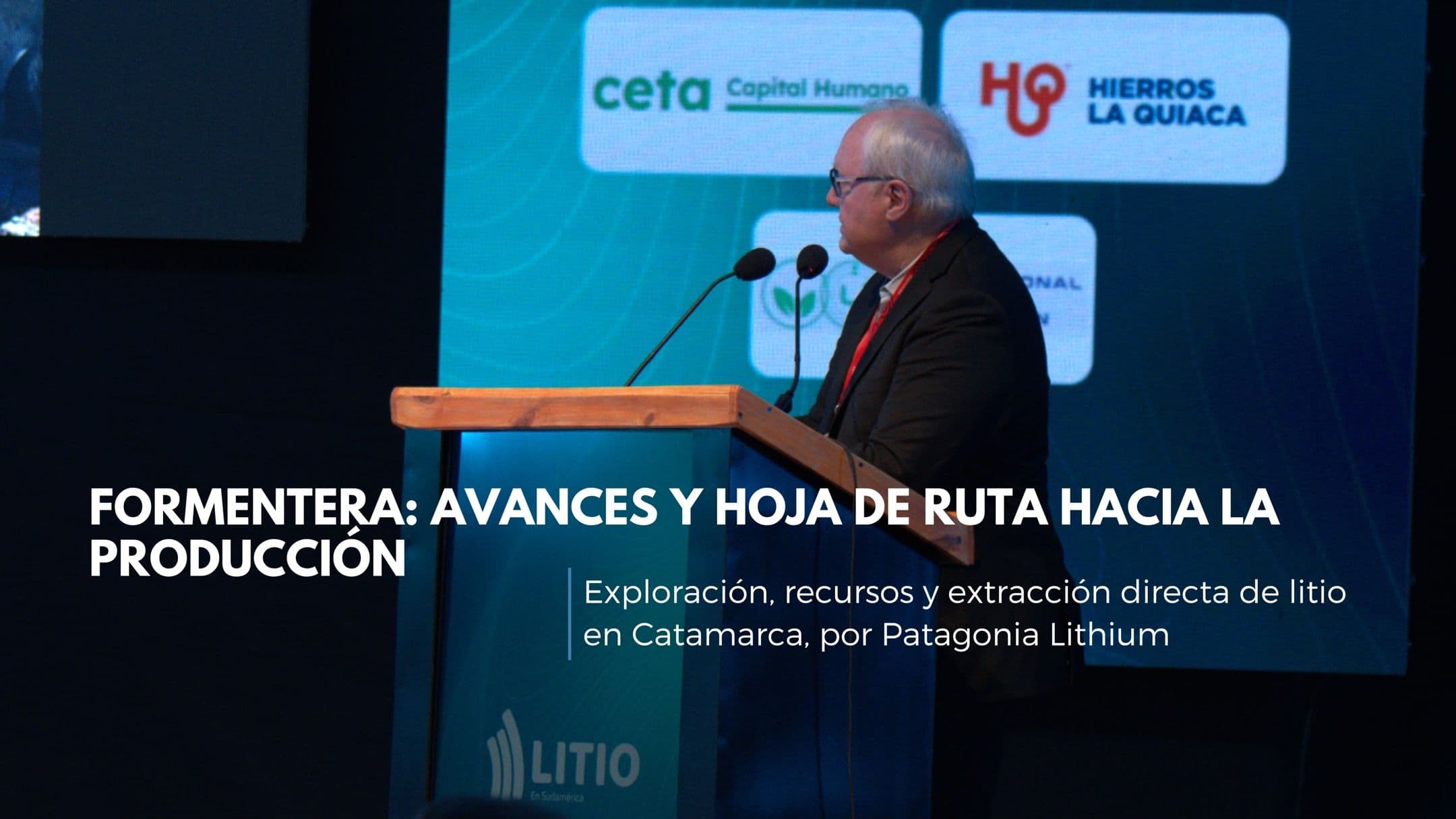

Formentera: Progress and Roadmap to Production
October 8, 2026 · Duration 17:22 · 1 speaker
Exploration, resources and the application of direct lithium extraction in Catamarca
Speakers

Phillip Thomas
Executive Chairman, Patagonia Lithium
Transcript
Read the full transcript
0:16Good morning, everybody, and welcome. I'm going to give you about three and a half years of exploration in about 13 minutes, so everyone's got to concentrate. onto the next slide. So we've got nine wells, we've completed eight and nine just recently this month. Our whole number eight came in at 232 ppm, which is about 70 ppm below the average for the whole project. Our 72 hour pump test, we redid wells two, three and six and got 225 ,000 litres at 3 ,250 with a 5 ,400 litre per hour pump, but we're at 4 ,100 metres above sea level, so the pump performance was slightly less. We used the passive seismic survey to determine the basement, and that had limited success. With passive seismic, you've got to be very careful on what results you're looking at, and I'll talk about that in a minute. Zelandes completed all our BMR and our highest porosity was 38.
1:26By comparison, Kachauri is 6%. So you can see that we have a very sandy clay system within the Harma Basin, which we have about 90 % of the Fomentera Basin. Core analysis has been done. A couple of providers, and they're ranging from 20 to 40, so there's a reasonable degree of... correlation between the BMR gamma surveys and the core surveys. Of course, core can be analysed in many ways, and we've been using helium and fluids.
2:06We have two mineral resource estimates. The first one was 3.8 million tonnes. It was done by WSP Australia. We all jumped for joy. We thought, you beauty, we've hit pay dirt. Then we looked at it a bit closer, did it again. Again, the resource statement for actual yield, as opposed to what's contained, came in at 551 ,000 tonnes. Still 20 -year mine life, at least at 20 ,000 tonnes a year, but we're going to upgrade that.
2:36We're just having it done at the moment. The scoping report and the EcoSolverShaker tests have been very successful. The first one done at the University of Melbourne was 92.4% recovery. Salsa is 95 .6, so the ecosystem seems to be working exceptionally well. The solvent ratios have been improved, and they're now down to 6 to 1. These are our milestones. As you can see, we're waiting for the mineral resource estimate at the moment.
3:08We're just working on the scoping study at the moment. We're waiting for our permit from the Huhui Mines Department. and then that'll follow a bankable feasibility study. Our production wells, we're going to put four wells in, 21,000 litres an hour. That'll give us two megalitres of brine every 24 hours, and the EcoSolve system will process that just with one set of columns. So in 2028, we hope to be recording 1,000 tonnes of annual production.
3:38We'll build, we have a fair bit of salt, so we can, and the EcoSolve system produces... as it processes the fresh water. So the HCl and sodium hydroxide plant will be in there, and then we're going to go for solar with a diesel gas backup system. Just some pretty pictures of the resistivity from our MT survey, which was done, and you can see the aquifer basically has two components to it, which I think there's a little fault in the middle there.
4:12recorded 1 ,122 ppm of lithium and we've got some pretty good hits around holes one and two. You can see the the boys over there getting ready to to put a BMR gamma test down the well. It's a closer look and you can see where our holes are. Unfortunately we can't hear those two bullseyes because there's water In Harmar, you can't drill around water bodies, so we've had to relocate the wells.
4:50This is a cross-section, and you can see holes 1 and 2 where we've got 580 ppm. You can see the Ignambrite units of the volcanics producing a possible source of the lithium. And then there's the basement. We're not sure whether the basement really is the basement because we've got fairly high porosities you can see there 12 .9 and 13 .5 and one other sample of 14 .13 so they're they're pretty exciting porosities to have in a basement so we need to do some more work it's probably a seismic challenge rather than a passive seismic here you can see in the top left hand corner there the various units that we've picked from the electromagnetics signals from the passive seismic, and I tell our junior geologists, remember you're looking at electromagnetic waves, you're not looking at lithologies. So it's important to do that interpretation correctly, and you can see in the bottom left-hand corner where we went
5:51with the seismic, and you can see the lagoons, and to the top right -hand corner there's a small stream system. You can see our last location. nine, and then you can see the green dots where we've drilled, and our concession. The orange box in the middle is Ceylon, which was a borate mine, and I'll just look for borate because I know that usually there's lithium close by. So that was a given.
6:22And you can see the blue lines, which outline the 500 metre boundary to the water deposits. And in the top right-hand corner in the air. 2607, you can see the lagoon, where we may put our raffinate waste brines into that or evaporate it or re-inject it to the north of 2607. Above 2401 is where the EcoSolve plant will be put in. Shares have had a good run. This was up to October.
6:56We're back to 12 cents, but we've touched 22, 23. about 327 million shares on issue, and some quite heavy trading from the institutions when they came in. If you have a look at our performance, Patriot Metals have done 20, we've done 292, and there's some other players that are in our peer group, but obviously as lithium price changes, our share price changes. These are the sands.
7:30This is just an amazing photograph of Tamara's hand with a glove on it. And you can see there the sand at 284. It's just so porous, which is fantastic for pumping. And you can see in the top left -hand corner there our assay values on each of the packers. And they're reasonably representative of what we've been able to produce, but holds 2 and 3 were fantastic. I couldn't believe my luck, and of course it ran out when I went to 4 and 5, but came back again at 6. So our column data is well understood, and I guess that's the key here, is to really understand what the units are doing, how much brine you can pump out. So here's the mineral resource. You can see there the lithium grade. We're I'm interested in the magnesium, because the EcoSolve system is agnostic to magnesium.
8:31It gets washed out any that's remaining in the solvent that's entrapped, but it's peanuts, 1.9 milligrams per litre. So the model of production, we're really focused on the specific yield, which is the key point, and also the lithium grade. to the specific yield.
9:01Another interesting schematic of what the aquifer may look like, I think that this is probably simplistic in that we've got substantial porosity at levels of 280, 300, 350, 400. So when you do the block model, you get the WSP value of 300. 3.8 million tonnes. When you do the drain model, it's slightly less than that, but once again, it's a function of the distribution of our porosity across those different types of sediments, which is our key driver.
9:39Here's a really interesting graph, which sends most people to a sleep, but I'm going to try and show you what the key thing is. This is the key one. from Zealanders and that's basically the drainable water and then the beige is the capillary and the grey, the brown is the clay. So when we go down here we can see some very heavy porosities and big flow rates and this is what we're correlating to the actual soil lithologies that we're taking. So it's pretty important to look at those and also the...
10:17noise. A lot of geophysicists fall over when they don't consider the noise, trying to compute porosity.
10:29This is the results from the EcoSolve process that was run about two years ago. 92 % was recovered. That's gone up as high as 97 % recovery now. The time is 10 minutes. Three minutes to fill the column, two minutes to process to extract all the lithium, and then another four minutes to get rid of the lithium raffinate and move the solvents around. We've done a lot of work in it.
11:00We don't use any fresh water. In fact, we create fresh water in the process. It's all solvents, so it's hydrocarbons, and we've been able to get 100 % recovery of the solvents. The beauty of that is we don't have any OPEX of solvents. We only have OPEX of people and energy. And they're very low, powerful pumps. They're not high-powered, except for the production wells, of course.
11:28So they're very low energy use. Got good extraction, 100% recapture the solvents. We're producing fresh water, and it's a fast process. So two megalitres... will be produced out of, will be processed every 20 hours and in our demonstration plant, which we're targeting for 2027, 2028.
11:58Go. So this is just a elevation view from a couple of directions, which you can see the big... storage plant with a megalitre, and that'll get filled up. You can see some of the columns, some of the regeneration solvents area, and some of the packing and storage areas. So if we have a look at a planned view, it looks something like that, and a very, very simple system. There's very, very little complexity in the...
12:37plant design, except for the packing system and storage and the cricket room.
12:51Our second project area is in rare earths, and here I've put the rare earth ranking of the 41 ,700 square hectares that we've got. You can see on the right... hand side, all our sampling, which has been done. Thank you to our geologists who walked through those areas. On the left hand side, you can see the CMOC and Mosaic, two separate companies, processing the world's second largest supply of niobium phosphate. So I originally staked that area thinking that I'd be looking at niobium phosphate, and I knew that the Araxa carbonatite rare earth deposit was about...
13:34I didn't think we would have some big hits on the bottom two sections of that concession, which is up on the ranking area. So we've been using a lot of AI and agent AI systems. We've put a lot of time and effort into those. And we've come up with some pretty interesting results.
14:01So on the left... hand side there you'll see 25 drill locations. And the way we got those drill locations was we sent the geologists out, they sampled some soils, we had them assayed and they came back. Then we took some shortwave infrared, we took some satellite data, we took 3 ,700 academic and paper articles and we put it into a database. We then ran about 10 or 15 AI agents and basically asked them to give us a map. We didn't tell them where we sampled. So the AI agent came back and said, this is where you should drill. So we didn't tell where it was and it got 10 out of 10 within 50 metres. So unfortunately all these junior geologists who used to go out and do soil sampling are now going to be looking at AI agents rather than getting out there.
14:58So, as a joke, of course, we still need geologists. But the system was amazingly accurate, given we were looking for soils and changes in geology, changes in mineralogy through the system. We did notice a very high potassium overlay from a flood that Mosaic had. So we were able to pick up mistakes and human error in the system. But this has been amazing. major breakthrough for us and probably saved us $200,000 or $300,000.
15:36So this is the heat map of how the rare earths got there. The holinium came out as a spike, so we looked at that, and that's selling at about $120 ,000 a tonne. There's not many tonnes consumed around the world, but they're important for... for military applications and other sophisticated applications. And you can see there with the heat map and the potassium-uranium-thorium map on the right-hand side, the outline of our concession is right in the key spot.
16:23We've got a pretty all -star team, Rick, who a lot of you have met from Orocobre and obviously Allchem and Livent when it got sold to Arcadium, Pablo Tarantini, who's part of the Integra Capital Group, Ricardo, who's a new director, has joined us, but a lot of experience, so we've got a pretty good line-up of directors to... to develop strategy and implement.
16:59So that's the end of the presentation. That's a good picture of the solar. Thank you for your attention.
17:18You
More from this event
 Duration 40:29
Argentina’s Mining Industry in the Making
Oct 8, 2026 Duration 22:44
Cumulative Impacts in the Los Patos River Basin
Oct 8, 2026 Duration 53:21
The Next Frontier for Lithium
Oct 8, 2026 Duration 53:32
What Comes After the Salar
Oct 8, 2026 Duration 30:08
Rincón: Much More Than a Lithium Plant
Oct 8, 2026 Duration 52:01
The Lithium Market from Multiple Perspectives
Oct 8, 2026 Duration 20:28
Beyond Direct Lithium Extraction: Optimizing the Full Brine-to-Product Process
Oct 8, 2026 Duration 24:22
Lithium: An Industry Still Misunderstood?
Oct 7, 2026