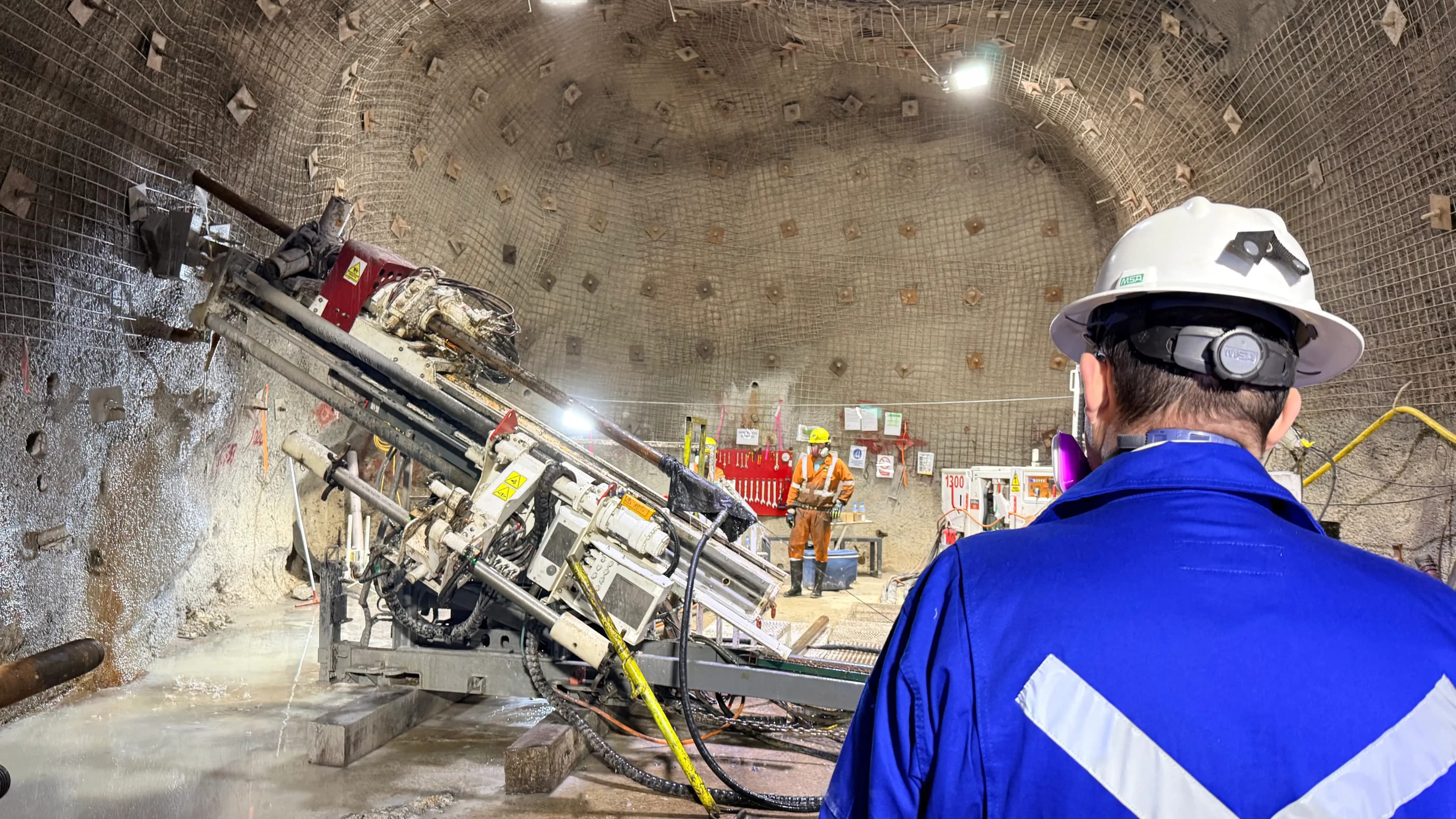
The result corresponds to the Santiago body and was obtained during the 2026 campaign. Minas Argentinas will continue drilling to evaluate the continuity of the mineralization.
By Panorama Minero
Minas Argentinas, a company belonging to AISA Group, reported a high-grade gold and silver intersection at Gualcamayo, in the province of San Juan. Drill hole 26QD-1649 returned 1.80 metres grading 1,510 g/t gold and 1,250 g/t silver in the Santiago body, which forms part of the Deep Carbonates Project (DCP).
According to the company, the gold grade is more than ten times higher than the highest grades previously obtained during exploration of the deposit. The interval is equivalent to a concentration of 1.51 kilograms of gold per tonne of rock.
Minas Argentinas stated that, due to its gold concentration, the result is on a scale comparable with high-grade intersections reported at deposits such as Windfall, in Canada, and Fosterville, in Australia. The next stage will focus on determining the continuity and extent of the mineralization and assessing its potential impact on the development of Deep Carbonates.
“Gualcamayo has a present, scale and a future. We have an operating mine, resources and reserves supported by independent technical reports, infrastructure and teams. Our ambition is to develop the district to its full extent, not to limit it to what we already know,” said Juan José Retamero, founder and President of AISA Group.
Retamero added: “This discovery is exciting for us, but our vision goes far beyond a single sample. We will maintain rigorous, long-term exploration to evaluate our entire property and turn that knowledge into new development opportunities.”
Exploration and Resources
The new result adds to a previously documented resource and reserve base. According to the December 2025 NI 43-101 independent technical report for the Gualcamayo Mining District, the asset contains 7.14 million ounces of gold in Measured, Indicated and Inferred Resources.
The document also identifies more than 3.1 million ounces in Proven and Probable Reserves corresponding to DCP and the remaining deposits, together with an inventory of 262,690 recoverable ounces in the leach pad as of the date of the estimate.
Within this total, Deep Carbonates contains approximately 4.86 million ounces in resources and 2.43 million ounces in Proven and Probable Reserves. Upcoming campaigns will seek to establish the continuity of the new mineralization and determine its potential inclusion in future estimates.
According to Minas Argentinas, exploration carried out to date represents approximately 4% of its mining property. The company plans to continue with a long-term program to expand geological knowledge of the district, identify new targets and define future drilling campaigns.
The 2026 geotechnical, definition and exploration drilling campaign has already exceeded 19,000 metres, out of more than 26,000 metres planned, with four rigs operating simultaneously. The work is aimed at obtaining samples for metallurgical testing, generating geotechnical information for underground design and expanding knowledge of DCP resources.
The Result at the Santiago Body
Drill hole 26QD-1649 was drilled from an underground drift, approximately 700 metres from the main access, with the objective of defining the upper boundary of the Santiago body and obtaining geotechnical information.
The high-grade interval begins at metre 138 of the drill hole. According to the company, the presence of visible gold, high silver grades and the location of the mineralization at the contact between limestone and shale provide information for defining the next stages of exploration.
“This drill hole, with the presence of a bonanza or high-grade zone at the contact between limestone and shale, is consistent with the geology we have been interpreting for this type of deposit, similar to the Carlin-type deposits found in Nevada, United States,” explained Ignacio Cuadra, Exploration Manager at Minas Argentinas.
“Now we need to continue drilling to understand its continuity and determine what impact it could have on the future mining sequence and on the economic variables of Deep Carbonates,” he added.
Deep Carbonates and Gualcamayo’s Next Stage
Deep Carbonates contemplates the development of a new underground mine and a pressure oxidation (POX) plant for ore processing. According to information released by the company, the project involves an investment of US$665 million, with the start of commercial production projected between 2030 and 2031.
DCP received approval to join the Large Investment Incentive Regime (RIGI) through Resolution 6/2026 of the Ministry of Economy, which establishes November 27, 2025 as the date of accession.
For the construction stage, the company projects more than 1,500 jobs. Once in production, the plan contemplates an operation lasting approximately three decades, with average production of 166,000 ounces of gold per year and cumulative exports estimated by the company at more than US$26 billion.