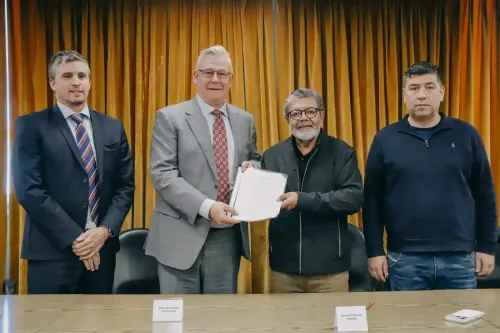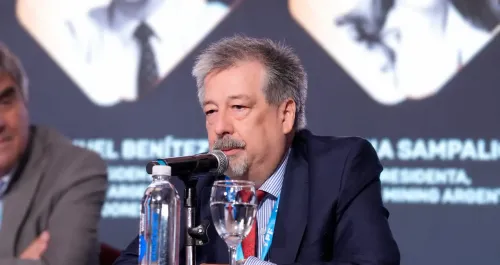
Recent statements by officials from Argentina’s Secretariat of Nuclear Affairs have once again placed uranium at the center of the country’s mining agenda. During an interview on a streaming program, Secretary of Nuclear Affairs Federico Ramos Napoli and Undersecretary of Nuclear Policy Ayelén Giomi confirmed that remediation work at Sierra Pintada is underway and stated that these efforts form part of a broader strategy aimed at restoring domestic uranium production.
By Panorama Minero
While that process moves forward in Mendoza, a private-sector project located hundreds of kilometers from San Rafael continues to accumulate technical and economic milestones that position it among the country’s most advanced initiatives for restarting uranium production.
The project is Amarillo Grande, in the province of Río Negro, where Blue Sky Uranium has reported new progress in the development of the Ivana deposit, the project’s main asset and one of the most significant uranium resources identified in Argentina.
Two Paths toward the Return of Uranium Production
The remediation of Sierra Pintada currently represents the primary focus of work for both the National Atomic Energy Commission (CNEA) and the Secretariat of Nuclear Affairs. The objective is to address historical environmental liabilities through the construction of infrastructure designed to treat water, radium, arsenic, and residual materials from past mining operations.
At the same time, Amarillo Grande is advancing under a different framework. The project already has a Preliminary Economic Assessment (PEA), resources defined under the NI 43-101 standard, a financing agreement to advance toward the feasibility stage, and drilling programs aimed at expanding and upgrading its resource base.
The difference between the two cases lies not in their strategic importance, but in their stage of development. While Sierra Pintada remains focused on environmental remediation activities, Ivana has already progressed into phases oriented toward a potential commercial operation.
The Numbers behind Ivana
According to information released by Blue Sky Uranium, the Ivana deposit contains indicated resources of 19.7 million tonnes and inferred resources of 5.6 million tonnes.
The total estimate includes 20.8 million pounds of contained U₃O****₈ and 10.5 million pounds of contained V₂O****₅.
The PEA is based on a uranium price assumption of US$75 per pound of U₃O****₈ and projects an after-tax Net Present Value (NPV) of US$227.7 million, an Internal Rate of Return (IRR) of 38.9%, a payback period of 1.9 years, average annual production of 1.5 million pounds of U₃O₈, and an estimated mine life of 11 years.
Under a uranium price scenario of US$105 per pound, the NPV increases to US$418.3 million and the IRR rises to 57%.
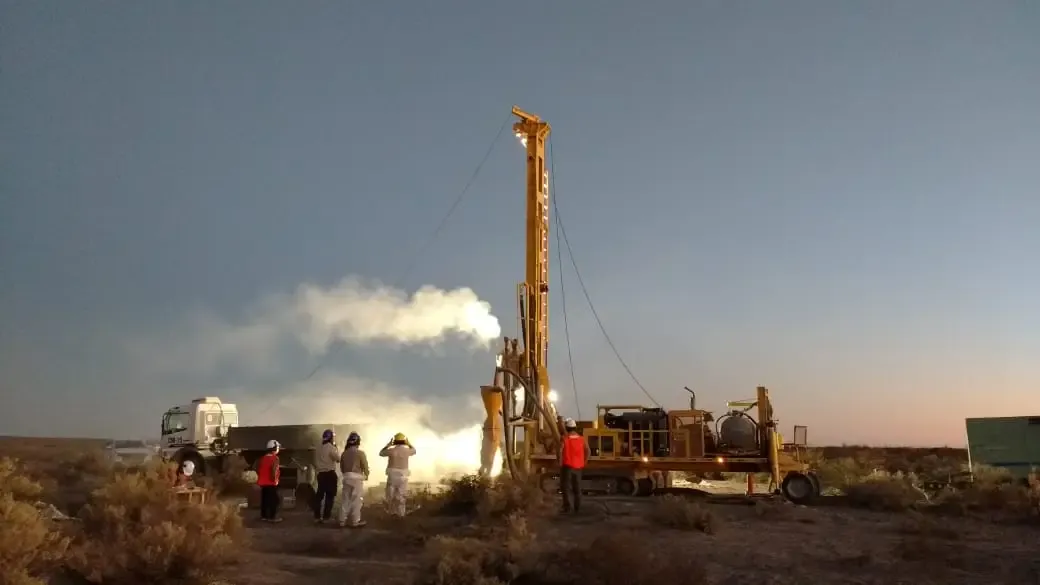
The company also reported the successful completion of an infill drilling program at Ivana, where it identified new higher-grade zones that could be incorporated into future resource updates and economic studies.
At the same time, diamond drilling continues at the Ivana Gateway and Ivana East targets, located less than 10 kilometers from the main deposit.
Financing and the Path toward Feasibility
One of the key aspects highlighted by the company is the earn-in agreement signed with COAM, which establishes a roadmap for advancing the Ivana deposit toward production.
Blue Sky states that project-related programs are being funded through this strategic partnership, allowing development and exploration activities to continue without requiring additional financing sources at this stage.
The company describes Amarillo Grande as a candidate to become a domestic uranium supplier for Argentina’s nuclear sector, at a time of growing interest in strengthening local uranium supply.
Blue Sky’s Presence in Mendoza
The advancement of Amarillo Grande also has a connection to Mendoza. Blue Sky Uranium is among the companies currently exploring for uranium in the province through the Corcovo project, located in southern Mendoza.
Although Corcovo remains at a much earlier stage than Amarillo Grande, the project forms part of the company’s strategy to identify deposits suitable for development using In-Situ Recovery (ISR) technologies, a mining method that seeks to recover uranium through solutions injected into mineralized formations without the need for conventional open-pit mining.
While Mendoza remains at the center of the national discussion regarding the future of uranium through Sierra Pintada, the progress reported by Blue Sky demonstrates that the effort to restore uranium production in Argentina is also taking place in other mining districts. Today, the projects closest to a potential production stage appear to be led by private-sector initiatives.