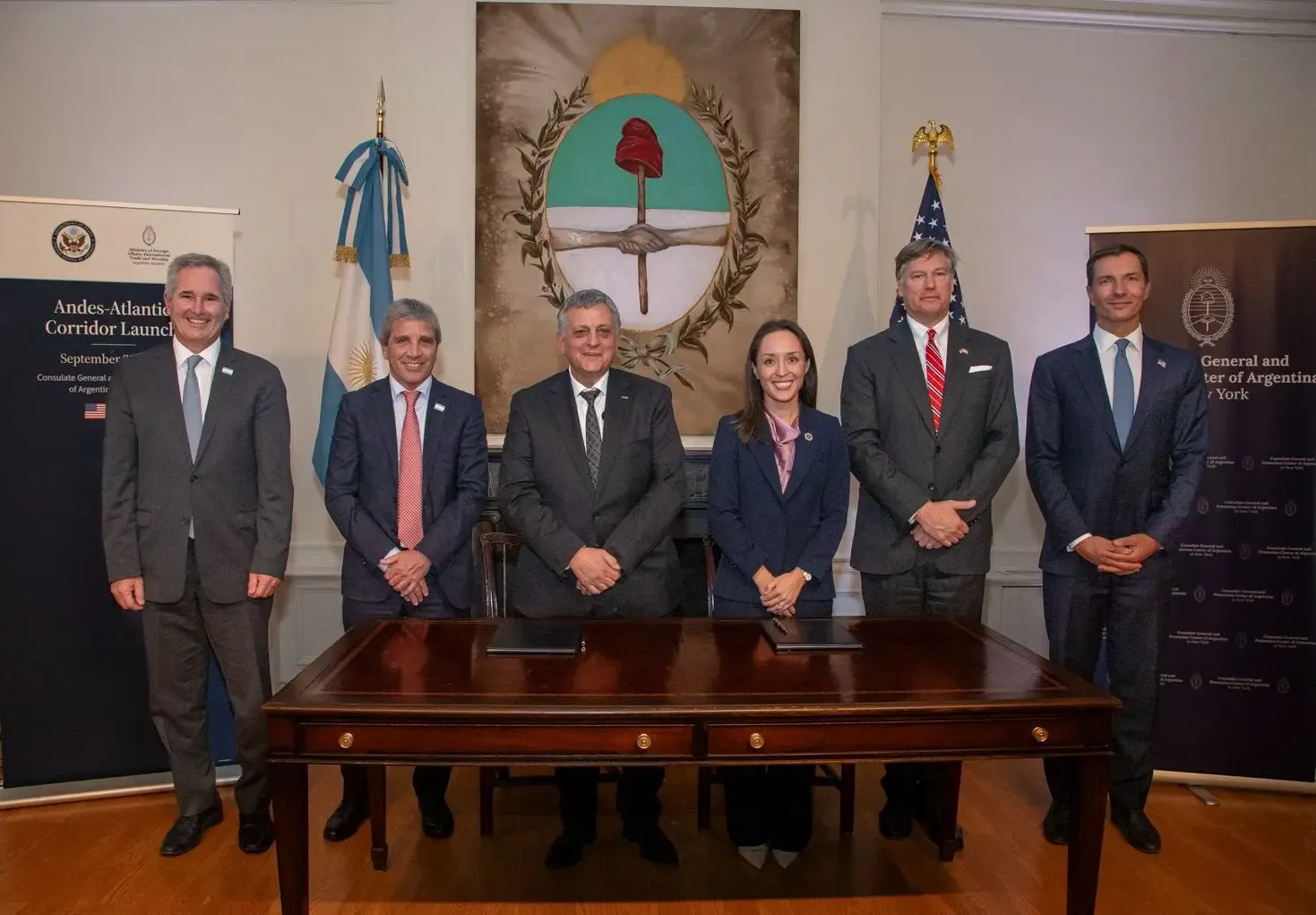
The announcement was made by U.S. Deputy Secretary of State Christopher Landau and Argentine Foreign Minister Pablo Quirno, during the High-Level Week of the United Nations General Assembly.
By Panorama Minero
The United States and Argentina launched the Andes-Atlantic Corridor in New York, a joint initiative to modernize infrastructure connecting Argentina’s mineral-rich northwest and the Vaca Muerta energy basin with Atlantic ports and Western markets.
According to a joint statement, through this new economic corridor both countries are advancing a shared commitment to the security and prosperity of the Western Hemisphere and its critical supply chains. The Andes-Atlantic Corridor is presented as a long-term initiative, designed to mobilize public and private investment over “a generation,” rather than as a program for immediate implementation.
The First in the Western Hemisphere
The Andes-Atlantic Corridor was presented as the first project under the Partnership for Global Infrastructure and Investment (PGII), the G7 infrastructure initiative, in the Western Hemisphere. It joins other strategic corridors promoted by Washington in different regions of the world, such as the India-Middle East-Europe Economic Corridor, the Trans-Caspian Trade Route in Central Asia and the Caucasus, the Lobito Corridor in sub-Saharan Africa, and the Luzon Economic Corridor in the Philippines.
The initiative seeks to facilitate public and private investment in transportation, energy and digital infrastructure, with the stated objective of making the United States a “fundamental partner” for infrastructure and investment in Argentina. Its classification within the PGII places the Argentine corridor within a framework that Washington presents as an alternative to other sources of infrastructure financing globally.
Critical Minerals and Vaca Muerta
According to the statement, cooperation under the new corridor is organized around four sectoral pillars. In transportation, both governments intend to identify priority projects for the rehabilitation and expansion of railways, waterways and ports, with opportunities for U.S. companies to participate as bidders or subcontractors. In energy, the focus is on Vaca Muerta.
Regarding critical minerals, the corridor will seek to identify projects within the framework of the Critical Minerals Agreement between Argentina and the United States, with the stated objective of supporting the extraction and processing of critical minerals, including lithium and copper, and diversifying global supply chains.
The fourth pillar, digital infrastructure, contemplates cooperation on platform security and equipment for customs control, under the concept of “trusted technology.”
US$7 Billion in Investment
A central element of the announcement is the agreement signed between Argentina and the Export-Import Bank of the United States (EXIM), which contemplates financing of up to US$7 billion through 2027 for projects that expand infrastructure and production capacity. The figure does not represent a single loan or a fund that is immediately available, but rather a platform through which U.S. government agencies and private investors will be able to support projects that meet the established requirements.
Alongside EXIM, the U.S. International Development Finance Corporation (DFC) and the U.S. Trade and Development Agency (USTDA) will participate as supporting actors in financing high-impact projects within the corridor. This multi-agency structure is the same model Washington has been using in other PGII corridors and seeks to combine public guarantees with private investment at each stage of the projects.
This translates into the concrete possibility for mining-related service, equipment and logistics companies to compete for railway and port rehabilitation contracts in the northwestern provinces, provided those projects are identified as priorities within the corridor.
Argentina’s Regulatory Commitments
In return, Argentina committed to continuing to strengthen its legal and regulatory framework and investment protections, including “transparent, predictable and effective” rules for infrastructure concessions, as well as greater participation by U.S. companies and financiers in corridor projects.
The announcement did not include a definitive list of specific projects or construction schedules, which will be defined during the subsequent stages of bilateral implementation.
“The framework agreement will make it possible to explore financing of up to US$7 billion for eligible projects through 2027. In addition, YPF and EXIM signed two letters of interest related to Argentina LNG, which could amount to a financing package of up to US$6 billion. More investment to develop Vaca Muerta, expand our energy capacity and connect Argentine production with international markets,” Foreign Minister Quirno stated.