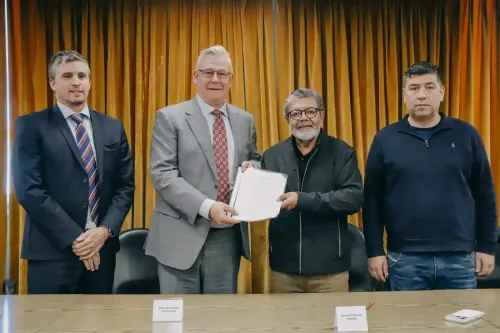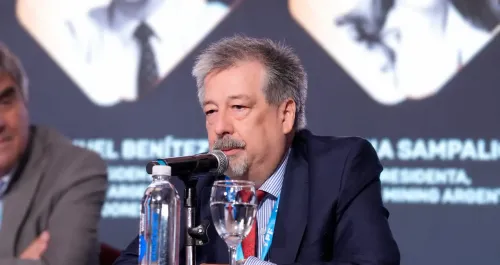
The San Juan Mining Chamber formally presented the renewal of its leadership amid a transformative period for mining activity in the province. The organization’s new structure seeks to respond to the demands of a productive scenario moving toward an unprecedented scale of investment. The strategy focuses on deepening member representation and consolidating technical dialogue with the public sector to ensure that the growth of mining projects translates into orderly regional development.
By Panorama Minero
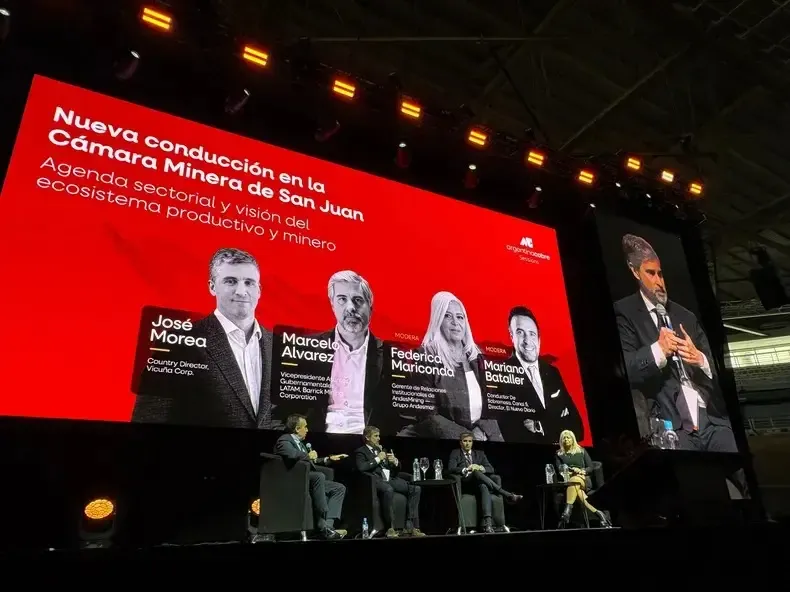
During the opening of the first day of Expo San Juan Minera 2026 organized by Panorama Minero, Vicuña Corp. Country Director José Morea and Barrick Mining Vice President of Government Affairs Latam Marcelo Álvarez highlighted the need to “maximize the chamber’s representativeness, given that while companies held the presidency and vice presidency roles, the current context in San Juan required a broader scope.” This vision aims to position the organization according to “international best practices and greater impact,” enabling more efficient management of the specific needs of each project and each member within the local productive ecosystem.
One of the pillars of the new administration will be the integration of diverse social actors to strengthen ties with communities. In this regard, Morea stressed the importance of “maximizing the social agreement by increasingly integrating the stakeholders of each project in order to build sustainable mining that includes communities, suppliers, the workforce, and promotes the San Juan of the future.” According to the executive, the institution currently has a historic opportunity to deepen this inclusion process.
Regarding the regulatory framework and investment incentives, the chamber is closely monitoring legislative transformations at the national level. Morea noted that the Large Investment Incentive Regime (RIGI) boosts mining investment, but emphasized that provincial leadership is essential to implement specific regulatory changes. “If one looks at San Juan’s potential and leadership in implementing changes to the Glacier Law—which we recognize from the chamber—investments should accelerate, and that is what we are working toward,” stated the head of the largest copper project submitted under the RIGI.
Legal predictability was identified as a determining factor in Argentina’s international competitiveness. “Regulatory stability is key,” he added. “If it evolves toward best practices, it can elevate San Juan much higher in global consideration, but today this is the result of many years of effort by the San Juan mining ecosystem, and it is reflected in the number of investments already announced and those that, although not yet committed under the RIGI, are still under consideration,” affirmed the Vicuña Corp. representative.
Coordination with the provincial government has become critically important under the new public works financing scheme. In this regard, Morea warned that “the provincial government no longer receives funds from the national government, which places even greater stress on the public infrastructure strategy, because while private infrastructure advances within each project, there is a disconnect that requires coordination based on openness, transparency, and trust.” In that sense, he reiterated the proposal to use future royalty revenues to “guarantee projects built today that will be supported by two or three years of production.”
From the perspective of operators with longstanding experience in the San Juan Andes, Álvarez explained the company’s decision to become more actively involved in the chamber. “At Barrick and Veladero, we carefully analyzed the role we should play at this key moment for what lies ahead; after 20 years of operating experience in the province, it was time to increase our participation in the chamber to support what is coming—a massive mining production expansion linked to copper that requires a much deeper level of engagement,” he stated.
The new phase demands a more robust technical structure capable of processing the complexity of copper projects. Álvarez emphasized that “the next stage requires co-construction among all social, political, and economic actors in the province, and the chamber must achieve a level of technical professionalization that matches the needs of both the industry and the province.” This approach seeks to raise the quality of sector discussions before a society that maintains high expectations regarding the impact of mining activity.
Social license was identified as one of the main drivers for the success of mining ventures. In this regard, the Barrick executive noted that “the energy transition and technological advances have created a much deeper civic and political awareness within Argentina’s debate, and this requires greater cohesion, more dialogue, and more collaborative construction, because there is a large society expectant about how mining reaches and impacts each individual.” He also added that “what is coming is ten times larger than what San Juan experienced with Veladero; what lies ahead is much bigger and requires the participation of the entire society.”
Despite growing global interest in Argentina’s natural resources, the sector warns that social consensus must be constantly cultivated. “The fact that today there is greater awareness, greater political agreement, and more interest from companies—and that everyone understands the world needs natural resources—does not mean there is greater consensus in favor of mining or that social license has already been achieved. That is what we must build,” Álvarez reflected during the presentation of the new working structure.
Strategic planning and the management of internal project data will be key tools for the new leadership. One of its priority missions will be to “generate within the chamber a database that allows visibility into the various stages of each project, their strategic infrastructure needs, and the ability to project this growth with the State in an orderly manner.” The ultimate goal is to “translate expectations into concrete actions and steps in order to properly dimension the different stages of advancement in relation to the broader announcements.”
Finally, the panel concluded with a broader perspective on Argentina’s mining future based on the San Juan model. Álvarez highlighted the importance of ethical and transparent management aligned with international standards to generate real value. “San Juan is an example of creating a State policy that transcends politics, and as long-term rules continue to be built and a constructive discussion develops around a supplier ecosystem supported by infrastructure, San Juan’s image in the eyes of the world will continue to improve,” he concluded.