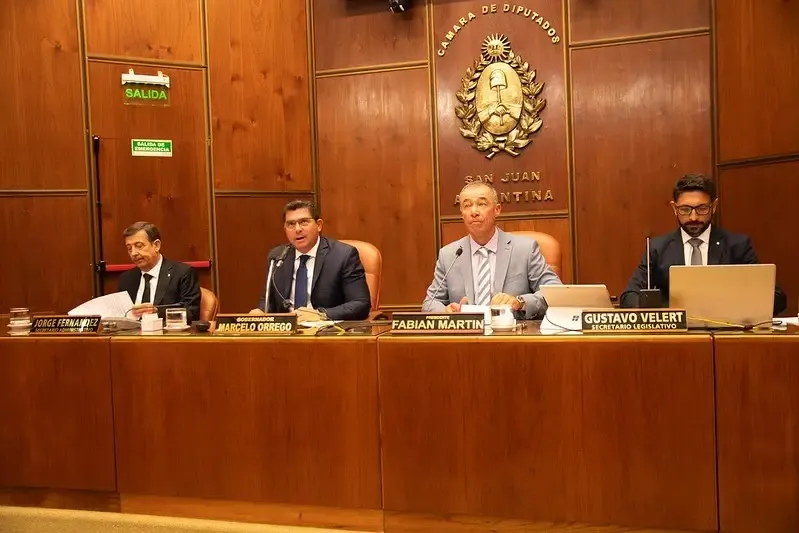
During the opening of Ordinary Sessions, Governor Marcelo Orrego stated that San Juan is facing a “second mining revolution,” driven by large-scale projects such as Vicuña, which has already initiated investments of US$900 million and could become the largest private investment in the country. The governor also highlighted the recent start-up of Hualilán, the first mine to operate in 17 years, and underscored the province’s leadership within the Large Investment Incentive Regime (RIGI).
Orrego also emphasized the direct impact of mining on daily life through works financed by mining trusts, such as the expansion of drinking water networks, the reactivation of irrigation canals, and the construction of road and water infrastructure in Jáchal. Additionally, he announced that the government will soon present the “Local Mining Development” bill, widely known in San Juan as the supplier development law.
By Panorama Minero
At the opening of Ordinary Sessions of the Chamber of Deputies, Governor Marcelo Orrego outlined mining development as a state policy and stated that the province is “at the doorstep of a second mining revolution,” even larger than the first phase linked to gold. He highlighted measures implemented since the beginning of his administration to organize and boost the sector, such as reducing geological evaluation timelines from 180 to 30 days, streamlining exploration permits, and fully digitizing the mining cadastre.
Orrego noted that this process has positioned San Juan internationally as a reliable destination for investment, supported by indicators such as the Fraser Institute ranking, which places the province among the most attractive jurisdictions for investment. He also emphasized the province’s leading role within the RIGI, concentrating 60% of the approved projects in the country, including large-scale initiatives such as Los Azules, Veladero, and Gualcamayo, as well as others under evaluation like Pachón and Vicuña.
One of the central points of the speech was the Vicuña project, which Orrego described as “the largest private investment in Argentina’s history.” He stated that it is an initiative with more than 70 years of productive projection and the potential to become one of the world’s leading producers of copper, gold, and silver. The governor highlighted that an initial investment of US$900 million has already been confirmed for early works.
According to the governor, this is not only about figures but about concrete opportunities for communities. He mentioned that it will generate local employment, strengthen local roots for young people in departments such as Iglesia and Jáchal, and drive infrastructure development. He also linked copper growth to the global energy transition, electromobility, and new technologies, positioning San Juan at the center of this transformation in future projections.
He also highlighted the recent start-up of Hualilán, the first mine inaugurated in the province in 17 years. Orrego explained that the gold deposit is already in production, with a scheme that integrates two departments: the ore extracted in Ullum is processed at the Casposo plant in Calingasta. This model, he noted, strengthens the local value chain with participation from San Juan-based companies, suppliers, and provincial workforce.
Among other points, the governor highlighted the implementation of hybrid classrooms in mining departments, currently reaching 350 students, the awarding of more than 400 scholarships, and the construction of the Savio School focused on technical training. He also mentioned programs such as Mujeres + Mineras, which has already benefited local women entrepreneurs, and the integration of more than 40 SMEs into the sector’s value chain.
Orrego emphasized the role of mining trusts as a key tool to finance infrastructure works throughout the province. In Jáchal, he detailed the expansion of the drinking water network in San Roque, with an investment of nearly ARS 1.5 billion, and the reactivation of the Canal del Norte, benefiting more than 1,800 producers and 26,000 productive hectares. Additional works include connectivity and flood defense infrastructure, such as bridges over the Tafí and La Quebrada rivers, and works on the Shuclián River.
He also reported that a portfolio of irrigation projects has already been approved, including the Chita, Romo, and Agua Negra canals, along with a wastewater treatment system in Niquivil, with an investment exceeding ARS 15 billion. All these initiatives, he emphasized, are financed with resources from mining activity.
Finally, he announced that the “Local Mining Development Law” will soon be submitted to the provincial Chamber of Deputies, aiming to ensure that investment generates the greatest possible impact on San Juan’s economy.
In his speech, he reaffirmed that mining should not be understood as an end in itself, but as a tool for comprehensive development. He stressed that the challenge is to translate resource wealth into tangible improvements in quality of life for the people of San Juan, through employment, infrastructure, and opportunities across the province.