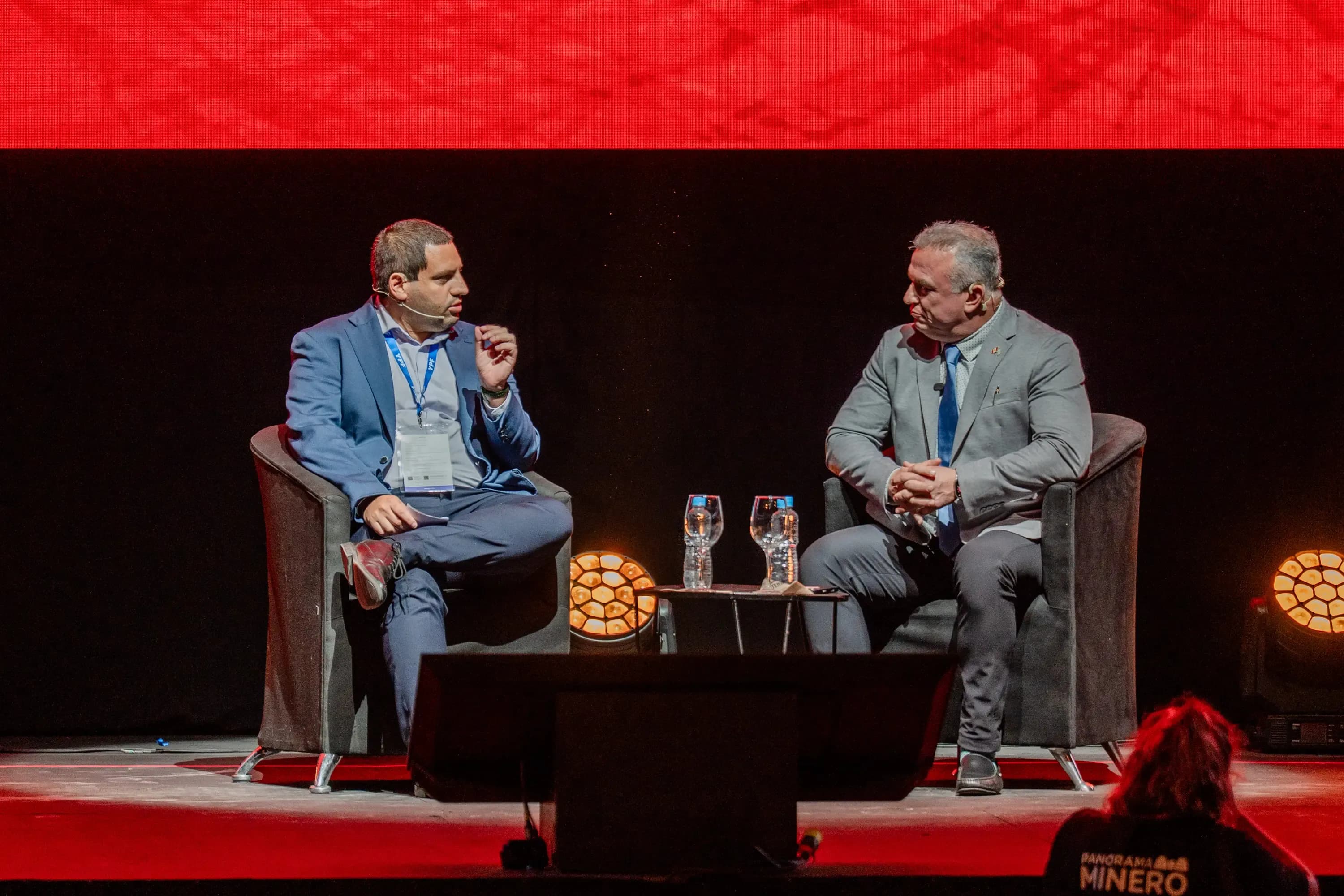
Michael Meding stated that the project is seeking US$4 billion in financing and highlighted San Juan’s mining ecosystem, regulatory stability, and the potential of Argentine copper to attract global investment.
By Panorama Minero
Michael Meding, Vice President of McEwen Copper and Honorary President of Expo San Juan Minera 2026, delivered a strong statement regarding the current situation of the province: “Mining development in San Juan is much easier than in other parts of the world.”
Amid the copper boom and renewed international interest in critical minerals, the executive outlined the financial and operational strategy behind one of Argentina’s most ambitious projects, which seeks to become a world-class mine with an estimated total investment of US$4 billion.
“We are looking to finance US$4 billion: US$2–3 billion in CAPEX, US$350 million in working capital, plus interest and facilities. The structure would involve US$600 million to US$1 billion in equity and US$2.4–3 billion in debt, mainly through export credit agencies,” explained Meding during the closing of the Argentina Copper Sessions במסגרת Expo San Juan Minera 2026 organized by Panorama Minero.
Located deep in the Andes Mountains of San Juan Province, about 80 kilometers from Calingasta and more than 3,500 meters above sea level, Los Azules recently completed its Feasibility Study, consolidating its position as one of the most advanced copper projects in the country. The development envisions an initial 21-year operation with annual production of approximately 148,200 tonnes of Grade A copper cathodes and highly competitive global costs.
The executive detailed that McEwen Copper has been working for years with international organizations and export credit agencies to structure financing. “You don’t achieve this by having coffee just once. You have to build relationships over years, present the project, and generate trust,” he stated.
Along this path, the company advanced with development and export agencies from several countries, including institutions from Canada, Germany, France, Japan, Switzerland, and the United States. “We have been working with these institutions for approximately four years, and today we are at a stage where we have already received financing offers,” he affirmed.
According to Meding, part of those resources could cover up to 85% of the machinery required for the operation. Added to this is the joint work being carried out with multilateral organizations.
“We are working with the World Bank and IFC, which is part of the World Bank Group. We have already signed collaboration agreements to move forward under international environmental and social standards,” he noted.
The Los Azules project now stands as one of the most relevant cases within Argentina’s new mining landscape, driven by copper and instruments such as the RIGI. Under the base case of the economic study, the project shows a Net Present Value of approximately US$2.9 billion and an internal rate of return close to 20%, with payback estimated in less than four years.
For Meding, one of the key factors behind the interest of international investors is the positioning achieved by San Juan as a mining jurisdiction. “I have great confidence in the province’s technical teams and in the work being done by Marcelo Orrego’s government to support mining development with the necessary speed,” he stated.
The executive acknowledged that permits and technical definitions are still pending before moving toward a final investment decision, although he highlighted the improved climate for long-term projects.
In this context, he also referred to the recent reform of the Glacier Law. Although he clarified that it has no direct impact on Los Azules, he considered that it significantly improves predictability.
“It does not directly impact our project because Los Azules had already been designed considering the previous law. However, it greatly increases investor confidence because it provides greater precision and less room for litigation,” he explained. He added: “When you think about a mine for 20, 40, or 50 years, predictability is fundamental.”
Infrastructure: The Great Copper Challenge
The growth of copper projects in San Juan also opens a central discussion regarding infrastructure. Meding identified energy and roads as some of the main bottlenecks for large-scale mining development.
“The province and the national government do not have sufficient funds to build all the required infrastructure, so it is logical for companies to participate and invest,” he stated.
According to Meding, improving the energy grid will not only benefit mines, but also the entire province. “When we invest in energy, we make the system more reliable for all San Juan residents,” he noted.
In this regard, he highlighted that Los Azules has already submitted proposals related to shared electrical infrastructure with other mining projects in the province. “We always have a Plan A, a Plan B, and a Plan C. The important thing is for the sector to be capable of coordinating and working together,” he said.
One of the concepts most frequently repeated by Meding was the differential value San Juan possesses in terms of human capital and specialized suppliers. “One of San Juan’s major competitive advantages is its mining and supplier ecosystem. Here, it is much easier to develop mining than in other parts of the world,” he assured.
The executive emphasized that the province has companies capable of executing roads, drilling campaigns, and complex works without depending entirely on external suppliers. “In San Juan, you can fill a mining pickup truck without any problem. There are companies capable of building roads, conducting exploration, and providing specialized services with international experience,” he pointed out.
He even stressed that the province already exports mining knowledge to the rest of the world. “San Juan has not only exported minerals, it has also exported professionals and know-how. That should give us a very high level of self-confidence,” he affirmed.
Los Azules’ own experience during exploration campaigns reinforces that view. Meding explained that the company succeeded in developing local technical teams and sustaining complex drilling campaigns with multiple contractors working simultaneously.
“We invested heavily in training and in developing people. When people feel the company is investing in them, they respond and make an extra effort when necessary,” he highlighted.
A Mining Model Focused on the Environment
The Los Azules project also seeks to position itself as a new copper mining model with lower environmental impact.
The redesign presented in 2025 replaced the traditional flotation plant with a heap leaching and SX-EW solvent extraction system, eliminating the need to build tailings dams. This scheme will allow the direct production of finished copper cathodes in San Juan, reducing dependence on external smelters while lowering water consumption, energy use, and emissions.
“We want to develop a competitive, modern, and sustainable project aligned with the most demanding international standards,” Meding stated.
The Opportunity of Argentine Copper
For the executive, the global context opens a historic opportunity for San Juan and Argentina. “I believe we are about to create a very important wave in San Juan that will lift the entire mining industry,” he assured.
At the same time, he valued the regulatory simplification signals promoted by the national government and stated that the challenge now is to consolidate confidence in international markets. “We must continue making things simpler, continue reducing bureaucracy, and build credibility in order to access international financing,” he concluded.