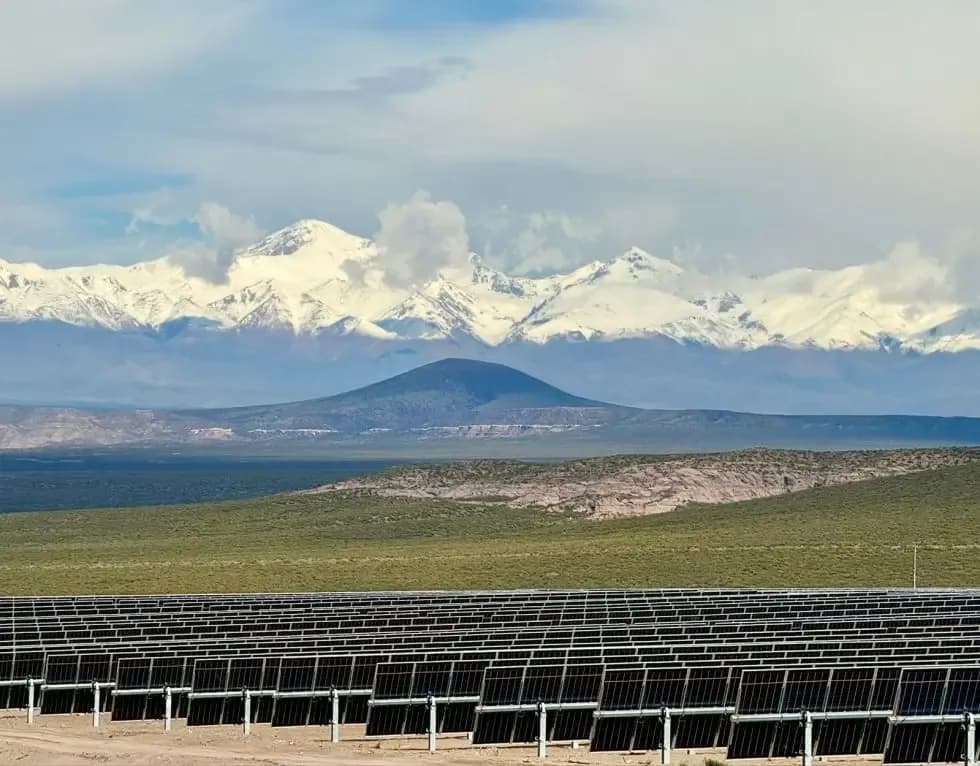
Mendoza has begun to more clearly articulate the link between energy expansion and mining development. The full commercial commissioning of the San Rafael Solar Park, with 180 MW of installed capacity, was presented by both the provincial government and Genneia not only as a new renewable generation asset but also as part of the infrastructure required to support the growth of large-scale industrial and mining projects.
By Panorama Minero
The park, developed by Genneia in the San Rafael district of 25 de Mayo, increased Mendoza’s installed solar capacity to nearly 800 MW in operation, as part of a strategy aimed at expanding the availability of competitive energy in a province where the energy debate has become increasingly linked to the advancement of high electricity-consuming sectors, including metalliferous mining.
Minister of Energy and Environment Jimena Latorre stated that the new energy infrastructure constitutes a fundamental tool to support industrial and mining development with “clean, competitive, and sustainable” energy. This statement comes within a broader context in which Mendoza seeks to simultaneously advance renewable energy projects and new mining initiatives.
Genneia’s Role and Mining’s Energy Demand
The project developer also explicitly highlighted this connection. Genneia CEO Bernardo Andrews stated that the San Rafael Solar Park will place a special focus on the regional mining sector, noting that the industry requires robust decarbonization solutions to maintain competitiveness and access to international markets increasingly shaped by environmental standards and ESG requirements.
This reference comes at a time when several copper and advanced exploration projects in western Argentina have begun incorporating discussions around energy traceability, carbon footprint reduction, and renewable energy supply agreements under mechanisms such as the Renewable Energy Term Market (MATER), which was mentioned in the official document as one of the tools designed to supply large industrial and mining users.
The San Rafael Solar Park required an investment of US$180 million and is located on a 500-hectare site equipped with 400,000 bifacial solar panels. The facility has an annual generation capacity exceeding 500,000 MWh, equivalent to the electricity consumption of approximately 135,000 households, while also reducing carbon dioxide emissions by an estimated 230,000 tonnes per year.
With this development, Genneia has surpassed US$430 million in investments in Mendoza and now operates 450 MW of solar capacity within the province, consolidating Mendoza as one of Argentina’s leading photovoltaic generation hubs.
Electrical Infrastructure Designed to Support New Demand
Alongside the growth in installed capacity, the provincial government linked the expansion of renewable generation to a broader electrical infrastructure program aimed at increasing transmission capacity and system reliability.
Key projects include the Valle de Uco Transformer Station, the Mendoza Norte Transformer Station, the Marcado–La Dormida project, and the launch of the tender process for the 132 kV high-voltage transmission line between San Rafael and General Alvear.
The emphasis on transmission infrastructure is particularly significant within Mendoza’s energy landscape, where various industrial and mining projects require greater power availability and improved supply conditions.
The official document also notes that Mendoza aims to exceed 1,000 MW of installed solar capacity by 2030, with additional projects under development, including the Mendoza Sur Solar Park.
Within this strategy, renewable energy expansion is presented as a critical component of the infrastructure needed to support the province’s productive, industrial, and mining growth.