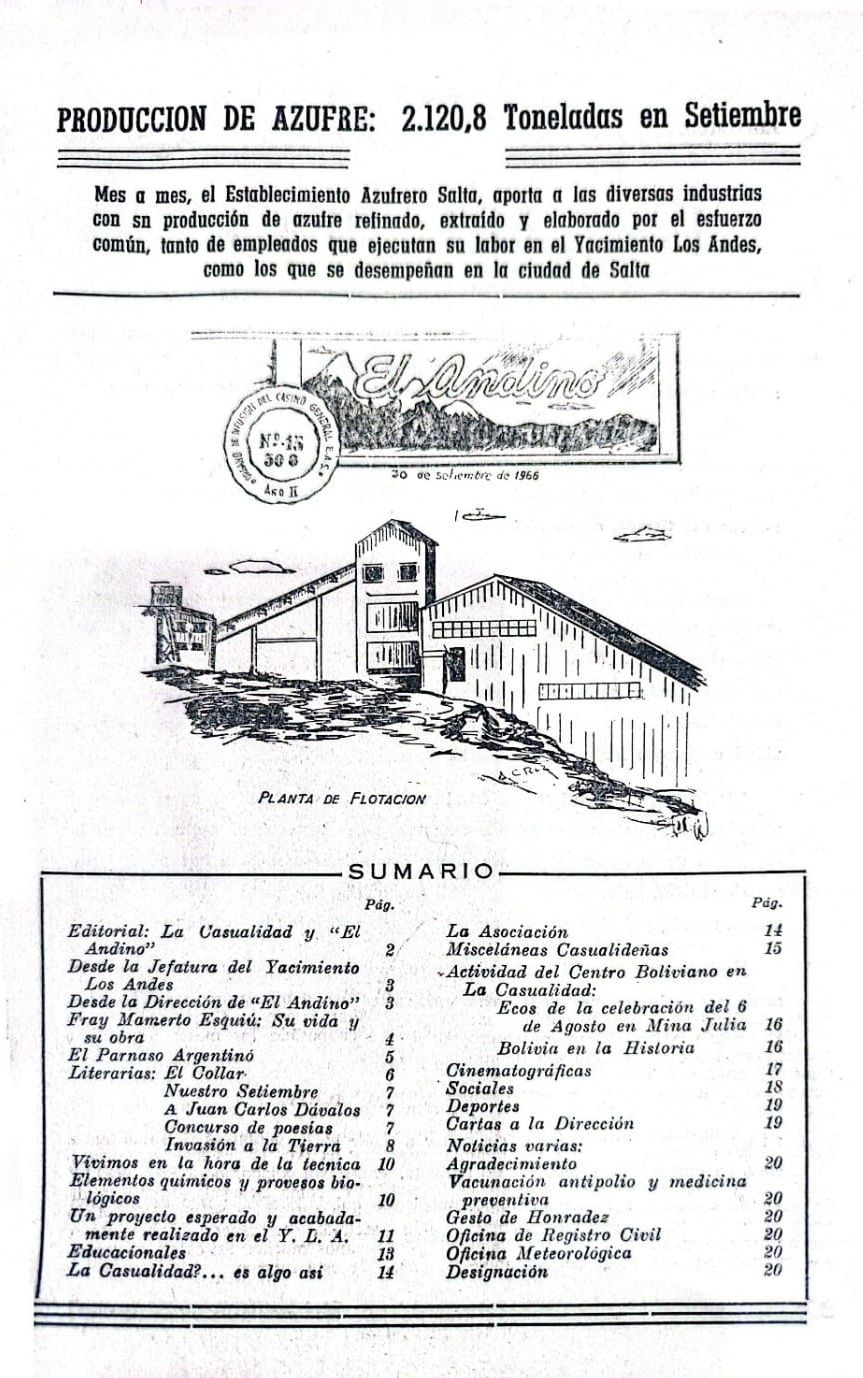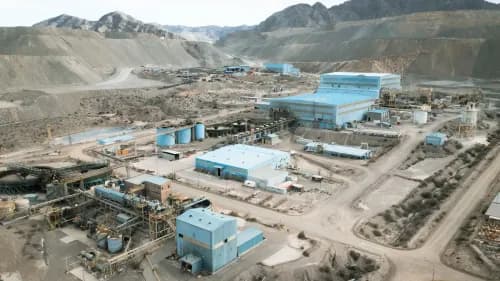
Many years before the Salta Puna occupied its current central role on the global mining map, at the western end of the Los Andes department, bordering Chile and Catamarca, Mina La Casualidad was for decades much more than a productive enclave: it was a town built around mining work.
By Panorama Minero
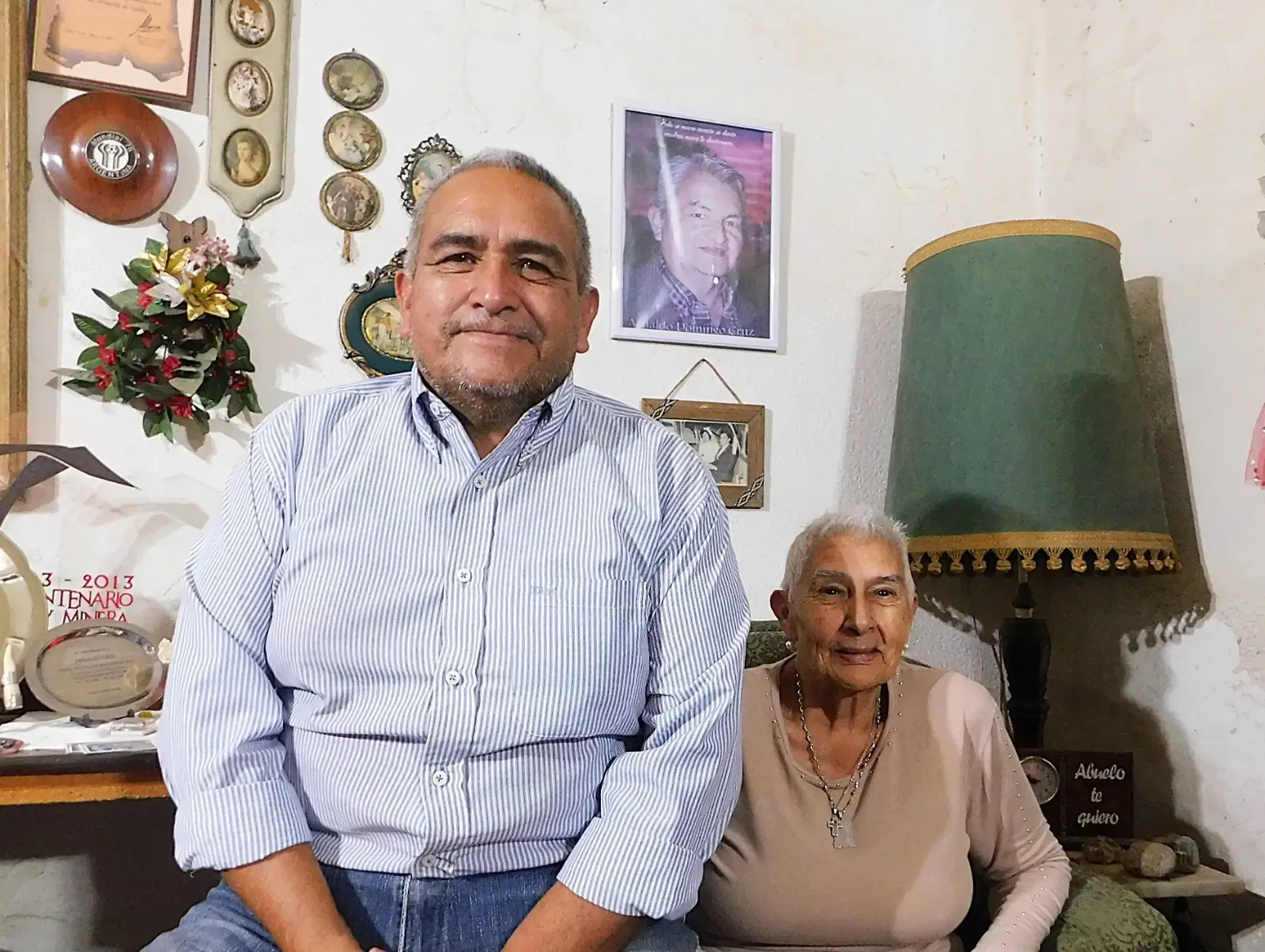
Like many families who lived in the camp, the Cruz family organized their lives around mining activity. While technicians and workers sustained the operation of the deposit, daily life unfolded in the town with a school, shops, and meeting spaces that shaped a community at 4,100 meters above sea level. This human dimension turned La Casualidad into one of the most singular chapters in Argentine mining history, where sulfur production coexisted with the construction of a shared identity among generations of workers and their families.
“There’s a phrase my father liked to use to describe the scale of the mine. He said the annual football championship had 11 teams. There were enough people to form 11 teams! Behind each person there was a family. There were dormitories for single men and women, but normally people who worked there had a family,” says Ariel Cruz.
The history of La Casualidad dates back to the 1940s, when Compañía Azufrera Argentina S.A. was created to exploit this resource in the Salta Puna. In 1947, 50% of the company was acquired by the Dirección General de Fabricaciones Militares, and by 1952 the entire shareholding package was acquired by the national State.
The project led to the largest sulfur plant in Argentina, which remained active from 1953 to 1979, reaching a production peak in the 1970s of 30,000 annual tons of sulfur with 99.97% purity. When the depopulation process began in 1977, around 2,000 people lived there.
“Until 1980, a country’s industrial potential was measured in kilos of sulfuric acid it produced and consumed. That was the time when production at La Casualidad mine disappeared. It was closed for a matter of continental strategy, so to speak, because it still had resources—at the production levels of that time, it had more than 50 years of useful life. It wasn’t depleted; the problem is that now the mine entrance ended up on the Chilean side,” Cruz explains.
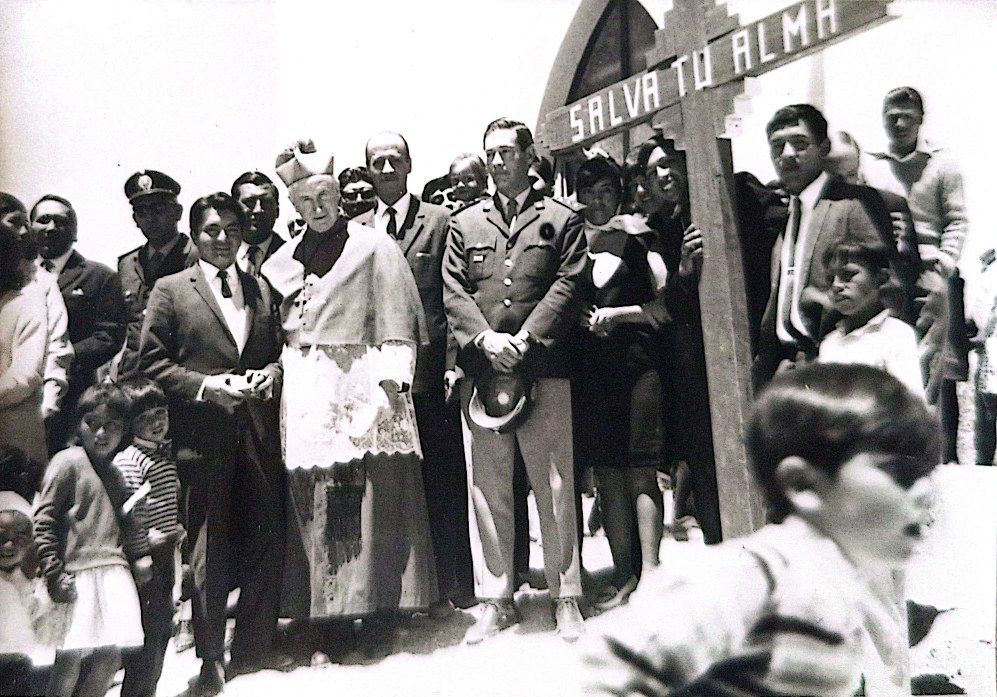
What is now for many a ghost town comes alive in the voices of the Cruz family, as if the hoppers and the skeletons of the cableway that transported material from the La Julia mine entrance over 15 km shook off their rust, and the post office, the medium-complexity hospital with an operating room, the houses with large pantries to store food for the harsh winter, the school, the church, the military casino with its à la carte restaurant, and the feeling of having been better connected to the world at that time from a remote locality in Los Andes all reappear vividly.
In this regard, Cruz states: “We only recently started with online shopping, and when I was born my mother chose my layette from a catalog of a store in Buenos Aires called ‘Gath & Chaves.’ A month later she had everything. There was no internet, but there were trains, there were airplanes. There was very efficient logistics.”
At 64 years old, Ariel is still active as a small-scale rare earth producer on demand, in addition to running the operations of a mining company. A company that is also a legacy of La Casualidad, because its main partner, Roberto Cruz, was the last person to leave the plant. As a young administrative worker, Roberto had to place the final padlock on La Casualidad. Ariel recounts it with shining eyes, as if the metallic sound of the gate closing could still be heard.
Protagonists and cutting-edge technology at La Casualidad
In his account, Ariel moves back and forth between events, inevitably comparing times and changes in the industry: “For those who know how to read mining, La Casualidad is currently a very interesting laboratory. All the structures there are between 70 and 80 years old. It is very useful to observe the formulation of the concretes, how they responded—there are construction and quality standards that always suggest looking at what has already been done and making comparisons. There we have a wonderful laboratory to see how concrete and metal structures behaved in such an aggressive environment as a sulfurous one.”
Kitaro Yahase
Regarding technology, Ariel pauses and highlights key figures in the life of La Casualidad: “One of them is a Japanese man, Kitaro Yahase, a doctor with five engineering degrees, a consultant for Fabricaciones Militares, who designed the program. At that time he had three projects in the world: the Atatürk Dam, the Moscow metro, and the sulfuric acid project in Argentina. My father was his technical translator, which is why he later remained in charge after assisting him in developing the process,” he recalls, adding about extraction methods: “There were two plants, one for concentration and one for flotation, which is a process now used in Pirquitas as cutting-edge technology**,** and we were already using it more than 60 years ago at La Casualidad—flotation cells. That helps one understand the magnitude of the decision made by the Argentine State at that time to bring in that kind of consultants to develop technology in our country. At that time, we were developing that production process and building the second jet aircraft in the world. That moment of Argentina’s technological flourishing could be experienced in such a remote place as La Casualidad mine.”
Respect for the resource and for those who exploit it
“The first lesson La Casualidad gave me was respect for the resource and for those who exploit it,” Ariel says. “We lived in the camp and the mine was far away—the journey was over an hour. So, when the anniversary celebration of the establishment was held, it was the only time the people from the mine came, and silence would fall when they entered. We knew those people were highly exposed. Most didn’t have old age, because the conditions were harsh. You learn to respect that. Mining in the past was different. Now I participate in mining operations, I handle logistics, I advise on projects, and for example, before I could invite anyone for coffee—now I can’t. There are rules and protocols. I think that’s absolutely right, but I also come from a time when mining was done through hard physical effort and sacrifice.”
A precursor of REMSA
“I was fortunate that my godfather, Mario Raskovsky, was the first Secretary of Mining of the province. Raskovsky created a mixed company called La Casualidad, whose purpose was to preserve the mining heritage of the mine. That company eventually became REMSA (Recursos Energéticos y Mineros de Salta S.A.). Fifty years ago, my godfather saw the need to preserve the province’s mineral heritage with both public and private interests working together.”
The end and attempts to reopen it
Since his friend Roberto Cruz placed the final padlock and handed over the keys to the gendarme, nearly 50 years have passed. During this time, different initiatives have emerged to preserve La Casualidad’s heritage, from the company created by Raskovsky to an NGO proposed by former residents’ families to develop tourism in the camp facilities.
“There are still people who get together and travel to the mine once a year just to walk around,” Ariel says. “The people who worked there had such a strong sense of belonging that they would hardly have left if it hadn’t closed. It was a hard blow—much of Salta’s mining activity was that mine. The number of people connected to it, the number of suppliers, was enormous. It meant a lot for Salta’s economy. La Casualidad is still a reference point.”
Ariel himself led a project in 2008 involving four Argentine and Chilean companies to reactivate production, but the market collapsed. Sulfuric acid was priced around US$1,000 per ton at the time, but within months it dropped to US$80.
“We had already assembled part of the plant in Olacapato, which is now used to concentrate sulfuric acid. We aimed to work with tailings, which were considered waste at the time but are now very rich, since production back then focused on the best material and discarded the rest. One of the partners, a Chilean company, ended up owning the deposit. The plant remained on the Argentine side, and the deposit on the Chilean side. The idea was to reactivate it—there are also properties in San Antonio with sulfur content worth exploiting. But it couldn’t be done; the economic shock was too great. There were ships stranded mid-journey with nowhere to unload,” Ariel recalls.
“Those of us who have been in mining for a long time know there is no magic—there is a lot of speculation. When you see the price of a product rising excessively, it’s because someone is sustaining it artificially. Many people made very good business when lithium prices rose, and then they returned to historical levels. That’s reality.”
Ariel pauses and returns to his childhood: “La Casualidad was the starting point of what my life would become. Having been born in a mining environment, I became a miner, and my daughters are also in mining—they are the third generation. It was a school. Many children finished primary school there and went on to study mining because they wanted to return to work where they grew up.”
“Today, La Casualidad is the saddest thing one can see—houses are dismantled, everything has been looted, but the church was not touched. I took my first communion there,” Ariel concludes, his eyes reflecting the vastness of the Puna.