Public, private, and union leaders agreed on the progress achieved regarding new investments, local development, and sustainability.
By Panorama Minero
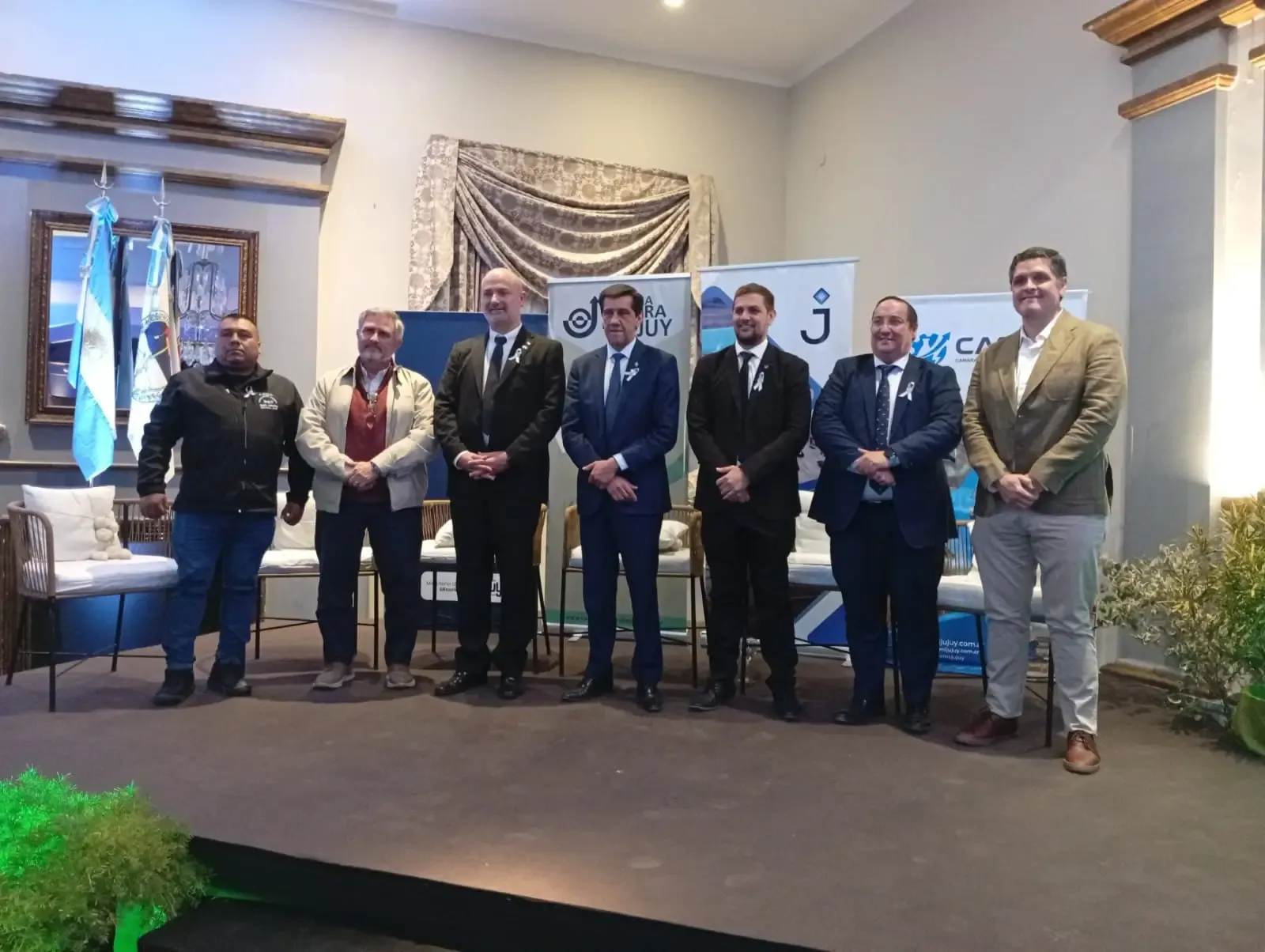
People in Jujuy concluded the Mining Day celebrations with a gathering that brought together representatives from the public, private, and union sectors, who agreed in highlighting the sustained growth of mining activity in Jujuy, its impact on employment, exports, and the increasing development of investments. They emphasized the elevation of the sector to ministerial status and celebrated the progress regarding the RIGI, for which Jujuy already obtained one approval and has another pending.
The meeting was jointly organized by the Mining Services Chamber (CASEMI), the Mining Chamber of Jujuy, and the Argentine Mining Workers Association (AOMA), in an event attended by Governor Carlos Sadir, legislators, workers, business leaders, suppliers, and academic representatives. Participants analyzed the present and future of an activity that is consolidating itself as one of the province’s main economic drivers.
During the event, Governor Carlos Sadir highlighted the model of coordination between the State, companies, workers, and communities as one of the pillars of mining growth in Jujuy, and stressed that the central challenge is for that development to translate into concrete benefits for the entire province. “This communion of work explains why Jujuy has been advancing in mining,” he stated, recalling that the creation of the Ministry of Mining was a strategic decision to provide the sector with greater institutional hierarchy, autonomy, and management capacity.
He emphasized the social impact that the activity is already generating in the Puna region. “Today people stay in their communities because they have opportunities,” he affirmed, highlighting the growth of technical education, training, and investments linked not only to mining, but also to renewable energy, metalworking, and tourism. He considered that mining must become a driving force capable of promoting other productive activities and strengthening the comprehensive development of Puna communities, where expansion in commerce and tourism is also being observed.
In turn, the Minister of Mining, José Gómez, highlighted the sustained growth of the sector and defended the political decisions adopted to strengthen the activity. “Today we are not discussing mining yes or mining no; we are debating what kind of country we want to build,” he stated.
He recalled that Jujuy was one of the first provinces to adhere to the Large Investment Incentive Regime (RIGI), considering that mining development requires not only natural resources, but also “institutions, clear rules, and legal certainty.”
Gómez specified that mining went from representing 5% of the Gross Geographic Product in 2020 to exceeding 8% today, and explained that it now accounts for 78% of provincial exports.
“In 2025 it generated more than US$1.15 billion in exports, with more than 10,000 jobs linked to the sector,” he detailed. He also stated that since 2018 Jujuy has attracted more than US$3 billion in exploration and development investments, a figure that could increase this year with new announcements.
“The US$1.2 billion investment from Exar has just been confirmed and we have another lithium project in Salar de Jama under evaluation. In addition, we are the only province in the country with copper production,” he highlighted.
He detailed that during 2025, 141 inspections were carried out, covering more than 64,000 kilometers across provincial territory to supervise compliance with environmental and operational regulations.
In this regard, he highlighted the implementation of the Integrated Mining Administrative Litigation System (SILAM), which fully digitized mining files.
For Gómez, the creation of the Ministry of Mining responded to the need to accompany this expansion process with a management structure aligned with the new challenges. “It is not just another bureaucratic structure; it is the strategic engine of a province that must sit down to negotiate with major global players,” he affirmed.
Among the hosts of the event, CASEMI manager Edgar González de Prada celebrated the holding of a joint event involving all sectors linked to mining activity, something he considered unprecedented in the province.
From the suppliers’ perspective, he stated that the current scenario represents an important opportunity for SMEs in Jujuy, although he warned that the challenge will be to meet the standards required by the industry. Therefore, he highlighted the need to deepen training, generate strategic alliances, and invest in strengthening local businesses.
For his part, the president of Jujuy Energy and Mining State Company (JEMSE), Ezequiel Lello Ivacevich, stated that provincial mining growth “is not the result of chance,” but of sustained work between the State, the private sector, workers, and communities.
He highlighted that Jujuy is currently the country’s leading lithium producer and the only Argentine province with copper production, in addition to having projects linked to silver, lead, and zinc.
He also underscored the strategic role of JEMSE in energy and mining development, mentioning key infrastructure works such as Cauchari, which enabled new productive projects, and highlighted the coordinated work with the National University of Jujuy for the training of specialized human resources.
The Private Sector Highlighted the Progress
The president of the Mining Chamber of Jujuy, Arturo Pfister, stated that mining in Jujuy has ceased to be a promise and has become a consolidated reality. “Today we can proudly say that Jujuy is the National Capital of Mining. These are not expectations; it is a reality built between the public and private sectors,” he expressed.
Pfister highlighted that Jujuy is the country’s leading lithium exporter and defended the development model promoted in the province.
“When we talk about sustainability, we are not talking only about the environment; people are also part of the environment. What we seek is a better quality of life, and mining is generating that even in places where opportunities previously did not exist,” he stated.
He also vindicated the development achieved at Cauchari-Olaroz as concrete proof that sustainable mining is possible in Jujuy and called for continuing to strengthen coordinated work to expand sector growth.
Meanwhile, Edgar González de Prada, manager of the Mining Services Chamber (CASEMI), highlighted that for the first time all actors linked to mining activity had been brought together in the same celebration, a fact he considered significant for the present of the sector in Jujuy.
From the perspective of supplier SMEs, he considered that the current scenario opens opportunities both for companies already part of the mining chain and for those seeking to join it. In that sense, he considered training to be a key tool to strengthen local business development.
For his part, Jairo Ibarra, from the Argentine Mining Workers Association (AOMA), representing General Secretary Luis Tinte, highlighted the transversal nature of mining activity and its growing relevance in the current context. “Mining is something that cuts across all aspects of life and is becoming increasingly necessary with technological advancement,” he stated.
The event began with Gustavo Leyría, who presented on public guarantee systems to enhance mining development.
The second invited speaker was Ernesto Cussianovich, director of the Natural Resources and Environment area at Poliarquía, who spoke on “Jujuy and the national context: politics, federalism, and expectations.” He estimated that the Argentine mining sector would require “expectation management” to handle the growing social interest surrounding the activity.