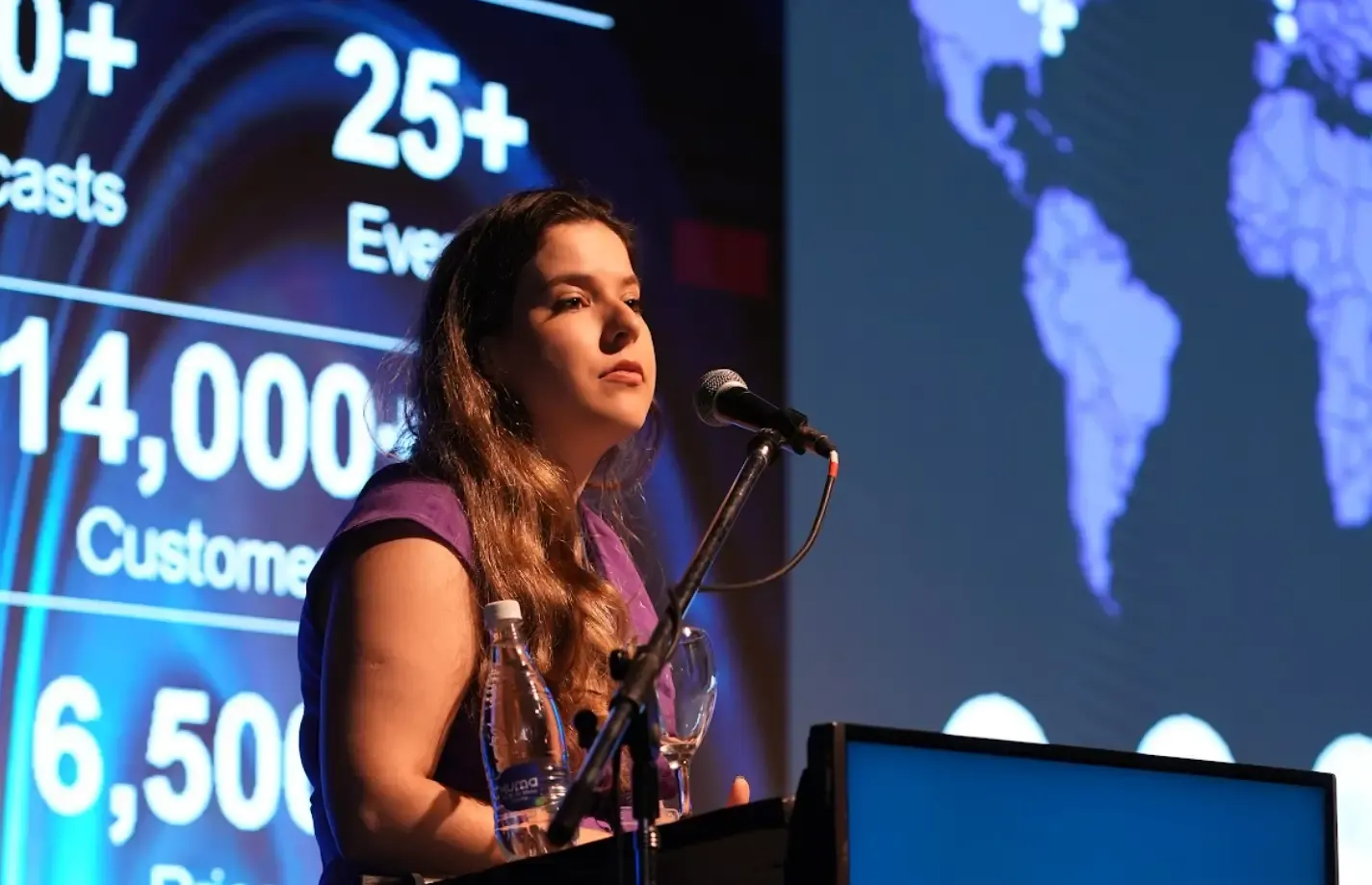
In an exclusive interview with Panorama Minero, Leticia Simionato, Senior Price Reporter at Fastmarkets, analyzes the latest developments in the global lithium market and explains why the industry may be entering a new cycle following the sharp market correction of 2024–2025. She discusses price forecasts, supply constraints, the growing role of energy storage systems (ESS), Argentina's position within the Lithium Triangle, and the long-term outlook for South America's role in global supply chains. The forward-looking views and projections discussed in this interview are based on forecasts produced by the Fastmarkets Analytics team.
By Panorama Minero
Following one of the most volatile periods in its history, the lithium industry is showing signs of a new market dynamic. According to Fastmarkets, demand growth is expected to outpace mine supply additions over the coming years, tightening market fundamentals after a prolonged period of oversupply and price weakness. At the same time, structural changes are reshaping the sector, from the rapid expansion of energy storage systems and artificial intelligence-related power demand to the growing strategic importance of South America as a supplier of critical minerals.
Against this backdrop, Argentina continues to strengthen its position as one of the world's most attractive destinations for lithium investment, while producers across the Lithium Triangle navigate a market increasingly shaped by geopolitical considerations, evolving battery technologies and the race to secure long-term supply chains.
In this conversation with Panorama Minero, Simionato examines the forces currently shaping lithium prices, the evolving balance between supply and demand, the future of battery technologies, and the opportunities and challenges facing Argentina as it seeks to consolidate its position among the world's leading lithium-producing countries.
Given South America's growing role in lithium supply, why doesn't Fastmarkets currently publish an FOB South America lithium benchmark?
For lithium, we provide price assessments for both technical-grade and battery-grade lithium carbonate and hydroxide, covering major consuming markets in Asia, Europe, the United States and Canada. We also publish a spodumene CIF China assessment.
We previously consulted market participants to evaluate whether there was sufficient demand for a dedicated FOB South America lithium benchmark, but the feedback did not support launching such an assessment.
We considered developing an FOB South America reference in the past. However, based on our understanding of the market and the feedback received from participants, such an assessment would likely dilute liquidity in the increasingly active CIF CJK (China, Japan and Korea) market.
The data reported to us indicates that very few consumers purchase lithium salts on an FOB South America basis. While some traders have occasionally reported FOB South America spot transactions, these remain relatively uncommon.
As a result, the CIF CJK assessment continues to serve as the market's preferred spot pricing benchmark, reflecting the fact that most lithium produced globally is ultimately destined for China, Japan and Korea.
Looking ahead, market dynamics could evolve as European and North American demand expands. Greater diversification of trade flows could eventually result in more South American material being sold under FOB terms.
For now, however, we do not see sufficient activity to justify a dedicated regional benchmark, although we continue to monitor market developments and remain open to industry feedback.
How would you describe the current lithium pricing environment, and what are the main factors shaping the market today?
Lithium prices in the CIF CJK market continue to follow developments in China, where prices have experienced significant volatility, falling before recovering in recent months. In our view, much of this movement has been driven by activity in the futures market rather than by changes in underlying supply-demand fundamentals.
Many sellers of lithium carbonate and lithium hydroxide remain reluctant to accept lower bids and are holding material off the market. They generally view recent price fluctuations in China as speculative in nature and are waiting for stronger price signals before increasing sales activity.
At the same time, demand remains supported by continued growth in the energy storage systems (ESS) market, which has become an increasingly important driver of lithium consumption.
On the supply side, several factors continue to limit availability. CATL's Jianxiawo mine is not expected to restart in the near term, while spodumene supply remains tight. Shipments from Zimbabwe are recovering only gradually and have yet to reach China in significant volumes, while Australian producers continue to offer limited spot availability.
China remains the world's largest lithium processing and consumption hub. What signals are you seeing there, and what is driving the market's recent recovery?
Lithium prices are rising as a result of a combination of fundamental market shifts and a cyclical correction.
The recent increase in spodumene and lithium salt spot prices reflects a more constructive demand outlook supported by stronger market fundamentals. Our research team expects the market to move into a deficit in 2026, as demand growth is projected to outpace supply additions.
Demand remains robust, particularly in the energy storage systems (ESS) sector, supported by Chinese policy measures and growing power requirements from data centers in the United States. At the same time, supply constraints continue to affect the market, with lower mine output in China and Argentina and reduced production guidance from Australian producers.
Strong ESS demand continues to support prices, particularly as these systems play an increasingly important role in complementing renewable energy sources such as wind and solar power and helping reduce energy costs for AI-related infrastructure. Meanwhile, supply disruptions and limited spot availability are adding further upward pressure. Prices are projected to begin softening in 2028 as new supply enters the market.
At present, lithium carbonate demand remains particularly strong, driven by ESS orders linked to LFP battery chemistry in China. This has kept lithium hydroxide trading at a discount to carbonate, although we expect price parity to emerge by 2027 as conversion flexibility improves.
Beyond market fundamentals, speculation and volatility continue to influence pricing. Activity in futures markets and uncertainty surrounding CATL's Jianxiawo lepidolite mine have had a significant impact on market sentiment. Rumors regarding the timing of a potential restart have frequently moved prices, with delays typically supporting higher prices in China.
Reflecting a tighter market outlook, Fastmarkets recently revised its short-term lithium carbonate price forecasts upward. The forecast for 2026 was increased to US$23.80/kg from US$17.40/kg, while the forecast for 2027 was raised to US$31.40/kg from US$22.65/kg.
The lithium market has experienced sharp shifts in supply, demand and pricing over the past few years. Is the industry entering a more stable phase, or should investors and producers expect continued volatility?
We are currently seeing a price correction following the extremely bearish environment of 2024–2025, as lithium demand growth in tonnage is expected to outpace mine supply additions.
However, lithium remains a relatively young industry, and its pricing mechanisms are still evolving. Unlike more mature commodity markets, where pricing structures are well established, lithium prices can be heavily influenced by market sentiment. The uncertainty surrounding a potential restart of CATL's Jianxiawo mine is one recent example of how sentiment can affect pricing dynamics.
As a result, volatility is likely to remain a defining feature of the market. While current conditions may point to a more bullish phase, speculative activity remains elevated and significant price swings are still possible.
In this context, the development of the lithium futures market is becoming increasingly important as a tool for managing price risk and improving market transparency.
Futures markets play a critical role in facilitating investment decisions and helping market participants manage volatility. Today, Fastmarkets lithium price assessments are listed on the world's four largest metals exchanges — CME Group, the London Metal Exchange (LME), Singapore Exchange (SGX) and Intercontinental Exchange (ICE).
The main challenge remains achieving the level of liquidity typically seen in more mature commodity markets. Even so, there are clear signs of progress, with trading volumes continuing to increase as producers, consumers and investors make greater use of futures contracts to manage exposure to lithium price movements.
South America holds some of the world's largest lithium resources and remains at the center of global supply growth. What comes next for the region, and how is Argentina positioned within that landscape?
South America accounts for more than 50% of global lithium resources, making the region a key player in the future of the industry. It is expected to remain a strategic supplier to both Western and Asian markets, supported by its role as a major producer and by access to multiple resource types.
The region is also widely recognized for its low-cost lithium production, although conditions vary significantly from country to country and even from project to project. As a result, each jurisdiction faces its own set of opportunities and challenges.
Several factors continue to shape the outlook for South American lithium supply, including the political environment, investment conditions, cost competitiveness and structural constraints. Recent political developments in Chile and Bolivia, together with upcoming elections in Brazil and Argentina, continue to influence policy direction across the region.
Foreign investment remains affected by issues such as government intervention, licensing uncertainty, regulatory fragmentation and access to capital, while operational challenges include infrastructure limitations, remote project locations, transportation constraints, product impurities and broader regulatory uncertainty.
From a cost perspective, integrated brine operations remain among the most competitive globally, although they are also affected by royalty regimes and, in some cases, less favorable evaporation conditions.
Within this regional landscape, Argentina stands out as one of the most attractive destinations for lithium investment. The administration of President Javier Milei has adopted a more business-oriented approach and introduced measures designed to attract capital, including tax, customs and foreign-exchange incentives through the RIGI framework. The country is also pursuing greater macroeconomic stability.
Investor interest remains strong, including from non-Chinese companies, supported in part by Argentina's geopolitical positioning and initiatives such as the critical minerals agreement signed with the United States earlier this year. The country has also attracted substantial private investment, with a significant portion of its salt flats under foreign ownership.
Despite these advantages, important challenges remain. Regulatory predictability and infrastructure development, particularly transmission capacity, continue to be key issues for the sector.
Fastmarkets forecasts that Argentina's lithium carbonate equivalent (LCE) production could reach approximately 403,000 tonnes by 2036, representing a 9% compound annual growth rate (CAGR) between 2026 and 2036. Current production, however, has been affected by limitations related to extraction technology, equipment availability and electricity supply.
In Argentina, much of the discussion continues to focus on lithium carbonate exports. Looking ahead, what role could the country realistically play in a more advanced value chain linked to refining, battery materials or related technologies?
I believe moving further up the value chain is a complex issue for lithium-producing countries in South America and should not be approached superficially.
In the near term, it is unlikely that countries in the region will develop highly sophisticated battery-related value chains, as Asia continues to dominate this segment of the industry. The combination of resources produced outside China and Chinese refining capacity remains the most cost-efficient pathway for lithium chemicals production.
China is expected to maintain its leadership position, accounting for 71% of global lithium carbonate production and 71% of lithium hydroxide production in 2026.
In South America, approximately 80% of mined lithium production is already converted into value-added products, including carbonate, chloride and hydroxide. This is largely a consequence of the nature of brine-based operations, which require on-site processing, as well as government policies aimed at encouraging domestic value addition.
Trade flows also reflect the current structure of the market. In 2025, roughly 80% of lithium carbonate exports were shipped to China, while 16% went to Japan and South Korea, with smaller volumes directed to the United States.
Given the region's still limited cathode active material manufacturing capacity, export-oriented markets are expected to remain the primary destination for South American lithium products in the foreseeable future.
Where is lithium demand growing most rapidly today? Which technologies and regions are driving that growth, and how could demand patterns evolve over the coming years?
Electric vehicle (EV) demand has softened in some markets, while energy storage systems (ESS) are emerging as an increasingly important source of growth.
In China, EV sales grew 17% year-on-year in 2025. However, stricter domestic requirements related to efficiency and minimum electric range have contributed to a 23% decline in sales so far this year, despite the continuation of government incentives.
At the same time, export growth has helped offset part of that slowdown, supporting EV adoption in markets outside China. Europe continues to record strong EV sales growth, driven by both Chinese imports and a growing number of competitive domestic models.
Recent headlines have suggested a broader slowdown in the EV market, but we believe those claims are overstated. While growth rates have moderated as the sector matures, global EV sales reached 21 million units in 2025, up 20% year-on-year, pointing to continued expansion rather than contraction.
We have revised our battery electric vehicle (BEV) outlook upward across the forecast period. Although 2026 began on a softer note in China and the United States, higher oil prices are supporting demand in Europe and other regions by improving the relative attractiveness of electric mobility.
At the same time, ESS demand is accelerating, supported by strong growth in 2025 and continued investment in data centres and artificial intelligence infrastructure, particularly in the United States, despite ongoing tariff-related uncertainties.
Most of this growth continues to favour lithium carbonate over lithium hydroxide, especially in ESS applications and lower-cost EV segments. While hydroxide remains an important part of the market, it is expected to represent a smaller share of future demand growth.
EVs remain the primary driver of lithium consumption globally, but demand is becoming increasingly diversified as new applications gain scale.
As new lithium-producing regions emerge across Africa, North America and Europe, is the industry moving toward a more diversified supply landscape, or will the Lithium Triangle and China continue to dominate the market?
South America was the world's largest source of mined lithium in 2025, accounting for approximately 30% of global supply. At the same time, Africa emerged as a major supplier during the most recent bullish cycle, highlighting the growing diversification of the industry's production base.
In China, mine supply faced disruptions across several operations during 2025, while uncertainty continues to surround the potential restart of certain lepidolite assets. Meanwhile, Australian production declined after a number of spodumene operations were placed on care and maintenance in response to weaker prices.
Although improving market conditions are expected to support the restart of some Australian mines, a return to full production capacity is likely to take time.
According to Fastmarkets' Research team, South America's share of global lithium supply is expected to remain broadly stable at 27% in both 2026 and 2036. This outlook reflects the strength of the region's resource base and the quality of assets within the Lithium Triangle, despite the longer construction and ramp-up periods typically associated with brine projects compared to hard-rock operations.
By 2036, global lithium supply is expected to be distributed as follows:
● Eastern Asia: 30%
● South America: 27%
● Australia & New Zealand: 21%
● Africa: 14%
● North America: 7%
● Europe: 2%
These projections suggest that while supply is becoming increasingly diversified, South America and Eastern Asia are expected to remain the two dominant pillars of the global lithium industry over the long term.
Battery technology is evolving rapidly. Which chemistries are driving lithium demand today, and which ones do you believe have the strongest long-term potential?
I recall interviewing Alfredo Santana, Chief Operating Officer at Vale Base Metals, on October 29 last year, when he noted that “there will be space in the market for both nickel cobalt manganese (NCM) cathodes and lithium iron phosphate (LFP).”
That perspective remains relevant amid ongoing industry discussions suggesting nickel could lose some of its prominence as NCM cathodes face increasing competition from LFP technologies.
Battery chemistries continue to evolve, and it is unlikely that a single technology will dominate the market over the long term. For example, sodium-ion batteries are expected to become part of the mix, particularly in energy storage system (ESS) applications.
According to Fastmarkets' Research team, NCM may retain a leading position in Western markets, while LFP continues expanding through Chinese OEMs. More broadly, LFP is expected to become the dominant chemistry in the overall battery market as ESS applications gain market share.
Both the Chinese EV and ESS markets are expected to remain heavily focused on LFP technology, with manufacturers such as BYD and CATL continuing to improve performance and address historical limitations, including charging speeds.