With a campaign combining resource expansion, the search for new discoveries and key studies for project development, Argenta Silver is seeking to reposition El Quevar on the global silver map. In this interview, its manager, Diego Mendilaharzu, details the progress at Mani-Copan, the upcoming market catalysts and why he believes Salta could consolidate its position as one of the world’s leading silver-producing regions.
By Panorama Minero
For many years, El Quevar was viewed primarily as the Yaxtché deposit. Today, you speak of a district with more than 20 exploration targets. What changed in the geological understanding of the project to enable this conceptual shift, and what implications does it have for El Quevar’s value?
The El Quevar Project was explored for many years in the area known as Yaxtché, although this meant focusing exploration on only 3% of the mining properties granted to Silex. Since the new management took over the project, work began to validate previous results, while also broadening the exploration horizon due to the positive surface results identified in current campaigns, which allow us to infer that El Quevar’s potential extends far beyond the Yaxtché deposit.
To reach these conclusions, modern mapping systems were used together with technologies such as ReveNIR spectrometry, geophysics and geochemistry. There is no doubt that the new resource expansion work will allow us to redefine the existing resource and thereby increase the ounces historically identified, while at the same time exploration work will help us increase the potential for new discoveries throughout the rest of the project.
The results obtained at Mani-Copan, with very high silver grades at surface, appear to be one of the most significant discoveries of the campaign. What are your expectations for this target, and what role will it play in the drilling program planned for the second half of the year?
Mani-Copan is located approximately 800 metres from Yaxtché and stands out for the high silver grades obtained from surface outcrops, where we detected peak values of up to 20,000 g/t silver, in addition to recent drilling with high-grade intersections.
Today, it is positioned as a central area in the company’s exploration program, encouraging us to continue discovering new targets during the second half of the year. Mani has three levels discovered to date: one at surface with grades of 1,500 g/t, 2,450 g/t, 6,000 g/t, 16,000 g/t and 20,000 g/t silver; another 40 metres below surface with recent results of 4,982 g/t Ag over 7.5 metres of drilling; and a deeper level, with recent results showing an interval of 1,350 g/t over 4.0 metres of drilling.
What makes this target attractive is its proximity to the main deposit (Yaxtché) and the high surface grades extending over an area 500 metres long by 90 metres wide.
In addition to resource expansion, the company is simultaneously advancing metallurgical studies, the environmental baseline and new exploration tools. What do you consider will be the next milestone capable of changing the market’s perception of El Quevar?
Without a doubt, the resource redefinition. To achieve this, we are focused on expanding new mineralized zones, applying an ambitious strategy in which each step will help us increase the number of known ounces to date.
First, we expect to obtain results from metallurgy and the environmental baseline during 2026, and then, during the first half of 2027, we will update the resource, which currently contains 45.3 million ounces at a grade of 482 g/t Ag in the Indicated category, and 4 million ounces at a grade of 417 g/t Ag in the Inferred category.
These events in themselves suggest that they will act as catalysts for the company’s market position and will also begin to lay the foundations that will allow us to apply engineering studies to move toward production stages in the future.
You currently have more than 20 targets identified at different stages of development. How is this project portfolio prioritized?
The company’s management has defined a strategy led by the geology team, under which 40% of capital is allocated to expanding the current resource and 60% to the search for new discoveries.
Resource expansion absorbs capital primarily through drilling at both ends of the deposit. Thanks to this work, the length of the Yaxtché deposit has already increased by more than 25%, from 1,500 metres to 1,900 metres.
Meanwhile, exploration aimed at new discoveries—the 20 announced targets—requires investment in surface activities, mapping, sampling, scientific studies, geophysics and drilling. To prioritize these targets, we classify them according to the level of available knowledge:
- targets requiring further exploration;
- targets requiring the definition of specific drilling locations; and
- targets that are already drill-ready.
Management recognizes that expanding the resource and evaluating its potential future development into production is fundamental. However, it also understands that the project’s extraordinary exploration potential cannot be overlooked, as new deposits could be discovered and developed in the future.
El Quevar has infrastructure that is unusual for an exploration project in the Puna. How significant is this competitive advantage when considering a future development stage for the project?
In terms of CAPEX, the project has an exceptional structural advantage. Over the years, high-cost infrastructure has been developed throughout the area, including:
- an operational railway directly connecting to the Atlantic Ocean;
- a gas pipeline dedicated exclusively to mining activities;
- a road in excellent condition;
- a high-voltage power line integrated into the national interconnected grid; and
- two high-capacity solar farms.
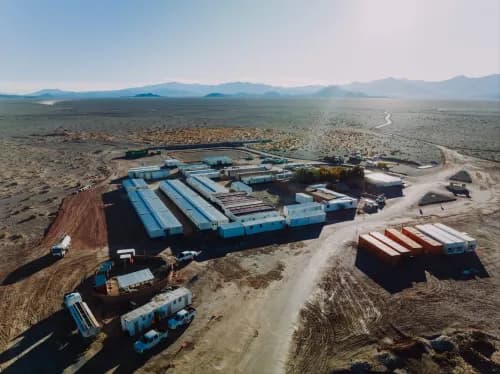
Internally, the project currently has more than 80 km of roads, a fully equipped camp for 100 people, core logging areas, fuel tanks, work facilities, heavy machinery and even a 1.2-km underground tunnel.
All this infrastructure—both external and internal—represents a multimillion-dollar investment already made by the previous company and by the national and provincial governments. This combination of assets positions us as a unique exploration project in the Andes, significantly reducing the CAPEX required both for the current exploration stage and for the future implementation of a mining plan.
Mining exploration in Salta is experiencing a period of strong momentum, driven primarily by lithium. From Argenta Silver’s perspective, do you believe the province can also consolidate itself as a development hub for silver and precious metals projects?
It is true that lithium has driven mining development in Salta and, in doing so, has supported the development of local suppliers, who are now fully capable of providing services to any company developing a mining project in the Puna.
In addition, we must consider Fortuna Mining’s Lindero mine, which is actively operating in Tolar Grande and has provided ample evidence that metalliferous mining can be successfully developed in the Province of Salta.
It is also worth highlighting the recent inclusion of AbraSilver’s Diablillos Project in the RIGI, which positions Salta as one of Argentina’s leading mining investment destinations. It should also be considered that Diablillos and El Quevar are currently the second- and third-largest primary silver projects in Argentina and, if they enter production, they could turn Salta into one of the world’s most relevant silver-producing jurisdictions.
What opportunities do you see in this scenario?
I see opportunities for development in remote areas, where geographical and climatic conditions make daily life difficult. The expansion of mining activity can therefore improve the quality of life of people in the Puna, who have the experience and capabilities needed to join mining companies.
We can also see the growth achieved by local suppliers, which provide services to the various projects operating throughout the Puna.
Argenta Silver currently has a strong financial position and is accelerating its drilling campaigns. Looking ahead over the next two or three years, what specific objectives does the company expect to achieve at El Quevar?
In addition to the drilling program and surface exploration activities, we are currently awaiting metallurgical results, completing an updated Environmental Baseline, and actively expanding the resource, with the objective of presenting a resource update during the first half of 2027.
These activities will provide us with greater certainty regarding the project’s potential and scope, allowing us to move toward evaluating the economic factors associated with the future extraction of the mineral. Management maintains a clear focus: discovering new deposits and increasing the ounces contained in the existing resource.
We recently issued a press release announcing a new discovery with a direct impact on the resource: a connector between the Carmen gold-copper discovery and the silver deposit. In this area, we can see how one mineralized system gradually connects with the other. Situations like this open up multiple possibilities while also raising valuable new questions that require further work, analysis and dedication to answer.
“We are focused on expanding new mineralized zones”.